


 Full Games List
 Featured Games
 New Games
 Reviews
 Media
Media Images
 Blogs
Blogs Game Updates
 Images Feedback Summary
 Game Design Highlights
 Tutorials
 Articles
 Scripts
 Utilities / Plugins
 Resources
 Engines
 Engine Bulletins
 What is Makerscore?
 Past Events
 Achievements
 Misaos
 Forums
 Post History
 Chat
Chat New to RMN?
 Full Store List
 RMN Music Pack (free)



HOW SOON DO YOU HAVE TO REVEAL THE MAIN ANTAGONIST?
Posts

 Shinan
 View playlists
 Close
CloseI would say in your case that you probably would have to introduce the villain somewhere in the first two chapters even if it's only in passing.
Like if it's very local. Like it's a small town in the middle of nowhere and the villain is an American oligarch that wants to expands his business by destroying the small town and building a mall where it was. Then in the first two chapters when there's no threat of the oligarch yet, he could still be mentioned on the news on tv or in a newspaper in passing. Thus seeding the fact that he does exist and doesn't appear out of nowhere.
Like if it's very local. Like it's a small town in the middle of nowhere and the villain is an American oligarch that wants to expands his business by destroying the small town and building a mall where it was. Then in the first two chapters when there's no threat of the oligarch yet, he could still be mentioned on the news on tv or in a newspaper in passing. Thus seeding the fact that he does exist and doesn't appear out of nowhere.

LockeZ
Standard literary theory suggests introducing all the main characters, including the main antagonist, in the first act. Standard RPG theory suggests spreading your protagonists gradually across the first two thirds of the game, but I think the villain should still show up early on.
A game is much longer than a play or TV show, and it's tempting to save the reveal for later. But the player expects to see, at the beginning of the game, a hook telling him why he should play this game. If that hook is a lie, the player feels betrayed. Though by a lie, I don't just mean a plot twist - I mean that the key motivation for playing the game, the core of your game's goal, was misrepresented. You can say that one thing is minor and the other is major when in truth it's really the other way around, but if you just completely leave out the whole point of the game for the first half of the game, you're gonna have a shitty first half of your game and a bunch of betrayed-feeling players when that second half hits.
In short, that means you should introduce the player to the villain early if at all possible, but you don't necessarily need to reveal that he is the villain.
For example, let's take a very very typical example of an RPG plot: FF7. FF7 is also a good example because it has multiple left-field twists, and because it changes the main villain of the game on you twice - once from the old President Shinra to Rufus at the end of Midgar, and again from Rufus to Sephiroth in the Northern Crater. And yet FF7 has Sephiroth appear - and it's a big appearance - at the end of Midgar, about 25% of the way through the game. You just don't know he's the main villain yet.
This seems like a good way to do it if you want a plot twist main villain. Your evil empire can appear to be the main villain at first and then later get destroyed by demons, but make sure the demons are introduced to the player before that. Your evil usurper viceroy can kill the evil emperor and take his place, but a random dude we've never seen before cannot do so.
Wild ARMs 3 is an example of doing it wrong. 30% of the way through the game, the main villain is revealed. 80% of the way through the game, you kill that guy. And someone else, who you've never seen before, shows up and replaces him. Because you've never seen this person before and it's completely out of left field, this makes it feel like it's a brand new conflict instead of the conclusion of the previous conflict. Instead of feeling like you uncovered the truth, you feel like you should be done with the game.
Meanwhile, Zelda: Skyward Sword doesn't have the main villain appear until part 4 of the final battle. You have heard his name, and you have fought, uh... a giant black blob that is composed of his soul's essence or something? But as a person, he does not appear until the final stage of the final battle. This is different from FF9's stupidity, though, in that this isn't a plot twist. You've know for the entire game exactly who you were fighting. You just spend the entire game trying to keep him sealed, and only at the end do you (predictably) fail. It's not my favorite method, but I think it kinda works. But I'd have preferred if you were trying to keep a power sealed instead of a person, and in the end that power took control of someone who was already part of the story. As it stands, the main villain is essentially not a character. For all intents and purposes, he's just a force, a name, a macguffin. So I felt no hatred for him in the final battle. I only felt hatred for his leiutenant (and for Groose).
You gotta have the big villain do stuff. Not just threaten to do stuff, and not just be revealed to have been secretly responsible all along for stuff. He's gotta personally piss the player off.
I have the main villains appear in the flashback prologue in my mediocre old RM2K3 game, and then again briefly (in a mysterious and ominous scene that provides no useful information) at the end of the second dungeon. After that it's a long time before you see them again - half the game. But the hook is there. And once they do appear, I try (perhaps unsuccessfully) to make them show up enough times that the player can get to know them and start to really hate them. (Though... it could also be argued that the main protagonist is the main villain in that game.)
your entire argument is false and based on games that are just shit.*
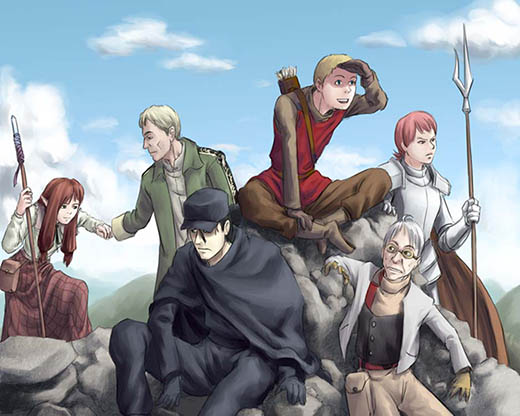
^ Proof. ^
Last Scenario's plot is effective both as a story, and as a critique of the bullshit that most everybody is spurting out in this topic (<UPRC> HAVE A BIG BAD, AND AN ACTUALLY-DEVELOPED GUY PLAYING THIS MINION. I HAVE FF GAMES ON AN IV DRIP).
My answer: play good games from start to finish, and then do what you want. Something organic and written well will be successful; something formulaic (without a literary purpose) will not.
Optional extra credit homework assignment:

This game tells one excellent story twice -- there are two realities, and only one character that can traverse between them. And I don't mean WORLD OF LIGHT versus the WORLD OF DARKNESS, I mean the same world where the political power is skewed toward a different nation, or a certain piece of technology fell into different hands, or the plants grew instead of died.
Is there a primary villain? Yes. Do they do stuff? Constantly. Do the other villains do stuff constantly? Yes. Does the story go where it needs to go without focusing on some "RPG VILLAIN STANDARD?" See: Last Scenario.
*(at least story-wise, I have only heard about but not played them)
author=CrazeSo it is a game with a main villain that appears only at the very end but still manages to work somehow?
Last Scenario's plot is effective both as a story, and as a critique of the bullshit that most everybody is spurting out in this topic
no
EDIT: I will also say that it's not THE HERO IS THE VILLAIN TROLOLOLOL because while that CAN be effective, just... no. Nope. Hilbert (the MC) does have an intriguing character arc with one of the most interesting final scenes in any game I've played. And no, it's not I HAD A HORRIBLE PAASSSSTTTTTTT. It's actual in-the-present character development.
That is probably what makes LS so successful: it works in the present, where a huge amount of RPGs focus on unplayable, hidden-away backstory. Yes, LS has an important backstory, but it brings it to the forefront and. Just. PLAY THIS GAME
EDIT: I will also say that it's not THE HERO IS THE VILLAIN TROLOLOLOL because while that CAN be effective, just... no. Nope. Hilbert (the MC) does have an intriguing character arc with one of the most interesting final scenes in any game I've played. And no, it's not I HAD A HORRIBLE PAASSSSTTTTTTT. It's actual in-the-present character development.
That is probably what makes LS so successful: it works in the present, where a huge amount of RPGs focus on unplayable, hidden-away backstory. Yes, LS has an important backstory, but it brings it to the forefront and. Just. PLAY THIS GAME
What a helpful answer. After pointing to a link to a game download that doesn't even have a description of the game.
I answered your question!
And here is your description: a young man is told by a mysterious woman that he is the descendant of a great hero. He joins the military in order to fight back against the Empire, all while hearing rumors about demons who live underground...
http://tvtropes.org/pmwiki/pmwiki.php/VideoGame/LastScenario?from=Main.LastScenario
And here is your description: a young man is told by a mysterious woman that he is the descendant of a great hero. He joins the military in order to fight back against the Empire, all while hearing rumors about demons who live underground...
http://tvtropes.org/pmwiki/pmwiki.php/VideoGame/LastScenario?from=Main.LastScenario
According to that tvtropes page it apparently is consciously subverting tropes. Of course I'm not going to read the whole thing to find out what tropes are being subverted. But I'd like to say that for a person to break rules, one first has to know them (and probably follow them for a bit). So yeah, there's great stuff to be made in subverting rules to make for a more effective story. But it's advanced stuff. Similarly to how advice like "it's your game you do what you think is right" is bad advice because it is only for people who already know what they're doing.
Or maybe the subversion in the game is that there actually is no main villain in which case that is not at all what this topic is about. It specifically asks when to reveal a main villain which strongly implies that there has to be a main villain to begin with.
Or maybe the subversion in the game is that there actually is no main villain in which case that is not at all what this topic is about. It specifically asks when to reveal a main villain which strongly implies that there has to be a main villain to begin with.
There is a main villain in LS and you meet him and know who he is and many hours later you fight him face-to-face.
I'm putting the game forward because of how the primary antagonist is dealt with by world powers, by the party, when he's introduced, how he's introduced, what the smart player might realize when they meet him, and how they know "oh shit, HE IS THE ONE" without him blowing up fifty nuclear reactors or anything silly like that. LS has an entire stable of (excellent) villains, ones who you will cry for and ones that you'll want to kill and ones that are downright horrible people and ones that aren't even human and ones that were helping you all along and yet
they never feel forced. Especially not the primary antagonist. They all maintain an air of mystique and plausibility that is lacking from CECIL
CECIL
HEY CECIL I AM YOUR BROTHER
I'm putting the game forward because of how the primary antagonist is dealt with by world powers, by the party, when he's introduced, how he's introduced, what the smart player might realize when they meet him, and how they know "oh shit, HE IS THE ONE" without him blowing up fifty nuclear reactors or anything silly like that. LS has an entire stable of (excellent) villains, ones who you will cry for and ones that you'll want to kill and ones that are downright horrible people and ones that aren't even human and ones that were helping you all along and yet
they never feel forced. Especially not the primary antagonist. They all maintain an air of mystique and plausibility that is lacking from CECIL
CECIL
HEY CECIL I AM YOUR BROTHER
So you are not actually saying that whatever LockeZ said is false. You are just providing another example of how to introduce the villain, while supporting the claim that it is best if the villain is introduced as early as possible?

Moved to Game Design and Theory. This is more of a game development issue than a discussion on RM games.

I've always been a fan of Kefka's role in FFVI. The way he starts out as little more than a nuisance to your party, but through trickery eventually becomes the most powerful being in existence. It's interesting when both the characters in the game and the person playing the game are made to underestimate a villain... only for him to suddenly unleash a gigantic shitstorm of death all over everyone. How you like me NOW?
LockeZ

I'd really like to get rid of LockeZ. His play style is way too unpredictable. He's always like this too. If he ran a country, he'd just kill and imprison people at random until crime stopped.
5958
Kind of weird that you'd claim my points are invalid because I picked shitty games as examples. Since, uh, only one of those three games was even supposed to be an example of my point. The second one was intentionally an example of a shitty game that did it wrong, and the third one was an example of a game that proved me wrong, which I included just to remind people that you can break any rule and still have a good game, if you have a good enough reason.
But I mean I didn't include FF7 as an example because it has the BEST STORY EVER. I just included it as an example because it's really prototypical, and it's hard to say FF7 has a bad enough handling of villains that it objectively ruined the game. It is the most popular RPG story ever, after all. If you emulate it, you won't win any Emmys, but I can at least guarantee you won't create anything that feels too bizarre to be enjoyable.
I'm not sure what your point is with Last Scenario's tons of villains, since villains other than the main villain aren't really relevant to the topic here, except to the extent that the game pretends they're the main villain for a while before revealing 35 hours into the game that OH NO THEY WERE JUST A PAWN OF THIS SUPERNATURAL ENTITY THAT IS GOING TO ANNIHILATE REALITY IN ORDER TO CLEANSE THE WORLD OF CHAOS
which I'm beyond sick of by the way, it was awful the first time and increasingly awful each successive time since then
But I mean I didn't include FF7 as an example because it has the BEST STORY EVER. I just included it as an example because it's really prototypical, and it's hard to say FF7 has a bad enough handling of villains that it objectively ruined the game. It is the most popular RPG story ever, after all. If you emulate it, you won't win any Emmys, but I can at least guarantee you won't create anything that feels too bizarre to be enjoyable.
I'm not sure what your point is with Last Scenario's tons of villains, since villains other than the main villain aren't really relevant to the topic here, except to the extent that the game pretends they're the main villain for a while before revealing 35 hours into the game that OH NO THEY WERE JUST A PAWN OF THIS SUPERNATURAL ENTITY THAT IS GOING TO ANNIHILATE REALITY IN ORDER TO CLEANSE THE WORLD OF CHAOS
which I'm beyond sick of by the way, it was awful the first time and increasingly awful each successive time since then
wait what
1) there is no supernatural entity that is going to annihilate reality
2) there are lots of villains but one is very much the MAIN VILLAIN. Also I'd totally argue that the final party member is a villain, even if they're a "good guy" (...yeah, that's not going to make any sense unless you've played the game). Also (see below) the numerous other villains entirely pertain to the topic at hand, since the villain and his appearance would be fruitless without them
3) the "time to introduce a villain" is so much more than an hour mark. In LS, you meet and learn about people who are connected to him (whether they be good, bad, neutral or playable), and about the geologic research that pertains to his plans. The time in LS is "when the player is ready to comprehend who the villain is and what he's doing," and I'd argue that's the best time in any game.
4) I'm arguing against your first three paragraphs, the big second one especially. There is no introduction to LS's main villain for a good part of the game, although there's much more after it too. There are multiple full-on story arcs in LS (the politics, the wars caused by the politics, the geology, and the demons below), all leading up to him. You have no idea who he is, and have never seen him for a long while, but everything is springboarding you up to his level of comprehension. That's good storytelling and follows my above rule that it's "when the player is ready to comprehend who the villain is and what he's doing." If you met him early on, say in that second dungeon with Thorve and Matilda, that would add nothing (and likely detract from) the game.
1) there is no supernatural entity that is going to annihilate reality
2) there are lots of villains but one is very much the MAIN VILLAIN. Also I'd totally argue that the final party member is a villain, even if they're a "good guy" (...yeah, that's not going to make any sense unless you've played the game). Also (see below) the numerous other villains entirely pertain to the topic at hand, since the villain and his appearance would be fruitless without them
3) the "time to introduce a villain" is so much more than an hour mark. In LS, you meet and learn about people who are connected to him (whether they be good, bad, neutral or playable), and about the geologic research that pertains to his plans. The time in LS is "when the player is ready to comprehend who the villain is and what he's doing," and I'd argue that's the best time in any game.
4) I'm arguing against your first three paragraphs, the big second one especially. There is no introduction to LS's main villain for a good part of the game, although there's much more after it too. There are multiple full-on story arcs in LS (the politics, the wars caused by the politics, the geology, and the demons below), all leading up to him. You have no idea who he is, and have never seen him for a long while, but everything is springboarding you up to his level of comprehension. That's good storytelling and follows my above rule that it's "when the player is ready to comprehend who the villain is and what he's doing." If you met him early on, say in that second dungeon with Thorve and Matilda, that would add nothing (and likely detract from) the game.
LockeZ
I'd really like to get rid of LockeZ. His play style is way too unpredictable. He's always like this too. If he ran a country, he'd just kill and imprison people at random until crime stopped.
5958
Heh. Well, my second paragraph is a reaction to being pissed off by things like Xenogears and Lost, where it starts out tricking you into thinking that the story is a completely different genre than it really ends up suddenly turning into 30 hours later. You get some stories where the real conflict is revealed really late, and it has absolutely nothing to do with what hooked you into the story, and the things that hooked you in just disappear without a trace.

FF6 and FF7 both introduce the main villains (Kefka/Sephiroth) before explicitly naming them the main villains - both are introduced as minor characters beforehand. Sephiroth is mentioned in passing when discussing the past or SOLDIER, and Kefka is a cartoony joke-villain who gets serious.
Also, both games provide misdirection - the main villains at first appear to be Emperor Geshtalt/Shinra - before a twist reveals the true enemy.
If you want the plot to be villain-centric, it makes little sense to wait until the end to introduce the villain. You don't have to reveal the character's true nature, but dropping hints of her personality or even just her name is a start. Hell, if your game is based on political intrigue, you could establish a certain modus operandi as villainous, and then introduce your villain later as the sum of all those evil things.
Also, both games provide misdirection - the main villains at first appear to be Emperor Geshtalt/Shinra - before a twist reveals the true enemy.
If you want the plot to be villain-centric, it makes little sense to wait until the end to introduce the villain. You don't have to reveal the character's true nature, but dropping hints of her personality or even just her name is a start. Hell, if your game is based on political intrigue, you could establish a certain modus operandi as villainous, and then introduce your villain later as the sum of all those evil things.
LockeZ
I'd really like to get rid of LockeZ. His play style is way too unpredictable. He's always like this too. If he ran a country, he'd just kill and imprison people at random until crime stopped.
5958
author=slashphoenix
If you want the plot to be villain-centric, it makes little sense to wait until the end to introduce the villain.
This is an important distinction, I suppose. Some stories are all about the heroes, and some stories are about the villains too. And then some stories are almost entirely about the villains, and some stories are just about the events. You'd handle the introduction of the villain differently in each of these.
author=WonderPup
For my particular story, the player's party is initially weak and non-threatening. Given their insignificance early on, they would never appear on the antagonist's radar, and their location doesn't put them in proximity of the "big bad guy". Does anyone else have experience with something similar? How did you write that? Do you felt your story suffered for it?
In that case, I don't think you should introduce the villain early on. It's hard to say what you should do without more details about the nature of the villain and other relevant information, but I think you should show the player the web that the villain spins. I imagine that there will be things that makes sense once the player see who the villain is and what he/she's about. If the villain isn't introduced until late, chance is the things that the villain will make sense of will be seen much earlier. Regardless, don't introduce the villain early if it harms the story in order to satisfy a "rule."

As others have wisely pointed out, one big antagonist should not be the only driving force of the plot; he/she/it belongs to a larger world, which, to come across as believable, is full of conflict and drama everywhere. The villains are a part of that world, and live by its ever-changing rules.
Take the real life historical figure of Ching Shih (1775–1844); she was a Cantonese prostitute who was captured by and married Zheng Yi, a notorious pirate. After her husband's death in 1807, she used her influence and her cunning to maneuver her way into leadership of the fleet, establishing a hegemony over coastal villages, imposing taxes and demanding 'protection' money, among other pirate practices. She was known for her brilliant tactics and extreme brutality, and was feared throughout China. When the power of her fleet grew too great, the entire Chinese navy was sent against her, along with the Portuguese and the British; Ching Shih decisively defeated them all. Finally, she and all of the pirates in her fleet were granted amnesty in 1810, and she retired with her loot and her husband (her former lieutenant) and her son Cheung Po Tsai. She opened a gambling house (most likely not without a sense of irony) and died in 1844, at the age of 69. She was one of the most successful pirates of all time.
Now, doesn't Ching Shih sound like she'd make a great antagonist for the heroes? Would anyone who met her back when she was a prostitute ever imagine her rise to power? She did not exist in a vacuum; like any ambitious individual, she keenly saw the world around her and took advantage of her circumstances. What makes her a villain is that she had no qualms about brutalizing or extorting the weak, as she herself had seen how cruel the world was towards the powerless. While her crimes were on her own head, she justified her actions within her historical, economic and geographic context; they had as much to do with her path in life as her gifts.
So, my advice to anyone wondering when to reveal the antagonist is this; is there a reason why such a character would emerge from the story you are writing, and, if so, is that reason believable? Most real-world villains don't want to destroy the world because they are manic depressive misanthropes (or, if they do, they likely don't have much economic or political influence); they want money, power, respect and a sense of 'winning' at life. Many of the most horrible people in history seek these goals while forming elaborate justifications for their behaviour, rationalizing the cruelty of the world, creating scapegoats, etc. The context for such characters is all-important, as it dictates if and how these individuals will have an opportunity to bring their ambitions to fruition, and the consequences to others if they should succeed in doing so.
When thinking about the setting for your game world, consider what forces of change are at work politically and economically, and how both the heroes and the villains fit into those conflicts; you will be surprised how fast the motivations of your characters become believable and organic.
One last bit of advice, which is some of the best writing advice I've ever received; don't force the plot. If you want the story to go one way, but everything you've written up to that point is going another, cut the strings and let the story take its course. If your characters have grown naturally from a world in motion, they will tell you what to write sooner or later.
Take the real life historical figure of Ching Shih (1775–1844); she was a Cantonese prostitute who was captured by and married Zheng Yi, a notorious pirate. After her husband's death in 1807, she used her influence and her cunning to maneuver her way into leadership of the fleet, establishing a hegemony over coastal villages, imposing taxes and demanding 'protection' money, among other pirate practices. She was known for her brilliant tactics and extreme brutality, and was feared throughout China. When the power of her fleet grew too great, the entire Chinese navy was sent against her, along with the Portuguese and the British; Ching Shih decisively defeated them all. Finally, she and all of the pirates in her fleet were granted amnesty in 1810, and she retired with her loot and her husband (her former lieutenant) and her son Cheung Po Tsai. She opened a gambling house (most likely not without a sense of irony) and died in 1844, at the age of 69. She was one of the most successful pirates of all time.
Now, doesn't Ching Shih sound like she'd make a great antagonist for the heroes? Would anyone who met her back when she was a prostitute ever imagine her rise to power? She did not exist in a vacuum; like any ambitious individual, she keenly saw the world around her and took advantage of her circumstances. What makes her a villain is that she had no qualms about brutalizing or extorting the weak, as she herself had seen how cruel the world was towards the powerless. While her crimes were on her own head, she justified her actions within her historical, economic and geographic context; they had as much to do with her path in life as her gifts.
So, my advice to anyone wondering when to reveal the antagonist is this; is there a reason why such a character would emerge from the story you are writing, and, if so, is that reason believable? Most real-world villains don't want to destroy the world because they are manic depressive misanthropes (or, if they do, they likely don't have much economic or political influence); they want money, power, respect and a sense of 'winning' at life. Many of the most horrible people in history seek these goals while forming elaborate justifications for their behaviour, rationalizing the cruelty of the world, creating scapegoats, etc. The context for such characters is all-important, as it dictates if and how these individuals will have an opportunity to bring their ambitions to fruition, and the consequences to others if they should succeed in doing so.
When thinking about the setting for your game world, consider what forces of change are at work politically and economically, and how both the heroes and the villains fit into those conflicts; you will be surprised how fast the motivations of your characters become believable and organic.
One last bit of advice, which is some of the best writing advice I've ever received; don't force the plot. If you want the story to go one way, but everything you've written up to that point is going another, cut the strings and let the story take its course. If your characters have grown naturally from a world in motion, they will tell you what to write sooner or later.
The main villain could be introduced anytime jeeez. It just depends on how the story is set to play. I haven't really introduced my main villain yet into one of my games Combat Specialists which is largely focused on missions. Each mission unravels the whole plot slowly where you meet a range of foes, some you may have to meet again. Anyways there will be a main villain but he hasn't been introduced to the narrative quite yet. I think at some point I'll create it that the organisation you work for is actually the real threat to the world not the fake socially constructed cult Mavis. You discover those in charge working behind the scenes have some sort of agenda and are using false flag attacks to create conflict and blind everyone from the truth. You also discover that some of Mavis are actually the good guys. However, the main villain works for that Agenda and eventually kills all his allies who to have the same Agenda who was previously the best Combat Specialist and responsible for ending the Demi War, prior to the narrative timeline.