



 Full Games List
 Featured Games
 New Games
 Reviews
 Media
Media Images
 Blogs
Blogs Game Updates
 Images Feedback Summary
 Game Design Highlights
 Tutorials
 Articles
 Scripts
 Utilities / Plugins
 Resources
 Engines
 Engine Bulletins
 What is Makerscore?
 Past Events
 Achievements
 Misaos
 Forums
 Post History
 Chat
Chat New to RMN?
 Full Store List
 RMN Music Pack (free)



OH YEAH? WHADDYA GONNA DO ABOUT IT?
Posts
Pages:
1
LockeZ

I'd really like to get rid of LockeZ. His play style is way too unpredictable. He's always like this too. If he ran a country, he'd just kill and imprison people at random until crime stopped.
5958
 LockeZ
 View playlists
 Close
CloseThis topic is about making sure the player has a response to everything your enemies do. Because what's the point of a challenge that literally cannot be overcome? Even if that challenge is just a specific ability, and the game can be overcome even if you fail at overcoming that ability, shouldn't there be one or more "right" ways to respond to every threat?
I'll start with a slightly paraphrased excerpt from a boss design article I wrote:
Status effects are a really common culprit for having no way to be countered. You give an enemy a way to prevent the player from acting, but you don't give the player a way to do anything about it. Or at least not a good way. Other slightly less serious but equally common problems are unpredictable big damage spells, enemy buffs that can't be prevented or dispelled, and other types of enemy power that can't responded to in any way other than "do what you were already doing, but with less margin of error." These sorts of enemy strategies aren't strictly bad, but they would be more fun if the player could feel like he "won" against them.
I'm interested to hear problems people have encountered with coming up with ways for their enemy skills to have counters. And I REALLY want to hear your cleverest methods of giving the player a way to respond. But if you just have a problem and not a clever solution: post it! We'll help you!
Here's an example from this week in my MUD, working with a co-developer who wanted to design a superboss. This is a Final Fantasy fan game, and he wanted to make the boss be based on Ruby Weapon.
I'll start with a slightly paraphrased excerpt from a boss design article I wrote:
author=Five points of designing a boss
In most RPGs, a lot of enemy damage is unavoidable - you're supposed to heal it, not avoid it. So the definition of "success" when responding to an ability needs to take that into account. What's success in this case? Surviving until the next ability? Taking less damage than you can recover? It depends on the game, the boss, and the ability, in truth. In a game where you can fully heal one character each round, you can be said to have succeeded if you survive the hit. In a game where your MP is extremely limited, you can be said to have succeeded if you minimized your MP costs. If a boss uses a skill to inflict a status ailment that makes you take triple damage from the next attack, you can be said to have succeeded if you cleanse the ailment before the next time you get attacked.
In that last example, taunting the boss to attack someone other than the ailed character can make the ailment easier to handle. In fact, taunting the boss to attack someone less vulnerable instead of someone more vulnerable is a common way of dealing with threats in any RPG that has tanking. This is why tanking has become popular in RPGs: it gives the player a response to most of the things enemies do, so they can feel like they succeeded. Tanking can easily be done wrong - it's extremely hard to make tanking an optional way of playing, for example - but when done right it lets the player respond to enemy abilities by partially nullifying them, which creates engaging gameplay with success and failure conditions, but doesn't get in the way of the standard RPG idea of unavoidable damage that must be healed (because you're still taking some damage).
If a skill has no way to respond to it, it's a bad skill. For example, randomly stunning the player for one round, with no way to avoid it. For a longer stun, healing it would feel like a successful response by the player. But for a one-round stun, even if you have a spell or item to remove the effect, removing it has almost the same effect as leaving it alone.
Status effects are a really common culprit for having no way to be countered. You give an enemy a way to prevent the player from acting, but you don't give the player a way to do anything about it. Or at least not a good way. Other slightly less serious but equally common problems are unpredictable big damage spells, enemy buffs that can't be prevented or dispelled, and other types of enemy power that can't responded to in any way other than "do what you were already doing, but with less margin of error." These sorts of enemy strategies aren't strictly bad, but they would be more fun if the player could feel like he "won" against them.
I'm interested to hear problems people have encountered with coming up with ways for their enemy skills to have counters. And I REALLY want to hear your cleverest methods of giving the player a way to respond. But if you just have a problem and not a clever solution: post it! We'll help you!
Here's an example from this week in my MUD, working with a co-developer who wanted to design a superboss. This is a Final Fantasy fan game, and he wanted to make the boss be based on Ruby Weapon.
<Developer> How should the whirlsand be handled? In FF7 it took a character out of the battle completely, but I'm thinking maybe it should be temporary and let you return after 30 seconds or so.
<Me> That's still 30 seconds of doing nothing. That's pretty lame.
<Developer> I like the idea, it makes the other characters have to temporarily change strategies to deal with different people's absences.
<Me> In FF7, that was what a character's absense did. The player changed how he used the other party members. But here, each character is controlled by a different player. You're taking a player out of the battle, and there's nothing he can do about it, either before or after the fact. He didn't do anything wrong and no one can do anything to fix it.
<Developer> What could he do? I don't want him helping in the fight, and I don't want it to be something you can be immune to.
<Me> Have him fight one of the boss's tentacles underground. Maybe if he kills it, he can return above ground?
<Developer> That's mean to healers. They'll never get to return. Maybe link its HP with the tentacles above ground?
<Me> Hmm, that'd work. That gives the above-ground party two things to do: take over the missing person's role, and kill the tentacles ASAP. Make the person underground deal double or triple damage, so he feels like escaping is largely his own doing. Even a healer's damage will feel meaningful if it's tripled. And then there's a "success!" moment for everyone when they escape and things revert to normal.
<Me> That's still 30 seconds of doing nothing. That's pretty lame.
<Developer> I like the idea, it makes the other characters have to temporarily change strategies to deal with different people's absences.
<Me> In FF7, that was what a character's absense did. The player changed how he used the other party members. But here, each character is controlled by a different player. You're taking a player out of the battle, and there's nothing he can do about it, either before or after the fact. He didn't do anything wrong and no one can do anything to fix it.
<Developer> What could he do? I don't want him helping in the fight, and I don't want it to be something you can be immune to.
<Me> Have him fight one of the boss's tentacles underground. Maybe if he kills it, he can return above ground?
<Developer> That's mean to healers. They'll never get to return. Maybe link its HP with the tentacles above ground?
<Me> Hmm, that'd work. That gives the above-ground party two things to do: take over the missing person's role, and kill the tentacles ASAP. Make the person underground deal double or triple damage, so he feels like escaping is largely his own doing. Even a healer's damage will feel meaningful if it's tripled. And then there's a "success!" moment for everyone when they escape and things revert to normal.

I love how all of your ideas always come from World of Warcraft. Sucked underground to blow up a tentacle is C'thun.
LockeZ
I'd really like to get rid of LockeZ. His play style is way too unpredictable. He's always like this too. If he ran a country, he'd just kill and imprison people at random until crime stopped.
5958
Heh, I haven't even seen that fight, actually. At this point I think World of Warcraft has probably done literally everything.
author=LockeZIs it going to be The Simpsons of RPGs?
Heh, I haven't even seen that fight, actually. At this point I think World of Warcraft has probably done literally everything.
Anyway, I apologize for not contributing to any discussion.

I think a lot of the common problems we find in battle systems come from making assumptions or not thinking about how an individual addition or change will affect the battle as a whole. Something as seemingly innocuous as an enemy with a sleep spell can drastically change the dynamics and strategy of a battle.
---
Since my game is a roguelike where your ability list is semi-random, I wanted to create a battle system that revolved around finding an way to use your current abilities against whatever enemies you faced. Instead of focusing on min-maxing characters, your job is to use the cards you are dealt as effectively as possible. I wanted to create battles and enemies that could be dealt with several different ways, but were always fun and gave you a fair shot at success. It was tricky to simultaneously create multiple fun approaches to battle while also maintaining a semblance of balance no matter what strategy was chosen.
As an example, one way I addressed this was creating a variety of defensive abilities that each had their own pros and cons:
As you only have some choice when picking abilities, it's unlikely you would ever have reliable access to all of these defenses. Instead, you have to learn which enemies your defenses are effective against, and take that into consideration when choosing targets.
Many enemies in Lily cast "devastating" attacks, and always telegraph them. These attacks either do massive damage or cause painful conditions. Depending on the enemy ability and the player's setup, they should have one of several tools to prepare:
Since several enemies have these "devastating" attacks, the player learns quickly to plan for them. Even enemies that cast buffs on themselves often waste their turn doing so, giving the player a chance to counter it or focus fire the enemy. In addition, enemies have varying rates at which they cast their most devastating spells. Some have low HP and cast them early, and some take a long time to prepare but have high HP. A large portion of the strategy is balancing which enemies you can eliminate quickly (avoiding their attacks completely) and which enemies have attacks you can minimize efficiently. This is dependent both on your position in the current battle as well as your overall resources (remaining HP/MP or items) and your character's build.
I think it all comes together to form a fun battle system! It encourages adaptability, rewards cleverness, and (hopefully) doesn't get stale!
---
Since my game is a roguelike where your ability list is semi-random, I wanted to create a battle system that revolved around finding an way to use your current abilities against whatever enemies you faced. Instead of focusing on min-maxing characters, your job is to use the cards you are dealt as effectively as possible. I wanted to create battles and enemies that could be dealt with several different ways, but were always fun and gave you a fair shot at success. It was tricky to simultaneously create multiple fun approaches to battle while also maintaining a semblance of balance no matter what strategy was chosen.
As an example, one way I addressed this was creating a variety of defensive abilities that each had their own pros and cons:
- Toughness/Weakness: DEF-up/ATK-down respectively. These reduce damage dealt by direct attacks, but must be reapplied and do nothing against damage-over-time spells like Poison or Bleed.
- Dodge: Avoid all attacks. This is especially effective for avoiding massive attacks the enemy has telegraphed or avoiding being afflicted with a condition. However, it typically has a short duration and can only be cast every few turns. It also doesn't avoid damage from DoTs already affecting you.
- Shield Points (SP) : Act as armor - damage is dealt to your SP before your HP. SP is very good for reducing all forms of damage, including DoTs. However, they build up slowly and are lost at the end of battle.
- Stun: Stuns are very effective for avoiding one enemy's massive attack and reducing damage taken. However, stuns cost lots of MP and so aren't cost-effective enough to use on low-threat attacks.
As you only have some choice when picking abilities, it's unlikely you would ever have reliable access to all of these defenses. Instead, you have to learn which enemies your defenses are effective against, and take that into consideration when choosing targets.
Many enemies in Lily cast "devastating" attacks, and always telegraph them. These attacks either do massive damage or cause painful conditions. Depending on the enemy ability and the player's setup, they should have one of several tools to prepare:
- Cast defensive buffs or build shield (to reduce damage taken)
- Cleanse the enemy's debuff (after it hits)
- Cast offensive debuffs (to reduce damage dealt)
- Stun or otherwise interrupt the enemy
- Focus fire the enemy if it's low enough on HP
Since several enemies have these "devastating" attacks, the player learns quickly to plan for them. Even enemies that cast buffs on themselves often waste their turn doing so, giving the player a chance to counter it or focus fire the enemy. In addition, enemies have varying rates at which they cast their most devastating spells. Some have low HP and cast them early, and some take a long time to prepare but have high HP. A large portion of the strategy is balancing which enemies you can eliminate quickly (avoiding their attacks completely) and which enemies have attacks you can minimize efficiently. This is dependent both on your position in the current battle as well as your overall resources (remaining HP/MP or items) and your character's build.
I think it all comes together to form a fun battle system! It encourages adaptability, rewards cleverness, and (hopefully) doesn't get stale!

In my current project, all enemy abilities are telegraphed by at least a turn, and the player has some capacity to affect their sequence and targeting.
Obviously being able to plan for, say, a PC of the player's choice getting stunned in a turn can be a lot different than having to react to a random PC getting stunned for a turn. (Though it's just an example, I personally don't have enough PCs to throw stuns around willy-nilly.)
Obviously being able to plan for, say, a PC of the player's choice getting stunned in a turn can be a lot different than having to react to a random PC getting stunned for a turn. (Though it's just an example, I personally don't have enough PCs to throw stuns around willy-nilly.)
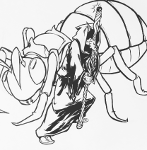
This is actually one of the reasons I absolutely love the Mario & Luigi RPGs: pretty much every single attack for every single enemy is telegraphed in such a way that after a couple of battles you know not only what move is being used but which brother is being targeted and can avoid/counter it as needed.
In my game, Final Dragon Legacy, there is a boss called the Pagemaster. While he himself isn't that strong, he is accompanied by three book monsters, each with a different role. The Book of Mother Earth, which heals and buffs the enemy party, The Book of Shadows, which debuffs the player (silence being a particular nuisance), and The Book of Storms, which uses damaging magic that affects the entire party. Obviously, just focusing on the Pagemaster will cause the player to become quickly overwhelmed, resulting in a humiliating defeat.
However, the player can defeat each of the books, leaving just the Pagemaster to deal with. However, once the main boss is alone, he will quickly revive the books, leaving the player in a position where they will need to deal with the swarm, or be overtaken. Defeating each book will leave a pile of pages behind, and by using fire-elemental attacks, the player can destroy the books permanently. Doing this quickly turns the tides of the battle, ensuring the player's victory... Providing the player can survive the initial onslaught.
I left no clues in this particular dungeon as to how one defeats this boss (or any boss), so the strategy relies on the player's common sense and how prepared they are when the battle starts (which shouldn't be an issue, since all bosses appear on the map and don't attack until the player interacts with them). Of course, this isn't to say that the battle would be impossible if the player ran out of MP or MP restoring items, or didn't acquire a certain fire-elemental weapon beforehand. The boss is still very much beatable, but just not as easily accomplished.
However, the player can defeat each of the books, leaving just the Pagemaster to deal with. However, once the main boss is alone, he will quickly revive the books, leaving the player in a position where they will need to deal with the swarm, or be overtaken. Defeating each book will leave a pile of pages behind, and by using fire-elemental attacks, the player can destroy the books permanently. Doing this quickly turns the tides of the battle, ensuring the player's victory... Providing the player can survive the initial onslaught.
I left no clues in this particular dungeon as to how one defeats this boss (or any boss), so the strategy relies on the player's common sense and how prepared they are when the battle starts (which shouldn't be an issue, since all bosses appear on the map and don't attack until the player interacts with them). Of course, this isn't to say that the battle would be impossible if the player ran out of MP or MP restoring items, or didn't acquire a certain fire-elemental weapon beforehand. The boss is still very much beatable, but just not as easily accomplished.
I like the sound of that boss, but I would suggest perhaps having lesser versions of the books as normal enemies in the dungeon so the player knows about the "use fire on pile of pages" mechanic.
Although I can see where sometimes boss mechanics can be more fun coming straight out of left field, I feel it's a better example of game design if you're subtly introduced to said mechanics in previous battles if you know where to look. Nothing a boss does should ever be -completely- unexpected unless it's not powerful enough to pose a significant threat to the player if they go in blind.
Although I can see where sometimes boss mechanics can be more fun coming straight out of left field, I feel it's a better example of game design if you're subtly introduced to said mechanics in previous battles if you know where to look. Nothing a boss does should ever be -completely- unexpected unless it's not powerful enough to pose a significant threat to the player if they go in blind.

author=slashphoenix
- Toughness/Weakness: DEF-up/ATK-down respectively. These reduce damage dealt by direct attacks, but must be reapplied and do nothing against damage-over-time spells like Poison or Bleed.
- Dodge: Avoid all attacks. This is especially effective for avoiding massive attacks the enemy has telegraphed or avoiding being afflicted with a condition. However, it typically has a short duration and can only be cast every few turns. It also doesn't avoid damage from DoTs already affecting you.
- Shield Points (SP) : Act as armor - damage is dealt to your SP before your HP. SP is very good for reducing all forms of damage, including DoTs. However, they build up slowly and are lost at the end of battle.
- Stun: Stuns are very effective for avoiding one enemy's massive attack and reducing damage taken. However, stuns cost lots of MP and so aren't cost-effective enough to use on low-threat attacks.
I did something like this. I made several classes (and a way to add whatever you'd equipped back on) then a class-change ability that would either make your character Dodge, Block, Duck, or Jump. Sort of rock paper scissors battle style for four attacks (blunt, slash, ranged, ground). Jump avoids ground, but renders you weak to ranged. Dodge avoids slash, but makes you vulnerable to ground. Block blocks blunt but is weak to slash. And duck avoids ranged but makes you easy prey to blunt. I think this is how it worked. This works best for something like Hero's Realm (or Final Fantasy) where monsters use skill attacks.
author=Trihan
I like the sound of that boss, but I would suggest perhaps having lesser versions of the books as normal enemies in the dungeon so the player knows about the "use fire on pile of pages" mechanic.
Although I can see where sometimes boss mechanics can be more fun coming straight out of left field, I feel it's a better example of game design if you're subtly introduced to said mechanics in previous battles if you know where to look.
Actually, there are lesser versions of the book monsters that are weak to fire. The "turning into a pile of pages" bit only happens for the boss versions. I figured that this would make it obvious enough for players to figure it out. The pile of pages can be attacked, but are completely immune to anything but fire.
My idea was to throw some forced strategy at the player in a situation where they don't have much time to think about it, but also make it fairly obvious what needs to be done. As long as they don't panic if and when the Pagemaster revives his minions, they should make it through all right.
You could be right about the unexpected boss mechanics, but nobody has ever had a real problem with it yet. I guess if people start having trouble with that boss, I could go about putting hints somewhere to tell people how to beat it.
LockeZ
I'd really like to get rid of LockeZ. His play style is way too unpredictable. He's always like this too. If he ran a country, he'd just kill and imprison people at random until crime stopped.
5958
For an RPG veteran, being targettable is enough of a clue, yeah. And the player's already got a good idea which element to use. It's a good mechanic.
Here's a boss I came up with to replace one that was really boring. The boring one was a test for tank characters, and was not supposed to be winnable by non-tank characters until they were higher level. This was accomplished by forcing the player to turtle at maximum defense. Needless to say, this was a horrible and boring battle.
Since tanks are among the best characters at using status effects to lock down enemies in this game, but bosses are immune, I decided to add some minions to the fight. This gives them something to do. But I handled them in kind of a weird way, both to make the player KEEP having stuff to do and to make defense still be a key to the fight.
There are two minions. Each round, one of them acts. If one is locked down or dead, the other always acts. They just do damage, nothing special. They don't have any immunities. They don't have much HP, since tanks don't deal much damage. But there's no way you can one-shot them.
The boss alternates buffing one minion or the other with an offensive buff every few rounds. Thus, whichever one is buffed needs to be locked down. This makes the status infliction a little more reactive than a normal fight - you're responding to a boss skill.
If both minions are locked down, the boss will heal ailments from whichever one isn't buffed.
If a minion goes below half health, the boss sacrifices a big chunk of its own HP to heal the minion to full health. This also removes the buff from the healed minion, creating a second way for players without lockdown skills to handle the buff. Since tanks deal crappy damage, this is their main method of responding to the boss's mega defense: make it hurt itself. Once it does this enough times, it'll run out of HP and you'll be able to kill the minions.
Once the minions are dead, you're in the final few rounds of the battle, but you still have to be able to survive the boss, which will start attacking for big damage once the minions are gone. The boss should die in 2-3 rounds though, so you don't have to survive a lot of hits. Just enough to make tanks glad they're tanks, and make glass cannons cry.
In summary:
Boss Action: One minion gets an offensive buff.
- Player Response: Lock down or immediately nuke the correct minion.
Boss Action: The non-locked-down minion does almost as much damage as the two combined, since it attacks in place of the locked down one.
- Player Response: Gear for maximum defense or chain-paralyze the second minion.
Boss Action: Boss has a shitton of HP and defense.
- Player Response: Make the boss hurt itself.
Boss Action: Boss deals heavy damage when about to die.
- Player Response: Use tanking skills to survive.
Here's a boss I came up with to replace one that was really boring. The boring one was a test for tank characters, and was not supposed to be winnable by non-tank characters until they were higher level. This was accomplished by forcing the player to turtle at maximum defense. Needless to say, this was a horrible and boring battle.
Since tanks are among the best characters at using status effects to lock down enemies in this game, but bosses are immune, I decided to add some minions to the fight. This gives them something to do. But I handled them in kind of a weird way, both to make the player KEEP having stuff to do and to make defense still be a key to the fight.
There are two minions. Each round, one of them acts. If one is locked down or dead, the other always acts. They just do damage, nothing special. They don't have any immunities. They don't have much HP, since tanks don't deal much damage. But there's no way you can one-shot them.
The boss alternates buffing one minion or the other with an offensive buff every few rounds. Thus, whichever one is buffed needs to be locked down. This makes the status infliction a little more reactive than a normal fight - you're responding to a boss skill.
If both minions are locked down, the boss will heal ailments from whichever one isn't buffed.
If a minion goes below half health, the boss sacrifices a big chunk of its own HP to heal the minion to full health. This also removes the buff from the healed minion, creating a second way for players without lockdown skills to handle the buff. Since tanks deal crappy damage, this is their main method of responding to the boss's mega defense: make it hurt itself. Once it does this enough times, it'll run out of HP and you'll be able to kill the minions.
Once the minions are dead, you're in the final few rounds of the battle, but you still have to be able to survive the boss, which will start attacking for big damage once the minions are gone. The boss should die in 2-3 rounds though, so you don't have to survive a lot of hits. Just enough to make tanks glad they're tanks, and make glass cannons cry.
In summary:
Boss Action: One minion gets an offensive buff.
- Player Response: Lock down or immediately nuke the correct minion.
Boss Action: The non-locked-down minion does almost as much damage as the two combined, since it attacks in place of the locked down one.
- Player Response: Gear for maximum defense or chain-paralyze the second minion.
Boss Action: Boss has a shitton of HP and defense.
- Player Response: Make the boss hurt itself.
Boss Action: Boss deals heavy damage when about to die.
- Player Response: Use tanking skills to survive.
When it comes to non bosses, the biggest challenge is usually not to come up with counters, rather it is to convince the player to even bother. Most RPGs have status effects that can shut down randoms, but nobody cares to use them. I have a person experience where I designed a blindness spell that hits all enemies, has a 100% accuracy and lowers the enemy chance to hit to 0%. When I tested my game, I found out that the player was still better of not using it. Eventually I did manage to make my blindness spell useful in a satisfying way by fiddling with a lot of different numbers.
Speaking of satisfying, that would be the second challenge. It's easy to make a boss who spends one turn charging up a strong attack and then casts it the second turn so the player has to defend. However, there's no thinking involved, the game tells you "Defend!" and you obey. If you want there to be any brain activity involved, it gets trickier.
Anyway, I earlier stated that I did manage to make my blindness spell useful fiddling with numbers. This is also what I want to try first and foremost, getting the numbers to support counters rather than relying on clever methods. Basically, the player has an arsenal of skills that counters various enemy attacks. If the player don't use counters, the heroes will take too much damage and either get overwhelmed or run out of healing. If the player overuses counters (say tanking and casting blindness and keeping the blind immune enemies stunned and casting a fire ward spell) then the heroes will instead run out of MP because they are spending too many actions on the counters and too few on actually killing the enemies.
As for tricks, one that I've got to work at least when I test ran the battle, is a boss that summons help, but the twist is that the rate of reinforcements is reversible proportional to the number of already existing minions. So, if you kill all minions during one turn, the boss may summon two new at once while if there's four alive, the same boss may need two turn to summon just one. This forces the player to make a judgment call on how many actions should be allocated on killing the minions.
A trick I haven't tried yet, but want to try with human bosses is to give them much less HP than monster bosses, but they will heal themselves with potions. The first heal will maybe come once it's down to 75% HP, the second at 65% HP and so on. The player is then encouraged to exploit that mechanic fully. When the threshold is at 75%, you can't really prevent the boss from healing itself since you won't be able to remove 75% of it's max HP in one turn. However, you can use that mechanic to force the boss to heal instead of attacking. Later when the threshold is much lower, this method is no longer effective, but now you may be able to counter the healing. Bring it down to as close to threshold as you dare and then remove the remaining HP in one turn.
Speaking of satisfying, that would be the second challenge. It's easy to make a boss who spends one turn charging up a strong attack and then casts it the second turn so the player has to defend. However, there's no thinking involved, the game tells you "Defend!" and you obey. If you want there to be any brain activity involved, it gets trickier.
Anyway, I earlier stated that I did manage to make my blindness spell useful fiddling with numbers. This is also what I want to try first and foremost, getting the numbers to support counters rather than relying on clever methods. Basically, the player has an arsenal of skills that counters various enemy attacks. If the player don't use counters, the heroes will take too much damage and either get overwhelmed or run out of healing. If the player overuses counters (say tanking and casting blindness and keeping the blind immune enemies stunned and casting a fire ward spell) then the heroes will instead run out of MP because they are spending too many actions on the counters and too few on actually killing the enemies.
As for tricks, one that I've got to work at least when I test ran the battle, is a boss that summons help, but the twist is that the rate of reinforcements is reversible proportional to the number of already existing minions. So, if you kill all minions during one turn, the boss may summon two new at once while if there's four alive, the same boss may need two turn to summon just one. This forces the player to make a judgment call on how many actions should be allocated on killing the minions.
A trick I haven't tried yet, but want to try with human bosses is to give them much less HP than monster bosses, but they will heal themselves with potions. The first heal will maybe come once it's down to 75% HP, the second at 65% HP and so on. The player is then encouraged to exploit that mechanic fully. When the threshold is at 75%, you can't really prevent the boss from healing itself since you won't be able to remove 75% of it's max HP in one turn. However, you can use that mechanic to force the boss to heal instead of attacking. Later when the threshold is much lower, this method is no longer effective, but now you may be able to counter the healing. Bring it down to as close to threshold as you dare and then remove the remaining HP in one turn.
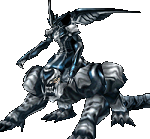
a bear like monster: 3 Consecutive attack without guarding make you disoriented, if you are disoriented enemy do 1 jump attack (bear get up on his leg).
elemental slime like enemy: have simple array of moves, double intelligence of himself, halve opponent magic defense, level 2 magic skill based on its element.
wolf: every attack cause bleeding, if your hp is below 25% "group attack" (all wolf attack together, damage is critical).
first boss: 1 healer, 1 defender, 1 attacker. defender prevent any damage to attacker and healer, the only way is to stun, net, entangle, taunt the defender and remove either attacker or healer
removing attacker cause healer to use black magic and forgo healing.
removing healer cause defender to drop his shield and become a attacker.
depends on your class (thief, defender, attacker, mage) you must chose witch enemy to remove first.
elemental slime like enemy: have simple array of moves, double intelligence of himself, halve opponent magic defense, level 2 magic skill based on its element.
wolf: every attack cause bleeding, if your hp is below 25% "group attack" (all wolf attack together, damage is critical).
first boss: 1 healer, 1 defender, 1 attacker. defender prevent any damage to attacker and healer, the only way is to stun, net, entangle, taunt the defender and remove either attacker or healer
removing attacker cause healer to use black magic and forgo healing.
removing healer cause defender to drop his shield and become a attacker.
depends on your class (thief, defender, attacker, mage) you must chose witch enemy to remove first.

Mine is a simple one really. In my game Infection, infected will "grapple" you, which does a base damage then continues damage unless you use the skill "Break Free" it's a basic poison/cleanse but I think the player feels like they win if they are immersed, being grappled by a zombie and being able to break free from their grasps.
It's very simple and isn't complicated or ground breaking, but it's a player win.
You have to counter it quickly before it does more damage than it should, also I use rm2k3 where it isn't turn by turn, but ATB. So if they grapple you, and it's your turn you can quickly break free and stop in dead in its tracks.
Not to mention, it's a self target, so you don't have a "healer" that just takes care of it, it's the targeted characters responsibility to rid themselves of it.
It's very simple and isn't complicated or ground breaking, but it's a player win.
You have to counter it quickly before it does more damage than it should, also I use rm2k3 where it isn't turn by turn, but ATB. So if they grapple you, and it's your turn you can quickly break free and stop in dead in its tracks.
Not to mention, it's a self target, so you don't have a "healer" that just takes care of it, it's the targeted characters responsibility to rid themselves of it.
author=InfectionFiles
Not to mention, it's a self target, so you don't have a "healer" that just takes care of it, it's the targeted characters responsibility to rid themselves of it.
I actually really like this mechanic. Especially in games that require a lot of character customization. It really requires characters to be self-sufficient, which you don't see outside of MMORPG's, usually. I toyed around with this idea in an RPG based on Double Dragon, since there were only two characters in your party. I wanted each character to be responsible for themselves. So, I made most healing and/or buffing skills target the "caster". If the player wanted to affect their party, they had to specialize their characters to be able to affect the other party members with their abilities. That's where the custom level-up system came into play. :p The player could choose what skills they would gain, depending on how they distributed skill points, much like in the Diablo games.
Of course, I never got too far with this idea (as far as bosses, or even enemies). I've pretty much scrapped the whole project, but I like that I'm not the only one who used the "every man for himself" game mechanic. :p I've actually looked at your game profile before, and I must say that I'm just as interested in it now as I was then. I hope you actually finish your project, unlike I did!
That's a perfect way to say it "every man for himself" is what a lot of my game mechanics are, there is of course spells that can target party members but they are far and few in between.
I never wanted one character to be the one that sits back and heals/buffs/debuffs, and then another be the ultimate tank/fighter. My game is slightly like that, but that's more trying to be true to the characters as real people and the storyline itself.
It just adds that much more strategy if each character has to deal with their own problems most of the time. You might lose out on some damage if your main attacker has to spend a turn ridding himself of a debuff/poison, instead of just constantly using his strongest attacks.
And thanks! I'm really working hard towards finishing Infection. :) I really don't see any reason why I wouldn't/or couldn't. I set in my mind that it's going to be a simple game(and hopefully effective) without a ton of custom systems or the like.
I never wanted one character to be the one that sits back and heals/buffs/debuffs, and then another be the ultimate tank/fighter. My game is slightly like that, but that's more trying to be true to the characters as real people and the storyline itself.
It just adds that much more strategy if each character has to deal with their own problems most of the time. You might lose out on some damage if your main attacker has to spend a turn ridding himself of a debuff/poison, instead of just constantly using his strongest attacks.
And thanks! I'm really working hard towards finishing Infection. :) I really don't see any reason why I wouldn't/or couldn't. I set in my mind that it's going to be a simple game(and hopefully effective) without a ton of custom systems or the like.
Pages:
1

