



 Full Games List
 Featured Games
 New Games
 Reviews
 Media
Media Images
 Blogs
Blogs Game Updates
 Images Feedback Summary
 Game Design Highlights
 Tutorials
 Articles
 Scripts
 Utilities / Plugins
 Resources
 Engines
 Engine Bulletins
 What is Makerscore?
 Past Events
 Achievements
 Misaos
 Forums
 Post History
 Chat
Chat New to RMN?
 Full Store List
 RMN Music Pack (free)



HOW THE HECK DO YOU DESIGN A TOWN?
Posts

 Isrieri
 View playlists
 Close
CloseI started trying to make a semi-serious project in VX Ace but ran into a little problem: I have no idea how to make towns interesting.
Sure, I can plop down some houses, put in some shops that sell important stuff the characters need, set up interesting & informative NPC dialogue, give it some backstory and a sense of location. I can do all that. I just can't....do it with tile mapping. All I end up is making something that looks like a town. But I never feel satisfied because it just seems slap-dash. I don't know how to design a town.
I subscribe to the somewhat old school approach. Which is something like this:
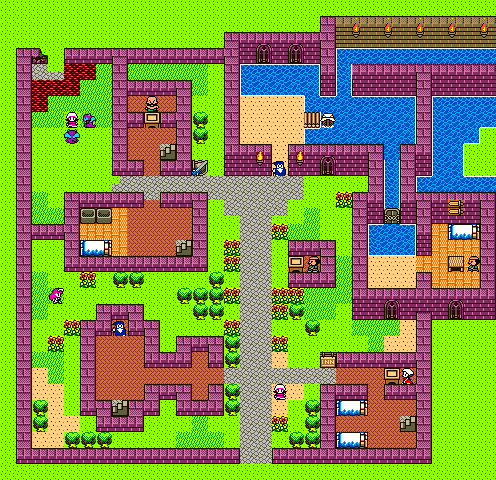
Right here is the bare bones of what you would need for a town of any sort. It may not be pretty to look at, but that's because it's functional more than it's pretty: There is a little design that goes into these instead of it just being a few houses scattered all over the place.
These small touches give the town some character and make it interesting to navigate. I don't know if I'm reading too much into town design, but I wonder if there's a conversation to be had concerning the finer aspects of what goes into make them fun to explore.
The point is -- I can't map.
Sure, I can plop down some houses, put in some shops that sell important stuff the characters need, set up interesting & informative NPC dialogue, give it some backstory and a sense of location. I can do all that. I just can't....do it with tile mapping. All I end up is making something that looks like a town. But I never feel satisfied because it just seems slap-dash. I don't know how to design a town.
I subscribe to the somewhat old school approach. Which is something like this:
Right here is the bare bones of what you would need for a town of any sort. It may not be pretty to look at, but that's because it's functional more than it's pretty: There is a little design that goes into these instead of it just being a few houses scattered all over the place.
- You arrive at the bottom, and the inn is right there for the sake of convienece. Inns are usually put somewhere that is easy to find/access.
- Across from the inn is a house with a guy who lets you save your game and a casino upstairs. Again with the convience and ease of access.
- The Item Shop is signified by the counter out in the open and easy to spot because of the merchant. Who're always green. (in the old DQ days, basically this was your SHOP sign hanging on the house).
- Pretty flowers and some patches of dirt sprinkled just so that it makes things look nice without cluttering the screen full of rocks and bushes.
- You've a lady NPC tucked away on the left to give people who go exploring around town something to talk to for the trouble. Rewarding exploring.
- You've got a nifty little port in the upper right to make the town differ from all the other towns and establish it's sense of place. And gives the town it's significance.
- No superfluous houses: Every one, you are able to enter and poke around in, even if they're just residences. Some are barred by locked doors, but you can find the key and return to them later. This gives you incentive to return and makes the place more useful than just a temporary rest-stop.
- You've got your DQ standard Wall-Around-Town because this is a monster-infested world and it establishes that these towns are safe-havens from bad guys.
- And in the upper left we see that the wall's been broken into and some monsters harassing a young woman. Because of the former point you know that this is a bad thing: You can see this scene from the weapons shop (a place that even people un-interested in exploring would be naturally inclined to check out first-thing upon arrival) and may be inclined to try and help the girl...or go and save your game before tackling them.
- Everything is easy to get to/find because it's all laid out in one basic strip: You need only follow the stone path and you never get lost. You don't have pathways that lead you around in a circle or a bunch of houses scattered around that might hide the important buildings.
These small touches give the town some character and make it interesting to navigate. I don't know if I'm reading too much into town design, but I wonder if there's a conversation to be had concerning the finer aspects of what goes into make them fun to explore.
The point is -- I can't map.

You seem to have all the fundamentals down. The only other advice I can give is to try to make your town feel "lived in". Make NPCs wander around doing their business. And when you're not sure what to do, small is always better.
*shrug* I can't really say anything more that that because I often have trouble designing towns too. Hell, every single town in my one complete game is a goddamn sample map. ;_;
Then again, I hate mapping in general.
*shrug* I can't really say anything more that that because I often have trouble designing towns too. Hell, every single town in my one complete game is a goddamn sample map. ;_;
Then again, I hate mapping in general.

Towns are the banes of rpgs
...but if you insist on having them, a few suggestions:
-even better than having inns near the entrance is to have it so that when you enter town, you just need to hit "up" and you will walk into the inn door. bonus points if you use yanfly's "event move restriction" so NPCs cannot walk into that straight path
-you don't always have to show the entire town. could just be like "we are in the commercial district," and have guards/fences/whatever stopping you from entering other parts of the settlement because you're not a resident or w/e
-if you don't let the player move at the game's max speed while in towns you're an asshole
-don't be afraid to lock houses. you really don't need to be able to barge into people's houses. some people like that shit but a lot of the time it's pure fluff that may net the player 10G... and wastes both their time and yours
-if an npc has nothing useful or world-building to say, delete that shit
...but if you insist on having them, a few suggestions:
-even better than having inns near the entrance is to have it so that when you enter town, you just need to hit "up" and you will walk into the inn door. bonus points if you use yanfly's "event move restriction" so NPCs cannot walk into that straight path
-you don't always have to show the entire town. could just be like "we are in the commercial district," and have guards/fences/whatever stopping you from entering other parts of the settlement because you're not a resident or w/e
-if you don't let the player move at the game's max speed while in towns you're an asshole
-don't be afraid to lock houses. you really don't need to be able to barge into people's houses. some people like that shit but a lot of the time it's pure fluff that may net the player 10G... and wastes both their time and yours
-if an npc has nothing useful or world-building to say, delete that shit

author=Craze
Towns are the banes of rpgs
Given that they're pretty common, I'm curious about what's wrong with them. Is it just because they don't really offer anything, gameplay-wise?
That makes me think - What is a good alternative to towns? Having no towns but traveling merchants that you run into that sell you stuff? Or maybe no merchants and you make all your own stuff via a crafting system. The inn is easy enough to replicate with a healing tile or something similar.

I kind of find it hard to design a town as well. From a practical standpoint, a town is just a spot for the player take a break from dangers within the game. They allow the player to improve their characters/chance of winning (through shops and all) and recuperate in a safe environment... Under that basic principle, you've designed this town perfectly well.
Tips to make it interesting, though? I guess I would mention the following:
- Add some items, either visible or hidden, in some spots in your town. It would encourage exploration and give the player a little bit more to do with your town than just make pit stop and heal. I think you have this down with your current map, though maybe you can add more to make use of some of your empty spaces.
- It's not a bad idea to add things that require the player to backtrack in order to obtain, either, because I think the more stuff you can do to interact with a town, the more memorable that particular town becomes. Think the monster arena in that one town in DQ3 or just place an item across a lake that the player needs a skill to cross over. That's at least what I figured by playing Pokemon, lol.
- Make things convenient for the player. You already did that by placing the inn closest to the entrance of the town, along a straight path, so that the player doesn't have to break a leg finding where to rest after going through hell on the fields. Do the same for shops. Heck, why not merge the regular item shop with the equipment shop? That's even more convenient!
- Lastly, try adding a bit of atmosphere to your town. Make a town represent the surroundings it's placed in, including the culture of its people. If it's a town located in the forest, for instance, maybe add some tree houses instead of the standard. Going futhur, you can change up the exploration methods by having the player climb up those said trees to find goodies or something, maybe even get around the town by swinging on a vine to each platform, just food for thought.
Tips to make it interesting, though? I guess I would mention the following:
- Add some items, either visible or hidden, in some spots in your town. It would encourage exploration and give the player a little bit more to do with your town than just make pit stop and heal. I think you have this down with your current map, though maybe you can add more to make use of some of your empty spaces.
- It's not a bad idea to add things that require the player to backtrack in order to obtain, either, because I think the more stuff you can do to interact with a town, the more memorable that particular town becomes. Think the monster arena in that one town in DQ3 or just place an item across a lake that the player needs a skill to cross over. That's at least what I figured by playing Pokemon, lol.
- Make things convenient for the player. You already did that by placing the inn closest to the entrance of the town, along a straight path, so that the player doesn't have to break a leg finding where to rest after going through hell on the fields. Do the same for shops. Heck, why not merge the regular item shop with the equipment shop? That's even more convenient!
- Lastly, try adding a bit of atmosphere to your town. Make a town represent the surroundings it's placed in, including the culture of its people. If it's a town located in the forest, for instance, maybe add some tree houses instead of the standard. Going futhur, you can change up the exploration methods by having the player climb up those said trees to find goodies or something, maybe even get around the town by swinging on a vine to each platform, just food for thought.

I have no experience mapping, and I'm sure there are nuances one would only pick up through doing it, rather than just observing others' work, but I'll add my two cents about what I think makes for an interesting town layout. Some of it conflicts with what you've already described, but if you're not happy with the results of what you've already described, you might want to try deviating from it.
I'd say that one of the fundamental points behind making an RPG town interesting is that it should, as much as is practical within the design constraints, look and feel like an actual town. That is, it's a place of habitation for its residents, not simply an institution for the convenience of the player character. So, don't just think in terms of convenience and ease of access for the player (your game is almost certainly full of challenges much, much greater than navigating a town, don't worry too much about inconveniencing them a little,) think about what would be convenient and practical for the inhabitants and store owners.
As a consequence, you might want to reconsider the "no superfluous houses" point. If you trim away everything that isn't useful to the player, you'll lose the sensation that the town exists for its residents, rather than for the player. You could go to the trouble of making every house explorable, but personally, I approve of the trend in games to make a lot of content in towns not explorable or interactive. After all, most people have better things to do than talk to random strangers on the street, and don't want people they don't know just waltzing into their houses. The non-interactive content should always be interspersed with interactive content, to give the player an incentive to explore, and there should be cues to distinguish interactive content from non-interactive so that players don't have to walk around clicking every damn thing in hopes of finding out which things do stuff, but having stuff around which isn't of immediate interest to the player character helps build a sense of verisimilitude.
Right now, the map you've shown is composed mainly of businesses and services which are useful to the player. Imagine for a moment that you're a person living in this town. Where do you live? Where do you work? What do you do with your free time? If you run a business, who are your customers? A well designed town should at least suggest these elements to the player.
In terms of what distinguishes a town from other towns, again, try and think of this in terms of its relevance to the inhabitants, not just the player. This town has a port, for instance, but how does the port relate to life and business in the town for the inhabitants? Do local goods concentrate in this location for shipping off to foreign locales, while foreign goods arrive and disperse from here? The design of the town should suggest some kind of infrastructure for handling this. Is it a fishing port? The setting should reflect that activity. Is the primary purpose to ferry travelers from one location to another? Then the town's design, and its context in the general geography of the setting, should mark it as a chokepoint for travelers.
I'd say that one of the fundamental points behind making an RPG town interesting is that it should, as much as is practical within the design constraints, look and feel like an actual town. That is, it's a place of habitation for its residents, not simply an institution for the convenience of the player character. So, don't just think in terms of convenience and ease of access for the player (your game is almost certainly full of challenges much, much greater than navigating a town, don't worry too much about inconveniencing them a little,) think about what would be convenient and practical for the inhabitants and store owners.
As a consequence, you might want to reconsider the "no superfluous houses" point. If you trim away everything that isn't useful to the player, you'll lose the sensation that the town exists for its residents, rather than for the player. You could go to the trouble of making every house explorable, but personally, I approve of the trend in games to make a lot of content in towns not explorable or interactive. After all, most people have better things to do than talk to random strangers on the street, and don't want people they don't know just waltzing into their houses. The non-interactive content should always be interspersed with interactive content, to give the player an incentive to explore, and there should be cues to distinguish interactive content from non-interactive so that players don't have to walk around clicking every damn thing in hopes of finding out which things do stuff, but having stuff around which isn't of immediate interest to the player character helps build a sense of verisimilitude.
Right now, the map you've shown is composed mainly of businesses and services which are useful to the player. Imagine for a moment that you're a person living in this town. Where do you live? Where do you work? What do you do with your free time? If you run a business, who are your customers? A well designed town should at least suggest these elements to the player.
In terms of what distinguishes a town from other towns, again, try and think of this in terms of its relevance to the inhabitants, not just the player. This town has a port, for instance, but how does the port relate to life and business in the town for the inhabitants? Do local goods concentrate in this location for shipping off to foreign locales, while foreign goods arrive and disperse from here? The design of the town should suggest some kind of infrastructure for handling this. Is it a fishing port? The setting should reflect that activity. Is the primary purpose to ferry travelers from one location to another? Then the town's design, and its context in the general geography of the setting, should mark it as a chokepoint for travelers.
LockeZ

I'd really like to get rid of LockeZ. His play style is way too unpredictable. He's always like this too. If he ran a country, he'd just kill and imprison people at random until crime stopped.
5958
Here's one problem I've encountered with trying to make towns:
- There's a set of buildings you absolutely need in every town. An inn, an item shop, 2-3 equipment shops, and possibly other things depending on your game. So you start by plopping these down.
- You probably have one important building the player has to visit for plot reasons, so you add that too. In many cases this one building ends up being the only unique feature of the town, except maybe the climate.
- You also, in order to make it seem more like a town instead of a minimall, need some other stuff that doesn't really add any gameplay, it's just there to look at. Most people do this just by adding random houses.
- By the time you're done that basic stuff, your town is as big as most RPG towns, and also you're exhausted, so you just add some doodads and call it a day.
THIS RESULTS IN SOME SERIOUSLY BORING-ASS TOWNS
Here's my alternate method:
- Come up with a setting or landmark that's unique and interesting. A key feature for the town. Some examples include: a monastery, a huge aqueduct, a battalion of cannons aimed at an encroaching orcish war party, a giant portal to another dimension, a dragon roost at the top of a cliff, a submarine port, a large temple, the crumbling outer wall of a demolished fortress, a haunted circus, etc. This will be more than just the most interesting thing in your town - it will be its theme. Its presence will pervade the entire town. It is the reason the town matters. This doesn't have to be directly connected to your plot at all. It totally can be part of the plot, but if nothing in your plot suggests a key feature for this town, then it's perfectly fine for it to be purely atmospheric.
- Put most of the important events in your town somewhere near the epicenter of this key feature. Any key plot buildings you need to make should usually be very close to it, if not inside it, unless you have a specific reason for needing them to be further away. This will emphasise the impact of both the plot building and the town's key feature.
- Flip a coin. If it comes up tails, give up on making anything resembling a traditional town. This will be an outpost or something instead. Maybe it'll be a very unfriendly place that only serves as a "town" because a party of travelling merchants are passing through. Or maybe the soldiers or researchers there are willing to trade supplies with you. Something like that; a place with NPCs, but not actually a town.
- Start building the rest of the town, or maybe "town", around your central key feature. Put as many things as you can as close to it as you can. Many of the shops and other things might be outdoors, or in caves, or in makeshift shelters, or in the engineering bay of the half-build steamship, or somewhere else other than a traditional building, depending on what your key feature is. Expand the key feature, spreading its tendrils through everything you place.
- The existance of something cool in the town, something that actually matters, will help sell the idea that the town is there for more than just the player's shopping convenience. You can often get away with having fewer houses, maybe even none, because the people there aren't there because it's a pleasant place to live. They're there because there's a 2500 meter tall crystal spire in the center of the town that people make pilgrimages to from all over the world, or whatever.
- If this is supposed to be a real town of a good size, and you still want more houses, consider making most of them unenterable, and use them as walls to create the borders of the town. This will give the impression that several thousand boring residences continue to sprawl out off the edge of the screen.
Using my "key thematic feature" method for every town might be overkill, but personally it helps me make a lot of my towns way more interesting.
- There's a set of buildings you absolutely need in every town. An inn, an item shop, 2-3 equipment shops, and possibly other things depending on your game. So you start by plopping these down.
- You probably have one important building the player has to visit for plot reasons, so you add that too. In many cases this one building ends up being the only unique feature of the town, except maybe the climate.
- You also, in order to make it seem more like a town instead of a minimall, need some other stuff that doesn't really add any gameplay, it's just there to look at. Most people do this just by adding random houses.
- By the time you're done that basic stuff, your town is as big as most RPG towns, and also you're exhausted, so you just add some doodads and call it a day.
THIS RESULTS IN SOME SERIOUSLY BORING-ASS TOWNS
Here's my alternate method:
- Come up with a setting or landmark that's unique and interesting. A key feature for the town. Some examples include: a monastery, a huge aqueduct, a battalion of cannons aimed at an encroaching orcish war party, a giant portal to another dimension, a dragon roost at the top of a cliff, a submarine port, a large temple, the crumbling outer wall of a demolished fortress, a haunted circus, etc. This will be more than just the most interesting thing in your town - it will be its theme. Its presence will pervade the entire town. It is the reason the town matters. This doesn't have to be directly connected to your plot at all. It totally can be part of the plot, but if nothing in your plot suggests a key feature for this town, then it's perfectly fine for it to be purely atmospheric.
- Put most of the important events in your town somewhere near the epicenter of this key feature. Any key plot buildings you need to make should usually be very close to it, if not inside it, unless you have a specific reason for needing them to be further away. This will emphasise the impact of both the plot building and the town's key feature.
- Flip a coin. If it comes up tails, give up on making anything resembling a traditional town. This will be an outpost or something instead. Maybe it'll be a very unfriendly place that only serves as a "town" because a party of travelling merchants are passing through. Or maybe the soldiers or researchers there are willing to trade supplies with you. Something like that; a place with NPCs, but not actually a town.
- Start building the rest of the town, or maybe "town", around your central key feature. Put as many things as you can as close to it as you can. Many of the shops and other things might be outdoors, or in caves, or in makeshift shelters, or in the engineering bay of the half-build steamship, or somewhere else other than a traditional building, depending on what your key feature is. Expand the key feature, spreading its tendrils through everything you place.
- The existance of something cool in the town, something that actually matters, will help sell the idea that the town is there for more than just the player's shopping convenience. You can often get away with having fewer houses, maybe even none, because the people there aren't there because it's a pleasant place to live. They're there because there's a 2500 meter tall crystal spire in the center of the town that people make pilgrimages to from all over the world, or whatever.
- If this is supposed to be a real town of a good size, and you still want more houses, consider making most of them unenterable, and use them as walls to create the borders of the town. This will give the impression that several thousand boring residences continue to sprawl out off the edge of the screen.
Using my "key thematic feature" method for every town might be overkill, but personally it helps me make a lot of my towns way more interesting.

unityCrazeGiven that they're pretty common, I'm curious about what's wrong with them. Is it just because they don't really offer anything, gameplay-wise?
Towns are the banes of rpgs
they're boring and pad the distance between me and my shops. they also have terrible music 95% of the time in jrpgs
only worthwhile traditional towns are in chrono trigger due to the world map setup, and elder scrolls games because you can kill people. maybe ff12 because even though they're a lot of padding they're, idk... rabanstre and bhujerba are epic (i mean that in scale and feel, not "lolepic"). MAYBE (maaaaybe) also Suikoden 1/2. Maybe. only due to the nature of the games and their stories revolving around PEOPLE
they are common because early ff/dq games had them, and they did them well enough -- they're small (although ff got a bit nuttier in some cases, elfland is pretty bad in ff1), clearly mark the important buildings, and any important npcs usually look different than the norm (esp. in the remakes of the early games).
buuuuut then they get bastardized and you get shit like wild arms 1 and the ps1 final fantasies and rudras (even though it's still my favorite snes game) with these large, unwieldy towns that are difficult to navigate and confusing to figure out where to go next. i mean i understand the desire to explore, but i don't care about the old lady going WHERE'S MY DANG HUSBAND. i really don't
lockez's best point is to include landmarks and shit. when people say "MAKE UR RM* TOWN LUK ALIVE" they are saying "put in a shitton of worthless NPCs." no. make the town a statement, something that shows what the world is actually like in that area. who do they worship? what do they believe in? are they friendly? divided? what are their imports and exports? etc. etc.
author=LockeZ
Here's my alternate method:
This man gives solid advice that I wish I had thought of and implemented consciously a long time ago.
Thank you.

:<
I like towns.
It's the writer in me that enjoys actual interaction with the story side of a game - and if you're struggling to make a town feel alive I do have a few tips and tricks.
- Make the NPCs have a life outside just serving the hero. Sure, they can still talk about monster attack patterns and where the next area to go is, but they're more likely to do so in relevance to their own lives. "Fire Goblins like fire" is boring. "The other day Kitty and I found a Fire Goblin's lair near the river shack. We were surprised to see them playing with flames - they weren't even being hurt by them. In fact, I think they were having fun! Can you imagine?" is a lot better (just an example.)
That piece of dialogue has just expanded your world lore. Instead of knowing that Fire Goblins like fire, you've now learned - there's someone in town called Kitty, there's a lair of Fire Goblins near the river shack, there's a river shack, there's a river, Fire Goblins actually exist aside from battles, Fire Goblins enjoy playing with fire and fire doesn't hurt them. Yeah... Just two extra lines and you've learned a lot about the area, monsters and world lore.
- Houses are lived in. They aren't just empty places (I am talking about the enterable ones). Give the NPCs small identities - maybe one's a chef who cooks a lot? Add random food and ingredients around. A child in the family? Toys and cute pictures. A bachelor? Empty plates, glasses and general messiness.
- Don't be afraid to allude to there being more of a town or block off access to places. Even if you have only a small part of your town open, you can have NPCs talk about the other areas that you can't see. It helps the town feel more complete. You don't have to 'lock' houses to keep people out, either. You can make their doors only open if you see them (see map below) and have entrances to back or sides be blocked. Hell, you can block off parts of houses, even. Put doors where the bedrooms should be and events saying "I shouldn't intrude" and the like. Unless your hero is a jerk/thief/etc.
- Opt for some kind of theme or give the town a moniker and go with it. Town of Silent Waves could back onto a beach, Town of Empty Sighs could be surrounded by forests, Town of Broken Dreams could be a town of washed-up heroes, Town of Viridian Leaves could have rare, red-leaved trees around. It doesn't have to be ultra-super special, but making it different in one way from another town helps when a player needs to backtrack or when thinking about certain towns.
- Backtracking to past towns can help expand world lore. Instead of just making one-time town, use them multiple times. Even little podunk villages deserve screen time - it's up to you to make them worth revisiting. Personally I like to use side-quests that involve different towns, or grow as you progress.
- Change occurs in most towns over time. If you're slaying large beasts and making an impact on the world, show it. Even small towns have changes occur while you're doing your thing. Re-elections of Mayors, deaths of people, new lives, new faces... People and places change.
Add to that the overall story of your game and world - political upheaval, wars, fighting and the like... Even destroying a local menace should change the way NPCs in towns act.
- Sharing people. I don't know about you, but I've noticed that families do spread out a lot, moving away from each other. So make this apparent - have members of NPC families in different towns. Let them communicate with each other. Maybe you helped someone in one town and later on you meet their child in another. Perhaps a letter has been sent, telling of your help. Perhaps you get a reward for helping their parent in a tough time. This makes the world feel more connected.
Hell, even towns have issues and friendships between them. Competitions, allies, resentments and ambivalence... all play a part in making a town feel more alive and real.
- History. Towns have it. You don't need to feed a long-ass history to the player, but having snippets here and there is nice. Just creating a history before you make the town can help in designing. Why is the town in that spot as opposed to another? Where did the inhabitants originate? What happened in the early years? What shaped the community? What are the main imports/exports of the town? Where does it stand politically?
These are some questions you should ask yourself when making a town. Is the town by a lake for the fishing industry? Then there's bound to be boats, fishing and fishermen. Is the town a centre of research and inhabited by scientists? Is it opposed to the current regime and willingly hosting rebels? Is it an old coal mining town that has found something surprising in the mines? Is it a castle that has an ancient self-defence mechanism that will pull it below the sands of the desert it resides in?
As for designing a town, it's a good idea to have a clear idea about what purpose the town has. Is it a hub for commerce? Is it an integral place for plot expansion? Is it just a place to restock before leaving for the next dungeon - a pit stop?
With that information in mind you can choose how you're going to map it. Will you allow full exploration or not? Will it be large or small?
The rest is up to you.
Some examples of 'closed' towns:

This city is a full city, but only the houses with squares on them are enterable.

Again, a small town with blocked off houses.

The outer edges show that there is more to the town than just the center area, but you can't go there. This is the full town map.

This game was odd in that you used a menu on the world map to interact with the towns. This is the only open area of one of the towns you could enter. The rest are about 3-4 houses.
I like towns.
It's the writer in me that enjoys actual interaction with the story side of a game - and if you're struggling to make a town feel alive I do have a few tips and tricks.
- Make the NPCs have a life outside just serving the hero. Sure, they can still talk about monster attack patterns and where the next area to go is, but they're more likely to do so in relevance to their own lives. "Fire Goblins like fire" is boring. "The other day Kitty and I found a Fire Goblin's lair near the river shack. We were surprised to see them playing with flames - they weren't even being hurt by them. In fact, I think they were having fun! Can you imagine?" is a lot better (just an example.)
That piece of dialogue has just expanded your world lore. Instead of knowing that Fire Goblins like fire, you've now learned - there's someone in town called Kitty, there's a lair of Fire Goblins near the river shack, there's a river shack, there's a river, Fire Goblins actually exist aside from battles, Fire Goblins enjoy playing with fire and fire doesn't hurt them. Yeah... Just two extra lines and you've learned a lot about the area, monsters and world lore.
- Houses are lived in. They aren't just empty places (I am talking about the enterable ones). Give the NPCs small identities - maybe one's a chef who cooks a lot? Add random food and ingredients around. A child in the family? Toys and cute pictures. A bachelor? Empty plates, glasses and general messiness.
- Don't be afraid to allude to there being more of a town or block off access to places. Even if you have only a small part of your town open, you can have NPCs talk about the other areas that you can't see. It helps the town feel more complete. You don't have to 'lock' houses to keep people out, either. You can make their doors only open if you see them (see map below) and have entrances to back or sides be blocked. Hell, you can block off parts of houses, even. Put doors where the bedrooms should be and events saying "I shouldn't intrude" and the like. Unless your hero is a jerk/thief/etc.
- Opt for some kind of theme or give the town a moniker and go with it. Town of Silent Waves could back onto a beach, Town of Empty Sighs could be surrounded by forests, Town of Broken Dreams could be a town of washed-up heroes, Town of Viridian Leaves could have rare, red-leaved trees around. It doesn't have to be ultra-super special, but making it different in one way from another town helps when a player needs to backtrack or when thinking about certain towns.
- Backtracking to past towns can help expand world lore. Instead of just making one-time town, use them multiple times. Even little podunk villages deserve screen time - it's up to you to make them worth revisiting. Personally I like to use side-quests that involve different towns, or grow as you progress.
- Change occurs in most towns over time. If you're slaying large beasts and making an impact on the world, show it. Even small towns have changes occur while you're doing your thing. Re-elections of Mayors, deaths of people, new lives, new faces... People and places change.
Add to that the overall story of your game and world - political upheaval, wars, fighting and the like... Even destroying a local menace should change the way NPCs in towns act.
- Sharing people. I don't know about you, but I've noticed that families do spread out a lot, moving away from each other. So make this apparent - have members of NPC families in different towns. Let them communicate with each other. Maybe you helped someone in one town and later on you meet their child in another. Perhaps a letter has been sent, telling of your help. Perhaps you get a reward for helping their parent in a tough time. This makes the world feel more connected.
Hell, even towns have issues and friendships between them. Competitions, allies, resentments and ambivalence... all play a part in making a town feel more alive and real.
- History. Towns have it. You don't need to feed a long-ass history to the player, but having snippets here and there is nice. Just creating a history before you make the town can help in designing. Why is the town in that spot as opposed to another? Where did the inhabitants originate? What happened in the early years? What shaped the community? What are the main imports/exports of the town? Where does it stand politically?
These are some questions you should ask yourself when making a town. Is the town by a lake for the fishing industry? Then there's bound to be boats, fishing and fishermen. Is the town a centre of research and inhabited by scientists? Is it opposed to the current regime and willingly hosting rebels? Is it an old coal mining town that has found something surprising in the mines? Is it a castle that has an ancient self-defence mechanism that will pull it below the sands of the desert it resides in?
As for designing a town, it's a good idea to have a clear idea about what purpose the town has. Is it a hub for commerce? Is it an integral place for plot expansion? Is it just a place to restock before leaving for the next dungeon - a pit stop?
With that information in mind you can choose how you're going to map it. Will you allow full exploration or not? Will it be large or small?
The rest is up to you.
Some examples of 'closed' towns:
This city is a full city, but only the houses with squares on them are enterable.
Again, a small town with blocked off houses.
The outer edges show that there is more to the town than just the center area, but you can't go there. This is the full town map.
This game was odd in that you used a menu on the world map to interact with the towns. This is the only open area of one of the towns you could enter. The rest are about 3-4 houses.
LockeZ
I'd really like to get rid of LockeZ. His play style is way too unpredictable. He's always like this too. If he ran a country, he'd just kill and imprison people at random until crime stopped.
5958
Re: my earlier advice about landmarks. For reference, towns in FF7 that did this include Cosmo Canyon and Rocket Town.
In Cosmo Canyon the central feature of the town was the observatory. It was at the top of a cliff, not in the literal center of the town, but on the way up that cliff to reach the observatory you passed through 80% of the town. Almost everything in that town's design revolved around climbing up to the observatory. Only two buildings and a bonfire were at ground level.
In Rocket Town the central feature of the town was, as its name implies, the rocket. I think this one was done better than Cosmo Canyon, personally. They went out of their way to make it more interesting than just a normal rocket; it's leaning over because it's a failed launch from years ago. It also is the central point of the plot in this section of the game, and you meet your new party member inside it. Instead of putting things literally in a circle around the rocket, the camera angle is set so that you can see the rocket from anywhere in the town, towering over everything else. You couldn't use this exact trick in RPG Maker, but you could do something similar if you had a two-story town and could see down to the lower level via a panorama background from the upper level, and the key feature were on the lower level.
Re: towns that are outposts instead of traditional towns, Bone Village is a great example from FF7. It's an archaeological dig site you pass through on the way to the Forgotten City, very unique. Definitely not a proper town, yet it sells items, weapons, and armor (in a single shop), and you can pay to sleep.
Towns in FF7 that didn't really do anything wrong but just totally failed to be interesting include Sector 5 Slums, Kalm, Gongaga, and probably North Corel. (Icicle Inn almost qualifies too, right up until you escape the town via a snowboarding minigame.) None of them are too big or hard to navigate or anything, they're just boring and forgettable. All of these towns basically just relied on the equivalent of using different tilesets from each-other to try to be interesting. And that was enough to make them not feel identical, but it wasn't enough to make them matter.
In Cosmo Canyon the central feature of the town was the observatory. It was at the top of a cliff, not in the literal center of the town, but on the way up that cliff to reach the observatory you passed through 80% of the town. Almost everything in that town's design revolved around climbing up to the observatory. Only two buildings and a bonfire were at ground level.
In Rocket Town the central feature of the town was, as its name implies, the rocket. I think this one was done better than Cosmo Canyon, personally. They went out of their way to make it more interesting than just a normal rocket; it's leaning over because it's a failed launch from years ago. It also is the central point of the plot in this section of the game, and you meet your new party member inside it. Instead of putting things literally in a circle around the rocket, the camera angle is set so that you can see the rocket from anywhere in the town, towering over everything else. You couldn't use this exact trick in RPG Maker, but you could do something similar if you had a two-story town and could see down to the lower level via a panorama background from the upper level, and the key feature were on the lower level.
Re: towns that are outposts instead of traditional towns, Bone Village is a great example from FF7. It's an archaeological dig site you pass through on the way to the Forgotten City, very unique. Definitely not a proper town, yet it sells items, weapons, and armor (in a single shop), and you can pay to sleep.
Towns in FF7 that didn't really do anything wrong but just totally failed to be interesting include Sector 5 Slums, Kalm, Gongaga, and probably North Corel. (Icicle Inn almost qualifies too, right up until you escape the town via a snowboarding minigame.) None of them are too big or hard to navigate or anything, they're just boring and forgettable. All of these towns basically just relied on the equivalent of using different tilesets from each-other to try to be interesting. And that was enough to make them not feel identical, but it wasn't enough to make them matter.
Eh, I think it's good to build towns around themes or landmarks a lot of the time, but that doesn't mean you have to do it all the time. If every town is constructed that way, I think you risk your setting coming across as conspicuously gimmicky. Final Fantasy's set design would have suffered a lot if every town had been a Kalm or a North Corel, but I think it's good to have an everyvillage sometimes. Part of what gives the really interesting settings in a game their impact is contrast, so incorporating some occasional neutral space can give extra force to the more powerful sets.
One of my favorite video game locations ever is Enhasa, from Chrono Trigger, and it wouldn't have had nearly as much effect without the barren snowfield the cast was wandering in before it. That's a short-term contrast, but I think something similar works over longer scales, where when you hit the player with an interesting location in-game, the impact it has on them will at least partly be based on a baseline set by other locations in the game.
One of my favorite video game locations ever is Enhasa, from Chrono Trigger, and it wouldn't have had nearly as much effect without the barren snowfield the cast was wandering in before it. That's a short-term contrast, but I think something similar works over longer scales, where when you hit the player with an interesting location in-game, the impact it has on them will at least partly be based on a baseline set by other locations in the game.

I like my towns with secret passages and stuff (though that won't work very well in the DQ art style above).
Like with hidden back entrances and then you can get the treasure chest behind the counter.
Like with hidden back entrances and then you can get the treasure chest behind the counter.
author=kentona
A town is just a dungeon without enemy encounters!
You need a theme, objective, obstacles/puzzles, exploration, rewards (Rewards of Glory, Sustenance, Access or Facility).
Desertopa
Eh, I think it's good to build towns around themes or landmarks a lot of the time, but that doesn't mean you have to do it all the time. If every town is constructed that way, I think you risk your setting coming across as conspicuously gimmicky.
yes let's bore the player with a boring map that makes it take longer to buy shit just to make that one statue sprite you edited into a tileset more prominent later on
towns are the banes of rpgs

@Craze: That might be the case for you, but I actually enjoy walking around, talking to NPC's and finding my way through a town. I love to see new things at every corner. Where might the shop be this time? Oh, that house looks so cute! Where to go next?
Whenever I play(ed), say, Pokemon for example I make/made sure to talk to everybody before I return to my adventure. There are people that actually like talking to NPC's and running through 'the banes of every RPG' is all that I wanted to say. :)
Whenever I play(ed), say, Pokemon for example I make/made sure to talk to everybody before I return to my adventure. There are people that actually like talking to NPC's and running through 'the banes of every RPG' is all that I wanted to say. :)
okay but what explore something banal instead of exploring something that always gives you something interesting to explore
"forest town" "mountain town" "WOW OBSERVATORY CITY HOLY SHIT" "forest town" "snow town" is like. why. why bother. talk to all the NPCs you like, wouldn't you rather visit "the forest town full of elves and humans that are dealing with racism and have split the town into two halves," "the mountain town where a mine recently collapsed and when you arrive there is a mass funeral going on, and if you do a sidequest in that mine you can save some 16yo laborer and brighten the town's hopes," "WOW OBSERVATORY CITY HOLY SHIT," "the forest town where all the buildings are in the trees, because the ground level has random encounters against direwolves unless you ask one of the elf shamans to guide you through a special warded path," and "the snowy town where three separate religions have moderately large places of worship, and the town government works hard to ensure peace among all the various believers... except right now voting is going on and a radical looks like he might be elected to office, threatening the peace"
idk "have dull things to make your special areas cooler" strikes me as dumb and lazy. i want to be engaged in a game not go "ugh time to endure another terrible town.mp3"
"forest town" "mountain town" "WOW OBSERVATORY CITY HOLY SHIT" "forest town" "snow town" is like. why. why bother. talk to all the NPCs you like, wouldn't you rather visit "the forest town full of elves and humans that are dealing with racism and have split the town into two halves," "the mountain town where a mine recently collapsed and when you arrive there is a mass funeral going on, and if you do a sidequest in that mine you can save some 16yo laborer and brighten the town's hopes," "WOW OBSERVATORY CITY HOLY SHIT," "the forest town where all the buildings are in the trees, because the ground level has random encounters against direwolves unless you ask one of the elf shamans to guide you through a special warded path," and "the snowy town where three separate religions have moderately large places of worship, and the town government works hard to ensure peace among all the various believers... except right now voting is going on and a radical looks like he might be elected to office, threatening the peace"
idk "have dull things to make your special areas cooler" strikes me as dumb and lazy. i want to be engaged in a game not go "ugh time to endure another terrible town.mp3"

Most fantasy games are analogues to periods in medieval history. If that's the case with your game, perhaps it might be worthwhile to research what is contained in your typical town. Ideally, the narrative should be told through more than dialogue alone - the town and its inhabitants is a tool for you to use to tell the story of your world on a social, political and economic level.
There's very few good towns in even the most lauded of traditional RPGs. In your typical fantasy RPG, towns are merely something to punctuate the plot, rather than be part of the plot itself. They'll probably all use the same chipset and charsets, detracting from any sense of varied culture, architecture or religion (and if they do, it'll likely be "desert town" and "japan town"). It's not a good rolemodel to follow, and I think it's a real problem with RPGs that deserves more attention.
There's very few good towns in even the most lauded of traditional RPGs. In your typical fantasy RPG, towns are merely something to punctuate the plot, rather than be part of the plot itself. They'll probably all use the same chipset and charsets, detracting from any sense of varied culture, architecture or religion (and if they do, it'll likely be "desert town" and "japan town"). It's not a good rolemodel to follow, and I think it's a real problem with RPGs that deserves more attention.

