



 Full Games List
 Featured Games
 New Games
 Reviews
 Media
Media Images
 Blogs
Blogs Game Updates
 Images Feedback Summary
 Game Design Highlights
 Tutorials
 Articles
 Scripts
 Utilities / Plugins
 Resources
 Engines
 Engine Bulletins
 What is Makerscore?
 Past Events
 Achievements
 Misaos
 Forums
 Post History
 Chat
Chat New to RMN?
 Full Store List
 RMN Music Pack (free)



MAP WEIGHT IN RPGS
Posts

 JosephSeraph
 View playlists
 Close
CloseSo I was having this friendly argument with a friend (which ended with me wishing him to choke to death with a cockroach on his throat as he slept) about how RPGs, in his opinion, will often have beautifully crafted backgrounds and maps which end up to be a waste because there's no real gameplay interaction with the map -- all that beautiful layout ends up being meaningless because the only thing the player ever does is passively walk on them as they trigger random encounters and talk to NPCs.
That's obviously a typical vision of a person who doesn't like the genre (he clearly dislikes RPGs) and there instantly comes to me countless exceptions:
-Lufia (which i've never played) which its puzzles, mechanical interactions and roguelike-ish monsters;
-Valkyrie Profile and its perhaps unorthodox sidescroller, action-ish exploration segments (further refined in VP2 which even included teleportation swapping between player and monster as a vital gameplay mechanic)
-the Seiken Densetsu franchise which is a hybrid of RPG and Action/Adventure that allows you to interact with the map not only through tools, but due to its action-rpg nature also have it have an impact on the battles themselves... Well, there's certainly a lot more!
And not only that, even on RPGs that follow the Dragon Quest formula of field > battle with no mechanical interaction with the map still have its flow clearly dictated by the layout of the dungeons, so yeah, level design is as important in RPGs as it is in any other genre. But most games emphasize much more the battles than the levels they take place, which might be what is to blame and to thank for people's common misconception that RPGs don't need/have level design
He even came to mention that, say, a mistake in a platformer is fatal whilst the worst that can happen in an RPG is you having to walk 20 steps more (while this is not a rule, this is a general truth)
So... Which RPGs puch an equal emphasis on field / exporation and battles? Which RPGs have field mechanics as tightly crafted as to be comparable to platformers / action-adventure games, etc?
He asked me to fetch him "an RPG that featured map exploration and level design as emphasized as the battles, and as mechanically crafted and balanced as if they pertained to another genre", as he more or less put it. What came to my mind as the prime example was Valkyrie Profile 2, which all its monster freezing teleportation dais gravity mumbo-jumbo which was quite in depth and fun, but perhaps you know better!
Also, when you make games, do you put more emphasis on the map / field segments or in battle? (basically, where the "meat" of the game is?)
I'm kinda sleepy as always (I always make topics late at night #yolo) but I hope I expressed myself well. xD
Anyway. ~
That's obviously a typical vision of a person who doesn't like the genre (he clearly dislikes RPGs) and there instantly comes to me countless exceptions:
-Lufia (which i've never played) which its puzzles, mechanical interactions and roguelike-ish monsters;
-Valkyrie Profile and its perhaps unorthodox sidescroller, action-ish exploration segments (further refined in VP2 which even included teleportation swapping between player and monster as a vital gameplay mechanic)
-the Seiken Densetsu franchise which is a hybrid of RPG and Action/Adventure that allows you to interact with the map not only through tools, but due to its action-rpg nature also have it have an impact on the battles themselves... Well, there's certainly a lot more!
And not only that, even on RPGs that follow the Dragon Quest formula of field > battle with no mechanical interaction with the map still have its flow clearly dictated by the layout of the dungeons, so yeah, level design is as important in RPGs as it is in any other genre. But most games emphasize much more the battles than the levels they take place, which might be what is to blame and to thank for people's common misconception that RPGs don't need/have level design
He even came to mention that, say, a mistake in a platformer is fatal whilst the worst that can happen in an RPG is you having to walk 20 steps more (while this is not a rule, this is a general truth)
So... Which RPGs puch an equal emphasis on field / exporation and battles? Which RPGs have field mechanics as tightly crafted as to be comparable to platformers / action-adventure games, etc?
He asked me to fetch him "an RPG that featured map exploration and level design as emphasized as the battles, and as mechanically crafted and balanced as if they pertained to another genre", as he more or less put it. What came to my mind as the prime example was Valkyrie Profile 2, which all its monster freezing teleportation dais gravity mumbo-jumbo which was quite in depth and fun, but perhaps you know better!
Also, when you make games, do you put more emphasis on the map / field segments or in battle? (basically, where the "meat" of the game is?)
I'm kinda sleepy as always (I always make topics late at night #yolo) but I hope I expressed myself well. xD
Anyway. ~

The Mana Khemia branch of the Atelier series featured maps that incorporated platforming, and where you also collected resources from fishing spots, plants, mining rocks, etc. The resource gathering was as much a part of the game as the battles, since the entire premise of the game is alchemy.
Final Fantasy XII was a seamless flow of environments where the battles took place in semi-real-time as you traveled through massive landscapes. It was set up like an action/adventure game with RPG stats and formulas. If you disabled the "pause when selecting an action (Wait/Active)", it became real-time.
I usually put way more emphasis on the maps if I'm not racing against a deadline, since that's what people are going to see regardless of whether or not the game even features battles, and screenshots of maps are a bigger draw to a game than screenshots of a front-view battle system with menus.
Final Fantasy XII was a seamless flow of environments where the battles took place in semi-real-time as you traveled through massive landscapes. It was set up like an action/adventure game with RPG stats and formulas. If you disabled the "pause when selecting an action (Wait/Active)", it became real-time.
I usually put way more emphasis on the maps if I'm not racing against a deadline, since that's what people are going to see regardless of whether or not the game even features battles, and screenshots of maps are a bigger draw to a game than screenshots of a front-view battle system with menus.

Lufia II is a great example as the puzzles are an ever-present part of the gameplay. You can skip battles or not, depending on your actions with the monster sprites on the maps, too.
Breath of Fire II had you interact with the environment a bit. Certain dungeons were built around your characters being able to utilise those abilities - Nina, when at the head of the party, wouldn't fall down holes, Katt could bash boulders in your way, Sten could stretch across gaps to get you to new areas, Rand could roll into a ball and avoid battles completely, Spar could walk through thick forests and talk to trees, Bow/Katt/Bleu could hunt animals on special hunting maps, Ryu could fish and Jean could turn into a giant frog to bounce over small cliffs and swim through water.
Most of the Breath of Fire series had some sort of map interaction, come to think of it.
Legend of Mana had some farming aspects where you'd interact with certain maps to grow fruit.
Secret of Evermore had hidden items that your dog could sniff out and find for you, which were required to create alchemical items and spells to use in your on-map battles.
Keep in mind that another thing maps are supposed to do is sell a story or setting. Especially so in RPGs - they are used to help the player immerse themselves in the world the game is set, to give them an idea of the civilisations, people, creatures, climate, lore and story of that world and the people who live in it. They're an integral part of telling the tale and helping the player understand the world by giving them visual cues as to what the world around them is like.
Maps are also where you usually find treasures.
Maps can tell a story more than words in a book on a shelf in-game ever can.
Breath of Fire II had you interact with the environment a bit. Certain dungeons were built around your characters being able to utilise those abilities - Nina, when at the head of the party, wouldn't fall down holes, Katt could bash boulders in your way, Sten could stretch across gaps to get you to new areas, Rand could roll into a ball and avoid battles completely, Spar could walk through thick forests and talk to trees, Bow/Katt/Bleu could hunt animals on special hunting maps, Ryu could fish and Jean could turn into a giant frog to bounce over small cliffs and swim through water.
Most of the Breath of Fire series had some sort of map interaction, come to think of it.
Legend of Mana had some farming aspects where you'd interact with certain maps to grow fruit.
Secret of Evermore had hidden items that your dog could sniff out and find for you, which were required to create alchemical items and spells to use in your on-map battles.
Keep in mind that another thing maps are supposed to do is sell a story or setting. Especially so in RPGs - they are used to help the player immerse themselves in the world the game is set, to give them an idea of the civilisations, people, creatures, climate, lore and story of that world and the people who live in it. They're an integral part of telling the tale and helping the player understand the world by giving them visual cues as to what the world around them is like.
Maps are also where you usually find treasures.
Maps can tell a story more than words in a book on a shelf in-game ever can.
LockeZ

I'd really like to get rid of LockeZ. His play style is way too unpredictable. He's always like this too. If he ran a country, he'd just kill and imprison people at random until crime stopped.
5958
Any tactical RPG qualifies, obviously. Most of them though, like Lufia 2, don't have attractive maps at all. The areas are very utilitarian. They also tend to not include any exploration at all.
Breath of Fire 5 is an interesting case of a game with typical JRPG exploration, but then when a battle starts, it plays out as a tactical RPG battle using the dungeon environment as the battlefield. You pretty much never see this in turn-based RPGs, which is a shame.
Lots of modern RPGs do the same thing, although they're never turn-based. The Dragon Age series and the Knights of the Old Republic series are examples where combat does feel like RPG combat, due to the player's ability to pause the game and issue commands to each character, then unpause it and watch them play out.
...also, Chrono Trigger obviously does this correctly, though Chrono Trigger does pretty much everything correctly.
Answering the question with action RPGs feels like cheating. I mean, obviously if the combat plays exactly like an action game, then you've solved the problem of the level design not interacting with the gameplay as much as an action game. The real question is how to solve that problem without betraying the RPG form.
I think Wild ARMs 3 had an interesting way of making the area geography interact with random battles. While exploring, you would get a warning about one second before a random battle started. You could spend energy to avoid the battle - this could be done a limited number of times before you had to recover your energy. Energy crystals could be found lying around in the dungeons. Also, the game's environments were extremely puzzle-heavy, like Lufia 2 or a Zelda game, and during that one second of warning before the battle started, you couldn't use any of your puzzle-solving tools, but if you interacted with any object that didn't require a tool, like a switch, ladder, treasure chest, etc., it would prevent the battle for free. You could also prevent the battle by dropping off a ledge during that one second of time, which was interesting as the environments were 3D and had tons of climbing and dropping and ledges, like Ocarina of Time. All of this basically made avoiding battles into a really enjoyable, engaging gameplay experience that interacted the geography of the area every bit as much as the combat in an action game interacts with it. Which sounds ridiculous, but worked amazingly. In fact, avoiding battles was so fun in that game that I would get through entire dungeons without fighting a single battle, making me absurdly underlevel for all of the bosses (though they were still possible to beat).
Breath of Fire 5 is an interesting case of a game with typical JRPG exploration, but then when a battle starts, it plays out as a tactical RPG battle using the dungeon environment as the battlefield. You pretty much never see this in turn-based RPGs, which is a shame.
Lots of modern RPGs do the same thing, although they're never turn-based. The Dragon Age series and the Knights of the Old Republic series are examples where combat does feel like RPG combat, due to the player's ability to pause the game and issue commands to each character, then unpause it and watch them play out.
...also, Chrono Trigger obviously does this correctly, though Chrono Trigger does pretty much everything correctly.
Answering the question with action RPGs feels like cheating. I mean, obviously if the combat plays exactly like an action game, then you've solved the problem of the level design not interacting with the gameplay as much as an action game. The real question is how to solve that problem without betraying the RPG form.
I think Wild ARMs 3 had an interesting way of making the area geography interact with random battles. While exploring, you would get a warning about one second before a random battle started. You could spend energy to avoid the battle - this could be done a limited number of times before you had to recover your energy. Energy crystals could be found lying around in the dungeons. Also, the game's environments were extremely puzzle-heavy, like Lufia 2 or a Zelda game, and during that one second of warning before the battle started, you couldn't use any of your puzzle-solving tools, but if you interacted with any object that didn't require a tool, like a switch, ladder, treasure chest, etc., it would prevent the battle for free. You could also prevent the battle by dropping off a ledge during that one second of time, which was interesting as the environments were 3D and had tons of climbing and dropping and ledges, like Ocarina of Time. All of this basically made avoiding battles into a really enjoyable, engaging gameplay experience that interacted the geography of the area every bit as much as the combat in an action game interacts with it. Which sounds ridiculous, but worked amazingly. In fact, avoiding battles was so fun in that game that I would get through entire dungeons without fighting a single battle, making me absurdly underlevel for all of the bosses (though they were still possible to beat).

Pokémon has a great deal of interactive map elements - tall grass (especially with Pokéradar), HM objects, dowsing machine items, trainers, berries and so on. Furthermore, the map influences the effect of the move Nature Power, as well as sometimes having a background object you can hit with certain moves (e.g. Air Cutter on a berry tree), which will grant an extra item drop.
Most Action RPGs have more interactive map segments as you battle in them (so do tactical RPGs and a few classic turn based ones such as Chrono Trigger), which can have interesting obstacles or movement options.
Terraria in particular has a block building system (think Minecraft in 2D) that encourages building platforms and such to gain an edge. There's a few interesting bosses regarding arena building:
-The Wall of Flesh is an Advancing Wall of Doom that drags you in front of it should you get behind or above it. You die instantly should you try to leave the underworld via Magic Mirror or simply get hit at the edge of the map.
-Plantera needs to be fought in the underground jungle as it becomes insanely powerful if it follows you outside. The underground jungle itself is a complex series of tunnels full of hornets and carnivorous plants, with the occasional giant beehive.
-The Golem is fought inside a temple. This is enforced as the temple blocks can only be broken with the Picksaw (a pickaxe/chainsaw hybrid), which the Golem drops sometimes.
Most Action RPGs have more interactive map segments as you battle in them (so do tactical RPGs and a few classic turn based ones such as Chrono Trigger), which can have interesting obstacles or movement options.
Terraria in particular has a block building system (think Minecraft in 2D) that encourages building platforms and such to gain an edge. There's a few interesting bosses regarding arena building:
-The Wall of Flesh is an Advancing Wall of Doom that drags you in front of it should you get behind or above it. You die instantly should you try to leave the underworld via Magic Mirror or simply get hit at the edge of the map.
-Plantera needs to be fought in the underground jungle as it becomes insanely powerful if it follows you outside. The underground jungle itself is a complex series of tunnels full of hornets and carnivorous plants, with the occasional giant beehive.
-The Golem is fought inside a temple. This is enforced as the temple blocks can only be broken with the Picksaw (a pickaxe/chainsaw hybrid), which the Golem drops sometimes.

You just look at graphics, why does the exact look of them even matter? Why would graphics ever matter?
It's a silly argument.
You can do a lot, you can do a lot for the atmosphere, and I wanna scream barrel. You may not care about the maps as much as other aspects of the game, of course.
It's a silly argument.
You can do a lot, you can do a lot for the atmosphere, and I wanna scream barrel. You may not care about the maps as much as other aspects of the game, of course.

Some extreme examples:
Riviera focuses more on exploration than battles. Almost every room of every dungeon has at least one event/cutscene you can activate by inspecting your surroundings. Those events may grant loot, develop the plot, the world or the characters, or unveil hidden paths.
Rolan's Curse 2 is also quite unique. You level up by picking treasure chests scattered on the maps. Fighting monsters can only give you random item drops that you'll seldom need to use. Therefore you can play the game by avoiding nearly all monsters, grabbing the level upgrades and fighting only the bosses.
Riviera focuses more on exploration than battles. Almost every room of every dungeon has at least one event/cutscene you can activate by inspecting your surroundings. Those events may grant loot, develop the plot, the world or the characters, or unveil hidden paths.
Rolan's Curse 2 is also quite unique. You level up by picking treasure chests scattered on the maps. Fighting monsters can only give you random item drops that you'll seldom need to use. Therefore you can play the game by avoiding nearly all monsters, grabbing the level upgrades and fighting only the bosses.
@LockeZ: Um... Lufia 2 dungeons had so much exploration it's not funny. They're still finding secrets that no-one knew even existed! Hell, I read an LP a while back where the player managed to find one that no-one else in the thread had found before. That game is riddled with secret treasure all over the place. XD
I know most people consider it an Action RPG or straight Action, (I'll always think of it as an RPG though) but Okami did this wonderfully. There's a lot of interaction all over the place and while battles are segmented off the maps themselves, they still use the parts of the map you were on when you transfer to the 'room' you battle in.
You can avoid enemies completely or use your on-map skills to stop them in their tracks. It's a great system and a lot of fun to play with... and that's without skills that let you change night to day by drawing the sun in the sky or cut rocks in half or blow up rocks with cherry bombs or slash fruit from trees or make flowers bloom.
Man, I wanna dig out my PS2 just to play it again.
I know most people consider it an Action RPG or straight Action, (I'll always think of it as an RPG though) but Okami did this wonderfully. There's a lot of interaction all over the place and while battles are segmented off the maps themselves, they still use the parts of the map you were on when you transfer to the 'room' you battle in.
You can avoid enemies completely or use your on-map skills to stop them in their tracks. It's a great system and a lot of fun to play with... and that's without skills that let you change night to day by drawing the sun in the sky or cut rocks in half or blow up rocks with cherry bombs or slash fruit from trees or make flowers bloom.
Man, I wanna dig out my PS2 just to play it again.
LockeZ
I'd really like to get rid of LockeZ. His play style is way too unpredictable. He's always like this too. If he ran a country, he'd just kill and imprison people at random until crime stopped.
5958
Right, I meant tactical RPG maps tend not to include exploration, and both tactical RPG maps and Lufia 2 maps tend to look visually awful.
author=Liberty
Man, I wanna dig out my PS2 just to play it again.
Do it.
Plus, the artstyle in itself emphasizes your divine brush powers, as in a drawn world, drawings have greater power and meaning.
author=LockeZ
Right, I meant tactical RPG maps tend not to include exploration, and both tactical RPG maps and Lufia 2 maps tend to look visually awful.
Well, to be fair they're supposed to be function over pretty. Probably doesn't help that the NA release had an issue where it replaced certain tiles in some temples with garbled craziness.
This is what it's supposed to look like.

This is what North America got.
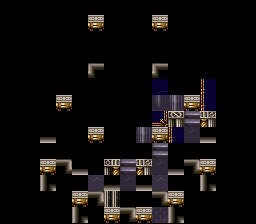
;.;
That said, for what it is, some maps are quite pretty. It's just a pity that they didn't bother making towns more interesting and varied places. At least the DS remake got that right (though again, it's more functional than fanciful.)

My take? Some things will only exist just to look pretty, and nothing else. There is nothing wrong with this.
You could say that fits the bill for most of Legend of Mana maps. But dear lord, did they add to the atmosphere and feel of the game!
Hoooo boy, you know what? This was actually brought up when I showed him some of my newest maps for Resonate and showed him one of the references -- a video of some Legend of Mana gameplay. He said that LoM did it differently because the player had the ability to """"interact"""" with the field. And he said RPGs don't do that. I got to play Lufia still but yeah! From what I've read / seen it's got some brilliant level design.
And while there's nothing wrong with maps just being pretty, this "just pretty" still often communicates (or should communicate) not only lore/plotwise to the player, but also about how they should feel / navigage the place. I mean, even colours must be taken into consideration.
Mechanically-wise I still think Valkyrie Profile 2 is one of the most engaging / well-crafted RPGs (at least in the field exploration sense)
I think he's diminishing the weight of the field due to RPGs being a considerably more complex genre than, say, your run off the mill platformer where touching a spike nets you a gameover screen.
There are so many subgenres that interact so differently with the map! Riviera, Azure Dreams, Valkyrie Profile, Lufia -- these titles look and play nothing alike despite all being... RPGs.
And while there's nothing wrong with maps just being pretty, this "just pretty" still often communicates (or should communicate) not only lore/plotwise to the player, but also about how they should feel / navigage the place. I mean, even colours must be taken into consideration.
Mechanically-wise I still think Valkyrie Profile 2 is one of the most engaging / well-crafted RPGs (at least in the field exploration sense)
I think he's diminishing the weight of the field due to RPGs being a considerably more complex genre than, say, your run off the mill platformer where touching a spike nets you a gameover screen.
There are so many subgenres that interact so differently with the map! Riviera, Azure Dreams, Valkyrie Profile, Lufia -- these titles look and play nothing alike despite all being... RPGs.

author=Joseph
That's obviously a typical vision of a person who doesn't like the genre (he clearly dislikes RPGs) and there instantly comes to me countless exceptions:
But it's true. I don't know why this viewpoint makes you angry as conceding to this viewpoint can make you a little more self aware when you make maps. You can easily figure out what's important to you and your game by realizing that.
I mean a lot of people talk about at length in making every single battle in their RPGs as strategic as possible when the reality is that a lot of classic RPGs didn't really have any hard designed battles. Most of the battles were just fodder for the sake of leveling up and getting strong. There's nothing wrong with that really, just that the style of RPGs were a little different back then. Just knowing that can make it easier to know what you really want to do.
Oh I'm not really angry, I'm just jokingly angry hahah but it probably doesn't look like it maybe i'm really angry but i don't think i am
but yeah I know, but the exceptions are so many that they aren't really exceptions, is there really a norm? Why do we all look up to Dragon Quest and state that as the default formula and everything that deviates from that as "non-standard" and "noveau"? I think that the RPG is a genre that's wide enough to make such a generalized statement untrue.
but yeah I know, but the exceptions are so many that they aren't really exceptions, is there really a norm? Why do we all look up to Dragon Quest and state that as the default formula and everything that deviates from that as "non-standard" and "noveau"? I think that the RPG is a genre that's wide enough to make such a generalized statement untrue.
You do seem angry, or at least very invested into the idea. Which, seeing as you love RPGs as a whole and are an artist at the same time and with the purpose (one of the many) to improve your games with it, this should be pretty natural.
And as it is, people not invested into the idea or genre tend to not want to see exceptional cases, nor do they have the indepth knowledge to give you a precise reason, other than their personal dislike.
Graphics are graphics. A map can help a lot, add a lot, but if someone cannot care about the possible additions it harbors, then that someone will not care about maps.
Simple as that.
And as it is, people not invested into the idea or genre tend to not want to see exceptional cases, nor do they have the indepth knowledge to give you a precise reason, other than their personal dislike.
Graphics are graphics. A map can help a lot, add a lot, but if someone cannot care about the possible additions it harbors, then that someone will not care about maps.
Simple as that.

I love RPGs, but I agree that many, many RPGs have maps that are only there to be pretty backdrops. This isn't only true of RPGs, though, obviously. Literally (almost literally, there are probably some exceptions) every modern FPS has a "skybox" surrounding its area, which is background detail that literally cannot be interacted with in any way; you have the core level, the borders of the level, and then the borders of the visual playing field. The skybox is only there to increase visual immersion, and some of them are barely noticed by the player. Stop and admire them for a moment, and you realize just how much detail has gone into graphics that have zero impact on the actual gameplay.
Is this a bad thing? Hells naw. Immersion is extremely important, especially in RPGs where you often have time to stop and smell the roses. I mean, look at the mapping Final Fantasy 6; almost none of it serves any really specific purpose (by which I mean map interaction is very low) but would I change it? Not for all the tactical RPGs in the world.
I don't know how well the Seiken Densetsu games hold up as an argument of clever map design, though. There are lots of areas that have enemies scattered at random in them, and not a huge number of locations where the monster placement is really tied to the map in any clever fashion. Secret of Evermore was a lot better about this, with enemies hiding in tactical locations or blocking chokepoints.
I disagree about Lufia 2 being ugly or even overly utilitarian! Sure, it's not one of the enduring masterpieces of visual map design, but for the most part they did a good job of mixing puzzles with scenery. Except in the towers. Those are mostly bland af
Is this a bad thing? Hells naw. Immersion is extremely important, especially in RPGs where you often have time to stop and smell the roses. I mean, look at the mapping Final Fantasy 6; almost none of it serves any really specific purpose (by which I mean map interaction is very low) but would I change it? Not for all the tactical RPGs in the world.
I don't know how well the Seiken Densetsu games hold up as an argument of clever map design, though. There are lots of areas that have enemies scattered at random in them, and not a huge number of locations where the monster placement is really tied to the map in any clever fashion. Secret of Evermore was a lot better about this, with enemies hiding in tactical locations or blocking chokepoints.
I disagree about Lufia 2 being ugly or even overly utilitarian! Sure, it's not one of the enduring masterpieces of visual map design, but for the most part they did a good job of mixing puzzles with scenery. Except in the towers. Those are mostly bland af

Like Lufia, Golden Sun always stuck with me as a JRPG with memorable level design. The dungeons and towns were mapped with psynergy puzzles in mind. Psynergy serves a toolkit for exploration and creates opportunities for unlocking new paths and backtracking once you've found the right spells. Usually each puzzle was small and easily solved, but they did create some interactivity and added more fun to exploration than just walking around.
About halfway through the Lily demo's dev, I realized that my maps were super boring to walk around. Each room contained an enemy, a treasure, or nothing (with a few exceptions for a shop and a Big Treasure room) and generally there was no real point to moving - I could've replicated the whole thing with a "Go Left / Go Right" text box. So, I added a few elements borrowed from some Zelda games to spice it up, like one-way paths, and overhanging ledges that would allow you to see a room before you entered, to see if it was a boss, shop, monster, etc. It wasn't perfect, but it definitely added a little more oomph to exploration.
For my current project, I've totally stripped out maps entirely. The focus of the game is JRPG boss fights, and I wanted to spend all my time and energy on making those as strong as possible. Exploration doesn't really fit this game! I'm sacrificing some of the world-building you can do easily with maps, but I'm also trying to save myself time. It's been tricky, but I think it works pretty well! I'm sure the opposite would be an interesting challenge too: an RPG with no fights, only about exploration.
About halfway through the Lily demo's dev, I realized that my maps were super boring to walk around. Each room contained an enemy, a treasure, or nothing (with a few exceptions for a shop and a Big Treasure room) and generally there was no real point to moving - I could've replicated the whole thing with a "Go Left / Go Right" text box. So, I added a few elements borrowed from some Zelda games to spice it up, like one-way paths, and overhanging ledges that would allow you to see a room before you entered, to see if it was a boss, shop, monster, etc. It wasn't perfect, but it definitely added a little more oomph to exploration.
For my current project, I've totally stripped out maps entirely. The focus of the game is JRPG boss fights, and I wanted to spend all my time and energy on making those as strong as possible. Exploration doesn't really fit this game! I'm sacrificing some of the world-building you can do easily with maps, but I'm also trying to save myself time. It's been tricky, but I think it works pretty well! I'm sure the opposite would be an interesting challenge too: an RPG with no fights, only about exploration.
author=Joseph
Why do we all look up to Dragon Quest and state that as the default formula and everything that deviates from that as "non-standard" and "noveau"?
Same reason why we use "RPG" to group several games together. It's just easier for clarity and communication.
Regarding random battles, the length between chest locations, save points and the boss/exit are the only thing that matters in regards to interactivity. Interestingly I find that on map enemy encounters make that less important if running away is not balanced properly. Choke points, backtrack loops, branches, open vs tight areas, don't really make that much of a difference other than how many times you have to wiggle the d-pad. In an FPS it could mean the disadvantages/advantages over your enemies very directly.
One idea is actually make a game where stepping on different types of tiles yields a lot of different results and you having to use items based on how they're configured to "brave" through them. Sorta like how pokemon has tall grass but much more advanced. That would look like a very ugly game though, like a fucked up chess board everywhere depending how strong the design is.

