



 Full Games List
 Featured Games
 New Games
 Reviews
 Media
Media Images
 Blogs
Blogs Game Updates
 Images Feedback Summary
 Game Design Highlights
 Tutorials
 Articles
 Scripts
 Utilities / Plugins
 Resources
 Engines
 Engine Bulletins
 What is Makerscore?
 Past Events
 Achievements
 Misaos
 Forums
 Post History
 Chat
Chat New to RMN?
 Full Store List
 RMN Music Pack (free)



DIFFERENT ELEMENTAL TYPES (THAN FIRE, ICE, ETC)
Posts
Pages:
1

 unity
unity View playlists
 Close
CloseI'm brainstorming for a modern game with psychic powers instead of magic, and that got me thinking: how often do people try to put in new elements in their game (instead of the traditional Fire, Ice/Water, Thunder, Dark, Holy etc)? I had the idea that since psychic powers are being used, I could come up with a whole new set of elements if I wanted, something like maybe:
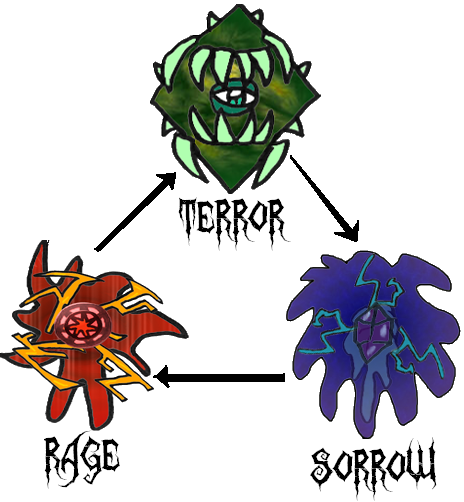
But if I did that, would it be confusing for the player? In normal RPGs, it's usually somewhat easy to guess what element to use on a lot of enemies. An ice person? Use fire. A fish? Use thunder. A darkness person? Use holy. But with new elements, how do you clue the player in on what element to use? Have the enemies color-coded? (This seems like it could work but maybe it's too easy?) Or perhaps have the enemies mostly use spells of what element they are? Or is it fair to just have the player have to use trial-and-error to find their weakness?
Thanks! ^_^
But if I did that, would it be confusing for the player? In normal RPGs, it's usually somewhat easy to guess what element to use on a lot of enemies. An ice person? Use fire. A fish? Use thunder. A darkness person? Use holy. But with new elements, how do you clue the player in on what element to use? Have the enemies color-coded? (This seems like it could work but maybe it's too easy?) Or perhaps have the enemies mostly use spells of what element they are? Or is it fair to just have the player have to use trial-and-error to find their weakness?
Thanks! ^_^

Most of the time, either elemental weaknesses feel like guesswork or they feel really obvious. Either you have to ping an enemy with every element to see what happens, or it's like, a fire lion, so you know it's weak to water.
If I was designing a classic RPG, I would probably make discovering weaknesses pretty easy. Most of the time the enemy will be facing the monster over and over again, and once they know the weakness, the monster will be a lot easier to defeat, so making them guess is kinda silly. If it's a boss, they can always save + reload once they know the weakness, too.
IMO, elements should have a little more flavor to them than just colors. You can add secondary effects like debuffs (Fire sets enemies on Fire, Terror attacks have a chance to Fear the enemy, ex.) and that adds another dimension to the elemental triangle that's pretty easy to pick up on, but gives you a lot of decision power in battle.
Anyway, since you're working with emotions - Rage, Sorrow, Terror - maybe some sort of dialogue would be the best way to hint at each monster's weakness? You could also just have unique visual cues - for example, a monster that trembles a lot would be weak to Terror, or something like that. It would still be pretty obvious to people who were paying attention, but it's at least slightly more subtle than color-coding. I don't know how well the "elemental triangle" would work in this case, though. "Rage beats Terror" doesn't seem like something I'd remember very easily :P
If I was designing a classic RPG, I would probably make discovering weaknesses pretty easy. Most of the time the enemy will be facing the monster over and over again, and once they know the weakness, the monster will be a lot easier to defeat, so making them guess is kinda silly. If it's a boss, they can always save + reload once they know the weakness, too.
IMO, elements should have a little more flavor to them than just colors. You can add secondary effects like debuffs (Fire sets enemies on Fire, Terror attacks have a chance to Fear the enemy, ex.) and that adds another dimension to the elemental triangle that's pretty easy to pick up on, but gives you a lot of decision power in battle.
Anyway, since you're working with emotions - Rage, Sorrow, Terror - maybe some sort of dialogue would be the best way to hint at each monster's weakness? You could also just have unique visual cues - for example, a monster that trembles a lot would be weak to Terror, or something like that. It would still be pretty obvious to people who were paying attention, but it's at least slightly more subtle than color-coding. I don't know how well the "elemental triangle" would work in this case, though. "Rage beats Terror" doesn't seem like something I'd remember very easily :P

Hmm, this is interesting. I'm gonna throw some ideas out there based on that image.
Since you have the psychic thing going on along with emotions, you can have the elements be dynamic. There could be a neutral element and using different psychic abilities will take a toll on their psychological state changing their element from Sorrow, Rage, Terror, etc. Someone with more Rage will be more of a threat to someone in Terror. You can also do typing advantage via weapons like Fire Emblem.
This may interest you: http://fireemblem.wikia.com/wiki/Weapon_Triangle
Sorry for the rambling. This piqued my interest haha
And btw don't get too overwhelmed about the player getting confused. As long as you pace everything nicely and are clear about the mechanics, they will eventually catch on. Good luck!
Since you have the psychic thing going on along with emotions, you can have the elements be dynamic. There could be a neutral element and using different psychic abilities will take a toll on their psychological state changing their element from Sorrow, Rage, Terror, etc. Someone with more Rage will be more of a threat to someone in Terror. You can also do typing advantage via weapons like Fire Emblem.
This may interest you: http://fireemblem.wikia.com/wiki/Weapon_Triangle
Sorry for the rambling. This piqued my interest haha
And btw don't get too overwhelmed about the player getting confused. As long as you pace everything nicely and are clear about the mechanics, they will eventually catch on. Good luck!
I think when dealing with elements in general, you should take a look back to their roots.
The Wu Xing is probably your best example, because if you look into it further, it's more than just a chart of generic elements, but each element carries additional meaning, to what animals belong to each element, to what organs represent the element, what kind of emotional concepts, etc. Tons of inspiration you can use for whatever game you make!
But on your custom elements, that's totally fine! I think for stuff that is a bit lesser known, however, you have to include some way to explain it.
Also I like Slash's post:
The Wu Xing is probably your best example, because if you look into it further, it's more than just a chart of generic elements, but each element carries additional meaning, to what animals belong to each element, to what organs represent the element, what kind of emotional concepts, etc. Tons of inspiration you can use for whatever game you make!
But on your custom elements, that's totally fine! I think for stuff that is a bit lesser known, however, you have to include some way to explain it.
Also I like Slash's post:
author=slash
IMO, elements should have a little more flavor to them than just colors. You can add secondary effects like debuffs (Fire sets enemies on Fire, Terror attacks have a chance to Fear the enemy, ex.) and that adds another dimension to the elemental triangle that's pretty easy to pick up on, but gives you a lot of decision power in battle.
Well, considering the things I occupy my real life time with, I'm actually pretty traditional when it comes to the elements. Realize that you don't have to use elements. Instead of the four elements, you could base your magic off of the four humors; blood (red)(hot)(sanguine), yellow bile (yellow)(hot)(choler), phlegm (green)(cold)(Phlegma), and black bile (black)(cold)(melancholic). But that might be still a little too close to elemental magic for your liking.
You can also base your magic on the Five Virtues or the Seven Deadly Sins (and come to think of it, spells based on avarice, envy, wrath, sloth, gluttony, lust, and pride would be pretty cool).
Remember, magic, at its core, is a philosophical science. If you want to build a new magical system, it would be best if you started by realizing that magic is a way of thinking and that Harry Potter is bullshit. You're talking about philosophical principals so base your magic on philosophical principles. Magic begins as a pattern thought. The notion of superpowers and mysteries (and those are really just procedures whose science is simply obscured and hidden so that the priest can claim that "god did it for me".) comes later and is a corruption of magic.
So, when you look for different powers as a starting point, you're doing it backwards. Look at the philosophical principles. Let's go ahead and look the Seven Sins. This is a philosophical concept. It is a teaching designed to help people live well. Then as the philosophy evolves over time, some people realize that they are able to take control of large groups simply because of belief. They can claim powers granted by following this philosophy.
So suppose there was a philosophy based upon following the Seven Sins? What powers could you claim Wrath gives you? Maybe you could take advantage of someone's Sloth to slow them down or put them to sleep. You could use Lust to confuse and fascinate enemies.
So develop your philosophy, and then base your system of magic off of that. This is why most games simply base their magic on an existing elemental system: it's the most recognizable with the clearest associations with the most concisely described effects. Most of the groundwork is already laid out for them so that they don't have to do any major thinking, and this is something you may want to think about before developing your own system of magic. You might be better off pouring through religious teachings and finding something you can fit a magic system to rather than trying to make one from scratch.
Now, since you're using psychic powers, your philosophy should reflect that. There are established psychic systems, but they merely reflect the classic elemental system. Remember your core philosophy is key. It will not only inform your system of magic, but it will also tie it together so that the player can understand it. That's why elements work so well: most people know the underlying philosophy and so nobody questions it beyond the basic "magic is fake" thoughts.
You can also base your magic on the Five Virtues or the Seven Deadly Sins (and come to think of it, spells based on avarice, envy, wrath, sloth, gluttony, lust, and pride would be pretty cool).
Remember, magic, at its core, is a philosophical science. If you want to build a new magical system, it would be best if you started by realizing that magic is a way of thinking and that Harry Potter is bullshit. You're talking about philosophical principals so base your magic on philosophical principles. Magic begins as a pattern thought. The notion of superpowers and mysteries (and those are really just procedures whose science is simply obscured and hidden so that the priest can claim that "god did it for me".) comes later and is a corruption of magic.
So, when you look for different powers as a starting point, you're doing it backwards. Look at the philosophical principles. Let's go ahead and look the Seven Sins. This is a philosophical concept. It is a teaching designed to help people live well. Then as the philosophy evolves over time, some people realize that they are able to take control of large groups simply because of belief. They can claim powers granted by following this philosophy.
So suppose there was a philosophy based upon following the Seven Sins? What powers could you claim Wrath gives you? Maybe you could take advantage of someone's Sloth to slow them down or put them to sleep. You could use Lust to confuse and fascinate enemies.
So develop your philosophy, and then base your system of magic off of that. This is why most games simply base their magic on an existing elemental system: it's the most recognizable with the clearest associations with the most concisely described effects. Most of the groundwork is already laid out for them so that they don't have to do any major thinking, and this is something you may want to think about before developing your own system of magic. You might be better off pouring through religious teachings and finding something you can fit a magic system to rather than trying to make one from scratch.
Now, since you're using psychic powers, your philosophy should reflect that. There are established psychic systems, but they merely reflect the classic elemental system. Remember your core philosophy is key. It will not only inform your system of magic, but it will also tie it together so that the player can understand it. That's why elements work so well: most people know the underlying philosophy and so nobody questions it beyond the basic "magic is fake" thoughts.

Yeah, I figure that using the traditional elements makes it easier for your player to guess what are strengths and weaknesses, since they already have some idea from pre-existing games and how these elements work in real life. Fire, ice, water, and grass moves are easier to visualize than attacks of terror, rage and sorrow. The imagery of water putting out a fire has been a common understanding of man for yonks. So when the player is confronted with a fire and tries to imagine "how do I defuse this situation?"... then they see a bucket of water, a solution pops off in their mind and they're gonna use it.
So that's my argument for traditional elements. My argument for non-traditional elements would be to catch the player off-guard and help them to understand a new way of battle... it could also feed into a kind of "alien" world where there's new rules, etc. Personally I'd opt for a combination of traditional and non-traditional elements, to give people a mixture of "hey I've seen this before, fire burns grass" and "wow, these elements are interesting... I wonder what happens if I use X on Y?"
So that's my argument for traditional elements. My argument for non-traditional elements would be to catch the player off-guard and help them to understand a new way of battle... it could also feed into a kind of "alien" world where there's new rules, etc. Personally I'd opt for a combination of traditional and non-traditional elements, to give people a mixture of "hey I've seen this before, fire burns grass" and "wow, these elements are interesting... I wonder what happens if I use X on Y?"
LockeZ

I'd really like to get rid of LockeZ. His play style is way too unpredictable. He's always like this too. If he ran a country, he'd just kill and imprison people at random until crime stopped.
5958
author=slash
If I was designing a classic RPG, I would probably make discovering weaknesses pretty easy. Most of the time the enemy will be facing the monster over and over again, and once they know the weakness, the monster will be a lot easier to defeat, so making them guess is kinda silly.
It's not completely silly. Getting better at the game does feel good, as a player. Getting rid of one aspect of the player's ability to get better at the game will annoy some players, as they will consider it dumbing down the game. And even among the players it doesn't annoy, they will miss out on the fun that comes from figuring stuff out.
Does that mean it's bad to make games with very obvious elemental triangles? No, of course not. Just that there's a small downside. If you're doing it, you should make sure that you feel like whatever benefit you're gaining makes up for that.
I have personally moved away from "this monster is weak to ICE DAMAGE and this other one is weak to LIGHTNING DAMAGE" and towards "this monster is neutralized by BEING KILLED FIRST and this other one is neutralized by AREA ATTACKS" because I think that's more interesting. However there's no real reason why that's any more interesting. The end result is honestly pretty similar. I just find it easier to add more depth to the battle this way. The types of combos and complexities I'm good at adding to combat are built around combining and countering those kinds of strategies instead of elemental strategies. But your mileage may vary.
author=LockeZ
I have personally moved away from "this monster is weak to ICE DAMAGE and this other one is weak to LIGHTNING DAMAGE" and towards "this monster is neutralized by BEING KILLED FIRST and this other one is neutralized by AREA ATTACKS" because I think that's more interesting. However there's no real reason why that's any more interesting. The end result is honestly pretty similar. I just find it easier to add more depth to the battle this way. The types of combos and complexities I'm good at adding to combat are built around combining and countering those kinds of strategies instead of elemental strategies. But your mileage may vary.
I agree, I prefer that sort of decision-making as well over elemental weaknesses. I think my reason is this: elemental weaknesses are almost always explicit, while general strategy is obscured and can only be inferred. Like I mentioned before, when dealing with elemental weaknesses, either the enemies have obvious visual traits (Fire Lion is weak to water) or you can Scan them, or you just ping them with every element you have available to see which does double damage (not too exciting, IMO). Meanwhile, there's a feeling of discovery and triumph for the player when they figure out that they should to use AoE on a boss that summons lots of weak adds, or to Stun a caster right before they finish winding up their big spell. It's never outright spoken, it's just implied, and there's more of a reward when the player figures that out.
Maybe it's just because I've played a lot of RPGs, however, and the discovery aspect of Water > Fire is not new to me in particular. I'm almost positive it was really exciting back when I played Pokemon Red the first time, and it's still pretty fun for people who are less experienced with the genre. It's definitely not a bad system, just a simple one. It is pretty impressive how enjoyable and deep elemental triangles can be, even with their simplicity.
WRT to Unity's system, assuming a slightly-more-experienced RPG player, there might be some fun in using the mental theme of your elemental system. Maybe there are monsters that you can provoke with dialogue in battle, for example, and afterwards they become temporarily susceptible to Rage attacks. Or, after you get an enemy past a certain HP %, their armor breaks and they become cowardly, making them weak to Terror. Using a certain item might remind an enemy of their horrible past, making them weak to Sorrow. With a little creativity you could probably come up with something that's a little more tricky than the normal element system, but deep and fulfilling. But, that'd probably be a lot bigger, scope-wise ;^^
Sooz

They told me I was mad when I said I was going to create a spidertable. Who’s laughing now!!!
5354
I've played plenty of games where the Elemental weakness isn't obvious, and it's not been a huge deal either way. It does feel rather nice to finally get that "HA! GOTCHA!" feeling when you guess the right weakness. :D

In my RPG, each character has next to a character role an element she's tied to. While equipment and attack items permit them to use other elements, their own elemental powers only encompasses one element (which also dictates innate resistances and weaknesses). So I can add enemies that matchup well/poorly against a particular element to encourage switching up parties. If you make elemental resistances/weaknesses important, make sure it takes more thought than just clicking whatever skill the enemy's weak to.
PS: There's some RPGs using partially/only wierd elements, like Kingdom of Loathing or OFF.
PS: There's some RPGs using partially/only wierd elements, like Kingdom of Loathing or OFF.
Corfaisus
"It's frustrating because - as much as Corf is otherwise an irredeemable person - his 2k/3 mapping is on point." ~ psy_wombats
7874
Oathguard did this and it was confusing and difficult as hell. That's why nobody played it.

there's a lot of interesting stuff to read here that i'll respond more in-depth to at work tomorrow (...lol) but my quick $0.02 is that:
>elements should be mechanically thematic
>elemental resistances/weaknesses should be fairly obvious (usually)
>the player should know when to not always hit with the weakness
for instance, if an enemy is weak to fire but it's a big brute and you really want to blind it, the game should not feel punishing for having you use the holy ability that blinds all foes. there's a lot that goes into that -- enemies being dangerous enough, having enough hp to withstand more than one hit to the weakpoint, etc -- but it can feel very rewarding when you successfully neuter an opponent and THEN get to blast away with your weakness-hitters.
this was basically the entire design of W&R and how it only had Phys/Solar/Lunar damage. it wasn't a triangle, it just was (especially since the narrative is primarily about dichotomy), and i think a lot of people unconciously grooved on weakness damage being more a convenient perk than "oops i need firaga over blizzaga"
this is also why the traditional black mage is boring as fuck lol. give those spells something to do besides "elemental lol" #dragonquestrules
edit: EXAMPLES


...so based on my screenshots i really like edna, but whatever, my points still stand
>elements should be mechanically thematic
>elemental resistances/weaknesses should be fairly obvious (usually)
>the player should know when to not always hit with the weakness
for instance, if an enemy is weak to fire but it's a big brute and you really want to blind it, the game should not feel punishing for having you use the holy ability that blinds all foes. there's a lot that goes into that -- enemies being dangerous enough, having enough hp to withstand more than one hit to the weakpoint, etc -- but it can feel very rewarding when you successfully neuter an opponent and THEN get to blast away with your weakness-hitters.
this was basically the entire design of W&R and how it only had Phys/Solar/Lunar damage. it wasn't a triangle, it just was (especially since the narrative is primarily about dichotomy), and i think a lot of people unconciously grooved on weakness damage being more a convenient perk than "oops i need firaga over blizzaga"
this is also why the traditional black mage is boring as fuck lol. give those spells something to do besides "elemental lol" #dragonquestrules
edit: EXAMPLES
...so based on my screenshots i really like edna, but whatever, my points still stand
Sooz
They told me I was mad when I said I was going to create a spidertable. Who’s laughing now!!!
5354
author=Corfaisus
Oathguard did this and it was confusing and difficult as hell. That's why nobody played it.
I dunno that one example works all that well, especially against some of the other examples cited above.

To the original post: If you're sticking with psychic powers, then the secondary effects mentioned above would be a great way to give the elements flavor, IE having terror have a chance to make enemies 'afraid' (lowering attack/defense perhaps), rage having a chance to berserk them, etc.
Obviously I don't know what sort of RPG you're going for here, if you do plan to have enemies be weak to one element or another, you need to set a baseline early on as to what clues indicate what they are associated with, and thus what they are weak/resistant to. Auras, general dispositions, etc, as long as you establish it, and then stay consistent, it should be fine. The only reason fire/ice/thunder/etc are considered 'normal' stuff to us is because tons of RPGs use them, and we have learned that baseline through numerous games. If you stuck a person who has never played an RPG before a game like that, they may not make the same conclusions (well, other than water working on fire, and fire working on ice, and stuff like that).
Another thing you could do is instead of weaknesses, focus on combinations. Perhaps using one element makes them weaker to another, and could be built up over time. In example, using sorrow over and over makes sorrow damage do less and less, but when you use terror after using sorrow for a long time, you get a massive damage boost. Obviously it would have to be worth it to ping them with weaker and weaker attacks, so for every 10% lost you get a bonus of 20% on the next terror attack, or something similar. Could also pin it to the status effects, reasoning that if a character is berserked, terror is a sudden mental shift that causes extreme damage, but removes the berserk effect.
Obviously I don't know what sort of RPG you're going for here, if you do plan to have enemies be weak to one element or another, you need to set a baseline early on as to what clues indicate what they are associated with, and thus what they are weak/resistant to. Auras, general dispositions, etc, as long as you establish it, and then stay consistent, it should be fine. The only reason fire/ice/thunder/etc are considered 'normal' stuff to us is because tons of RPGs use them, and we have learned that baseline through numerous games. If you stuck a person who has never played an RPG before a game like that, they may not make the same conclusions (well, other than water working on fire, and fire working on ice, and stuff like that).
Another thing you could do is instead of weaknesses, focus on combinations. Perhaps using one element makes them weaker to another, and could be built up over time. In example, using sorrow over and over makes sorrow damage do less and less, but when you use terror after using sorrow for a long time, you get a massive damage boost. Obviously it would have to be worth it to ping them with weaker and weaker attacks, so for every 10% lost you get a bonus of 20% on the next terror attack, or something similar. Could also pin it to the status effects, reasoning that if a character is berserked, terror is a sudden mental shift that causes extreme damage, but removes the berserk effect.
Thanks for all the responses, everyone! There's a ton of great advice in here!
I've been thinking on this over night, and I think I may have come up with a solution. Rather than have the player memorize a rock-paper-scissors weakness setup for new elements, instead I think it would be cool to have each element do extra damage to a different enemy "type." These types would be represented by icons, and each enemy would have their type icon shown in their name, like (Heavy Armor Icon) Crawler, (Spirit Icon) Phantom, etc.
This now means I need to figure out how to put icons in enemy names and in spell descriptions (so the player can easily match what skills will hurt what enemy). I may make a post in the Programming thread if I can't figure it out.
I'm going to be making use of a lot of the other advice, too, like making flavor status effects that match the element, and I'm going to try to tie decision-making into it too, like LockeZ, Slash, and Craze mentioned, where hitting the weakspot isn't always the priority. It'll be a good challenge for me, I think ^_^
Thanks again for all the great advice, and if anyone thinks of anything else, I'd love to hear it :DDDDDDDD
I've been thinking on this over night, and I think I may have come up with a solution. Rather than have the player memorize a rock-paper-scissors weakness setup for new elements, instead I think it would be cool to have each element do extra damage to a different enemy "type." These types would be represented by icons, and each enemy would have their type icon shown in their name, like (Heavy Armor Icon) Crawler, (Spirit Icon) Phantom, etc.
This now means I need to figure out how to put icons in enemy names and in spell descriptions (so the player can easily match what skills will hurt what enemy). I may make a post in the Programming thread if I can't figure it out.
I'm going to be making use of a lot of the other advice, too, like making flavor status effects that match the element, and I'm going to try to tie decision-making into it too, like LockeZ, Slash, and Craze mentioned, where hitting the weakspot isn't always the priority. It'll be a good challenge for me, I think ^_^
Thanks again for all the great advice, and if anyone thinks of anything else, I'd love to hear it :DDDDDDDD

@LockeZ: I'm not sure what you mean by "this monster is neutralized by BEING KILLED FIRST and this other one is neutralized by AREA ATTACKS". Do you mean that it's wise to kill enemy 1 because its the most threatening enemy in the troop and wise to kill enemy 2 if you're party has low HP (for example)? Or is there something I'm missing/don't understand here?
I made a small, but at the same time very big change to the elemental skills in my game. Fire now lowers an enemy's ATK and Ice lowers AGI. This is mostly the case for single target skills though. Some skills have other effects, like silencing, burning, freezing enemies etc.
There are also stronger version in the game, like Fire I-IV. However, all levels of those skills will remain useful throughout the entire game. This is mostly because stronger skills take longer to cast. Speed is can be very important when fighting faster enemies.
Just these few changes made the battles SO much more interesting, without making things too complicated. I've always enjoyed the "do much with little" approach.
That's some tips I have for you Uni, or anyone reading this. I think your custom states can help enhance the game to fit its theme/mood/story. They will give your game some identity, that's for sure.
Just make sure you explain the (new?) stuff in some form or another during the game. A simple skill description could be all you really need. Good luck.
I made a small, but at the same time very big change to the elemental skills in my game. Fire now lowers an enemy's ATK and Ice lowers AGI. This is mostly the case for single target skills though. Some skills have other effects, like silencing, burning, freezing enemies etc.
There are also stronger version in the game, like Fire I-IV. However, all levels of those skills will remain useful throughout the entire game. This is mostly because stronger skills take longer to cast. Speed is can be very important when fighting faster enemies.
Just these few changes made the battles SO much more interesting, without making things too complicated. I've always enjoyed the "do much with little" approach.
That's some tips I have for you Uni, or anyone reading this. I think your custom states can help enhance the game to fit its theme/mood/story. They will give your game some identity, that's for sure.
Just make sure you explain the (new?) stuff in some form or another during the game. A simple skill description could be all you really need. Good luck.
Pages:
1

