



 Full Games List
 Featured Games
 New Games
 Reviews
 Media
Media Images
 Blogs
Blogs Game Updates
 Images Feedback Summary
 Game Design Highlights
 Tutorials
 Articles
 Scripts
 Utilities / Plugins
 Resources
 Engines
 Engine Bulletins
 What is Makerscore?
 Past Events
 Achievements
 Misaos
 Forums
 Post History
 Chat
Chat New to RMN?
 Full Store List
 RMN Music Pack (free)



HORROR WITHOUT GORE AND GUTS?
Posts
 YDS
YDS View playlists
 Close
CloseI don't know anything about the horror genre, to be honest, though I am working on a horror game, as some of you know. I really wanted to avoid using BLOOD-GORE-AND-GUTS as a scare tactic and work on ways for the game to be "strange, creepy and bizarre" and hopefully "scary."
Again, I've never played horror games before so I was wondering if people could give me advice.
Again, I've never played horror games before so I was wondering if people could give me advice.


In my opinion, you shouldn't always consider blood and guts to always be associated with the Horror genre, it can even be used in comedy. I assume you're talking about Muse here, I've played the demo and the atmosphere is spot on and builds up perfectly (of what I can remember anyway). The thing is you've got a tough road ahead of you. Making a scary RM game isn't easy. My advice is to watch or play games like Clock Tower and Silent Hill, they both convey a scary and creepy atmosphere without the use of tons of blood.
Although, there's really a small limit to how scary a game can get.
Although, there's really a small limit to how scary a game can get.

You need to build tension in the player first and foremost. They need to be worried about something and the best way is to use the 'unknown.'
More specifically I'd suggest you find ways for the player to interact with the world and the world with the player that are unexpected at first, predictable but unsure after, and not unavoidable. Teach the player by shocking them with something once (a monster coming up through a grate in the floor, or the player falling through a weak floorboard into a totally dark area) and then use those things you taught them the same way through the game, but at unexpected place.
In the case of the grate example; have grates in many rooms and areas, but only make some of them actually do anything. The player will have learned "Monsters can appear from grates" and will be expecting it, so you need to lull them into a false sense of security again before using the same tactic.
Introduce mechanics one at a time, make sure it's obvious what's happening, but the first time should always be as unexpected as possible AFTER you've set up a tension in the room (haunting music, sounds, atmosphere, other game mechanics or mechanics like the grate, etc.)
You can then mix these mechanics together to make rooms dangerous and scary; there's some grates that look very obvious that detract their attention from a locker nearby that, when they get close enough (maybe by avoiding the grate,) something pops out or falls to the floor (non-gory dead body?)
Another thing is to use gameplay in a way that doesn't BREAK that immersion and tension. A suddenly battle screen transition and an easy turn-based battle will quickly give them confidence instead of caution and make the consequence of carelessness minimal and not as frightening.
Darkness and sound are powerful tools. Use very passive and quiet music when you want tension, change in music and suggestive sounds create immediate caution.
Create several levels of caution when you suggest something is about to happen; perhaps a very obvious dark spot, a locker nearby, and then a small puddle of water. They need to cross near the water and locker and through the dark area to get past, they're mostly likely to be concentrated on the darkness or the locker (depending on placement) and a watery arm coming from the puddle to grab their leg would be one of those "Darnit! I didn't see that coming!" moments that makes them jump and panic.
More specifically I'd suggest you find ways for the player to interact with the world and the world with the player that are unexpected at first, predictable but unsure after, and not unavoidable. Teach the player by shocking them with something once (a monster coming up through a grate in the floor, or the player falling through a weak floorboard into a totally dark area) and then use those things you taught them the same way through the game, but at unexpected place.
In the case of the grate example; have grates in many rooms and areas, but only make some of them actually do anything. The player will have learned "Monsters can appear from grates" and will be expecting it, so you need to lull them into a false sense of security again before using the same tactic.
Introduce mechanics one at a time, make sure it's obvious what's happening, but the first time should always be as unexpected as possible AFTER you've set up a tension in the room (haunting music, sounds, atmosphere, other game mechanics or mechanics like the grate, etc.)
You can then mix these mechanics together to make rooms dangerous and scary; there's some grates that look very obvious that detract their attention from a locker nearby that, when they get close enough (maybe by avoiding the grate,) something pops out or falls to the floor (non-gory dead body?)
Another thing is to use gameplay in a way that doesn't BREAK that immersion and tension. A suddenly battle screen transition and an easy turn-based battle will quickly give them confidence instead of caution and make the consequence of carelessness minimal and not as frightening.
Darkness and sound are powerful tools. Use very passive and quiet music when you want tension, change in music and suggestive sounds create immediate caution.
Create several levels of caution when you suggest something is about to happen; perhaps a very obvious dark spot, a locker nearby, and then a small puddle of water. They need to cross near the water and locker and through the dark area to get past, they're mostly likely to be concentrated on the darkness or the locker (depending on placement) and a watery arm coming from the puddle to grab their leg would be one of those "Darnit! I didn't see that coming!" moments that makes them jump and panic.

In horror the things I've always liked the most is stuff like messages from "the people from before". Diaries are a good example. I'm probably one of those few that really like all the build-up messages in the Resident Evils (and the obvious all-time favorite is the "itchy"-diary).
Having things that generally creep people out is a good idea too. Plingplong music (music box and carousel music), loudly ticking clocks. floorboard creaking. Hell even silence. Ghosts tend to be good too.
If you've played Vampire Bloodlines that game has a couple of places with freaky scary stuff that doesn't involve a lot of blood. It just has people appearing and disappearing in the distance. Newspaper clips. Things falling down suddenly and all that good stuff.
Of course in the end you'll have to have some sort of payoff to all the suspense. No point building up all that if it's for nothing, but again it doesn't have to be gory. It can be an exorcism of a ghost in a whirl of gratitude and old pains and all that good stuff.
Mysterious things happening is usually the best way to freak someone out. It can be as simple as walking down a corridor you've walked down plenty times and SUDDENLY A PAINTING IS GONE! (and it's hanging in a different room! And then the lights go out and you hear a crash and when you turn on the lights you see a pool of blood on the floor but you go and check it out and it is dried out blood that has been there for ages! Just take cues from the classic ghost stories :)
Having things that generally creep people out is a good idea too. Plingplong music (music box and carousel music), loudly ticking clocks. floorboard creaking. Hell even silence. Ghosts tend to be good too.
If you've played Vampire Bloodlines that game has a couple of places with freaky scary stuff that doesn't involve a lot of blood. It just has people appearing and disappearing in the distance. Newspaper clips. Things falling down suddenly and all that good stuff.
Of course in the end you'll have to have some sort of payoff to all the suspense. No point building up all that if it's for nothing, but again it doesn't have to be gory. It can be an exorcism of a ghost in a whirl of gratitude and old pains and all that good stuff.
Mysterious things happening is usually the best way to freak someone out. It can be as simple as walking down a corridor you've walked down plenty times and SUDDENLY A PAINTING IS GONE! (and it's hanging in a different room! And then the lights go out and you hear a crash and when you turn on the lights you see a pool of blood on the floor but you go and check it out and it is dried out blood that has been there for ages! Just take cues from the classic ghost stories :)

watch a couple of david lynch films, Mulholland Drive for that surrealistic tingle. Also, A tale of two sisters doesn't contain any real amount of blood or gore and it is pretty freaky.
Also, things that are cool is the "unnerving", semi-noticable scary things that happens in the background without any actual reaction from the characters (things that move almost unnoticable, even by the player, or stuff that seems really odd).
Also, games like 7th Guest were pretty strange and maybe in the direction you are aiming. I was FREAKED by this game when I was little.
Also, things that are cool is the "unnerving", semi-noticable scary things that happens in the background without any actual reaction from the characters (things that move almost unnoticable, even by the player, or stuff that seems really odd).
Also, games like 7th Guest were pretty strange and maybe in the direction you are aiming. I was FREAKED by this game when I was little.

YDS, Taut also has a nice atmosphere at the time you were in the mansion or police station. Maybe you can get some inspiration over there as well :)

I don't necessarily think that horror really needs to have either blood or monsters. It could just be the use of music and the environment to create tension and horror.
Subtle occurrences can create tension and horror. For example (combined with a quiet, subtle ambience, and a dark atmosphere), when moving near a table full of paint containers, one of them just falls off by itself and rolls under the player's foot. Upon entering the next area, the lights in the room turn out. Once the player moves onwards enough, the lights turn on and the player's image is painted on the wall in paint. This can create a 'creepy' atmosphere.
Sounds are especially effective when accompanied by a dark atmosphere and the right ambience. The proper use of sounds can allow for a tense atmosphere, or, could even tell the player 'when' to be scared. An example would be using a certain sound effect or occurrence whenever something scary is about to occur (e.g, in F.E.A.R, whenever a 'scare' is about to occur or is occurring, the player is accompanied by a radio transmission flicker, which is subtle, but basically tells you 'when' to be scared. Without the radio flicker, the game wouldn't be half as scary as it is. This is debatable, mind you.).
These are just some of the ways horror can occur without the use of blood or gore :).
Subtle occurrences can create tension and horror. For example (combined with a quiet, subtle ambience, and a dark atmosphere), when moving near a table full of paint containers, one of them just falls off by itself and rolls under the player's foot. Upon entering the next area, the lights in the room turn out. Once the player moves onwards enough, the lights turn on and the player's image is painted on the wall in paint. This can create a 'creepy' atmosphere.
Sounds are especially effective when accompanied by a dark atmosphere and the right ambience. The proper use of sounds can allow for a tense atmosphere, or, could even tell the player 'when' to be scared. An example would be using a certain sound effect or occurrence whenever something scary is about to occur (e.g, in F.E.A.R, whenever a 'scare' is about to occur or is occurring, the player is accompanied by a radio transmission flicker, which is subtle, but basically tells you 'when' to be scared. Without the radio flicker, the game wouldn't be half as scary as it is. This is debatable, mind you.).
These are just some of the ways horror can occur without the use of blood or gore :).

Horror can be everything without blood and guts. Tension and suspense should be your primary focus when making a horror game.
Blood and gore alone won't scare the player, but they could creep them out if done right.
Blood and gore alone won't scare the player, but they could creep them out if done right.

Personally, I regard horror games that rely on guts and gore to be scary as being pretty cheap and childish. Same with jump scares. Instead, I think you should rely more on creating a sense of creepiness.
Check out these links for good references:
http://www.dionaea-house.com/
http://www.angelfire.com/trek/caver/
http://en.wikipedia.org/wiki/Dyatlov_Pass_incident
http://en.wikipedia.org/wiki/Valentich_Disappearance
I've also been planning a (couple of) horror game(s) for some time now. If you're interested, I can help you with the storyline.
Check out these links for good references:
http://www.dionaea-house.com/
http://www.angelfire.com/trek/caver/
http://en.wikipedia.org/wiki/Dyatlov_Pass_incident
http://en.wikipedia.org/wiki/Valentich_Disappearance
I've also been planning a (couple of) horror game(s) for some time now. If you're interested, I can help you with the storyline.

Psychological horrors are always the best. To pull off a great horror game, you'll need to be a master of atmosphere. This does not mean make everything really dark and have a children's music box melody play throughout! (Though that works fine in small doses)
Large multiple headed enemies aren't required either. I'm most scared of an enemy of a threat I've yet to actually see, but have evidence of it's presence. Fast moving shadows, unusual noises, footsteps, these are all ways to indicate there is something nearby you should be scared of without showing you what the threat is.
What really gets me is when you leave a room, return to it later, and something has been moved. It also gets me when, say for example, a TV is displaying static or is completely turned off the first time you go through a room, but is on when you return.
Large multiple headed enemies aren't required either. I'm most scared of an enemy of a threat I've yet to actually see, but have evidence of it's presence. Fast moving shadows, unusual noises, footsteps, these are all ways to indicate there is something nearby you should be scared of without showing you what the threat is.
What really gets me is when you leave a room, return to it later, and something has been moved. It also gets me when, say for example, a TV is displaying static or is completely turned off the first time you go through a room, but is on when you return.

post=84554
http://www.dionaea-house.com/
Heh, this is my favorite.
This has great examples of psychological-type scares:
http://www.youtube.com/watch?v=eWz3Iox6Bh8
Yes, I know I'm a F.E.A.R. addict :)!
http://www.youtube.com/watch?v=eWz3Iox6Bh8
Yes, I know I'm a F.E.A.R. addict :)!

I'm probably one of those few that really like all the build-up messages in the Resident Evils (and the obvious all-time favorite is the "itchy"-diary).
And if you have even a MODICUM of writing ability, you can probably do MUCH better with this stuff than Resident Evil/Silent Hill did.
Hey, before I dive into Dionaea house (which incidentally I think would be 1000% more effective if I had clicked into it with at least the possibility in mind that it might be "real") is it an ARG or just an alternate format prose piece?
post=85876I'm probably one of those few that really like all the build-up messages in the Resident Evils (and the obvious all-time favorite is the "itchy"-diary).And if you have even a MODICUM of writing ability, you can probably do MUCH better with this stuff than Resident Evil/Silent Hill did.
But still the Itchy Tasty is the most awesome ever since you can both laugh at it because it's stupid and feel a bit uncomfortable because of what it's actually saying.
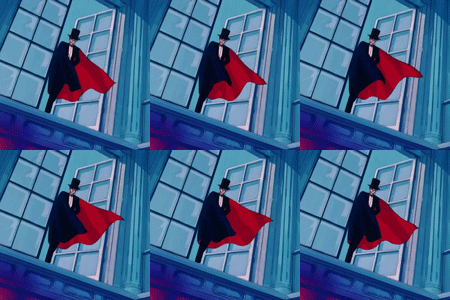
if you don't want blood and guts insanity is a great avenue to follow. see: much of the shining (though a lift full of blood does feature)

