



 Full Games List
 Featured Games
 New Games
 Reviews
 Media
Media Images
 Blogs
Blogs Game Updates
 Images Feedback Summary
 Game Design Highlights
 Tutorials
 Articles
 Scripts
 Utilities / Plugins
 Resources
 Engines
 Engine Bulletins
 What is Makerscore?
 Past Events
 Achievements
 Misaos
 Forums
 Post History
 Chat
Chat New to RMN?
 Full Store List
 RMN Music Pack (free)



ART OF THE PRETENTIOUS DEV: PART I - THE MEDIUM IS THE MESSAGE
Join me for a romp through the meta-design aspects of game development.
 NewBlack
- 05/01/2011 07:42 PM
- 1274 views
Hello fellow amateur game designers. I'm here today to talk about some things that you're probably all very well aware of on some level and possibly the things closest to our hearts as amateur game developers. Please me aware that most of this is pure conjecture and is probably of very little value other than to inspire some thought and to entertain. Don't worry though, there will be pictures.
Part I: The Medium is the Message.
"The medium is the message" is a phrase coined by Marshall McLuhan meaning that the form of a medium embeds itself in the message, creating a symbiotic relationship by which the medium influences how the message is perceived.
- From Wikipedia.
In this article I hope to expound on how this applies to game design and how we are all subject to this for-the-most-part-unwritten understanding whether we like it or not. On one hand, knowledge of this phenomena is responsible for self-aware game design, humor and the infamous fourth-wall break (and many other depth-enhancing things) and on the other hand anvilicious application of this principle leads to pretension, tiresome self-referentiality and a revoking of your "artistic licence".
So, getting down to brass tacks... How is the medium the message in game design?
Everything from the engine you use, the systems you have, your graphics, storyline and gameplay features to the platform the game is on are creating your game's narrative-as-experienced-by-the player together and should all be taken into account. The division between content and medium is illusory and I believe that treating them as separate entities leads to bad design choices.
The first and foremost obvious messages of the video-game medium would be "You are playing a game" and "You are here to be entertained" or pehaps even "You are being entertained!". These are very basic implicit messages inherent to the medium and essentially form the "box" that people refer to when they say "think outside the box". The box in game design is the sum total of the message of the video-game medium itself.
This can be seen as working on many levels at the same time. Take an RM game for example - There are various levels of this at work at any given time. The medium is a multi-layered phenomenon and carries an inherent message (and expectations) at each layer:
Example of an RM game's implicit messages, try to look at the immediate expectations that come to mind at each layer:
"This is an RPGMaker game"
"This is a PC game"
"This is an RPG"
"This is a video game"
"This is a game"
If you are following this abstract notion so-far then you'll no-doubt understand that each layer of "medium" creates the message through the unconscious expectations of the box it draws around your experience.
Simply put, the message in an rpg battle isn't "You are killing a monster" it is "you are killing a monster in an rpg-style battle in an amateur game for the PC".
Why is this in any way important or relevant?
I would argue that the sought-after elements of immersion and depth are created when a game designer can skillfully manipulate, subvert or utilize the message of the medium in order to make it work for you, rather than working against it as if it were a constraint. Of course the target audience plays a huge role in whether or not your creative vision strikes the right chords (and should be taken into account) but overall I think the outright ignorance of this phenomena is what leads to "bad games" that nobody would find appealing, immersive, atmospheric, engaging or any other coveted game-design adjective. Conversely I think that when a person can make each layer of "medium" work for them then they almost inevitably create something that is all of those things we love about a game.
I'll use a well-known, widely-respected, non-pretentious RM game as an example to show how this applies to us all and not just artsy decontrsuctionists:

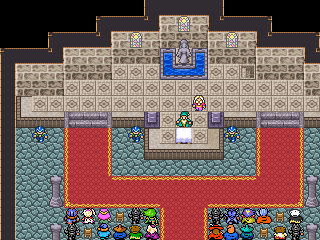
Hero's Realm is a game that knows what it is and is congruent with it on many levels. It knows it's a retro-style RPG. The gameplay, graphics, systems and storyline all point in the same direction. Each layer of the medium's message enhances the content's message. We can argue about personal differences in taste, style, theme etc. But I think most of us here would agree that it's a "good RM game" or just "it's a well-made game!" and that sense of quality is, at least it seems to me, achieved by the virtue of the medium's message enhancing the message of the content - creating a whole experience rather than something that feels cacophonous or disharmonious.
This does not mean that you have to use RPG Maker to make old-school RPGs in order to utilize the medium's message.. It's just a good example of how Kentona made the medium work with the content on many levels - creating a rich and whole gameplay experience.
In fact the very notion of making a retro-style rpg is in-itself an example of the medium's message being put to good use in service of the content. If it weren't then deliberately making something "old" would possibly have have much less entertainment value. Which leads on to...
Game-design innovation and originality are what happen when the expectations inherent in the medium are played with in some way.
Innovation and originality on their own are not necessarily "good", nor do they necessarily make for enjoyable experiences (this is very subjective and based on the player's tastes a lot also) but it is worth considering this when developing your ideas.
The two most common forms I've noticed of doing this in commercial and amateur games alike are:
1) Extend expectation toward logical conclusion.
2) Completely subvert, turn on it's head or undermine.
Both work and thinking about it now.. It's more of a spectrum between those two extremes in which most game design originality and/or innovation happens (especially in the amateur sphere, trying to make the best use of what you can do with your resources and current skill level) and in-fact I believe that they behave like two axes on a graph, one corresponding to the breadth of immersion of the gameplay experience and one corresponding to the depth of the immersion of the gameplay experience and they are mutually enhancing in most cases.
Remember in Metal Gear Solid 1 when you were asked to retrieve the codec frequency number from "the back of the box"? (incidentally I had a friend who tells me he spent hours trying to find a CD box in the game when the game actually meant the back of the box the game came in). It's a cheap-shot at creating immersion but it's a clever cheap shot nonetheless. The game, for a moment, stopped existing purely within the confines of it's medium and was brought into your physicality. An opposite example would be mods that exist for the game "Operation Flashpoint" that make the game super-hyper realistic to the point of war simulation rather than gameplay - Extending a facet of the medium to it's logical conclusion but without expanding outward from the confines of the medium.

There are probably hundreds and thousands of examples you could all come up with right now if you wanted to of the way the medium is used in a variety of ways to
enhance (or in examples of bad games; detract) the content and this operates to a certain degree within every aspect of game design. Clunky controls are bad, right? Well most Gears of War players would probably tell you that the clunkiness actually enhances the immersion of the game as you move your hulking armored character around the battlefield and couldn't imagine it any other way.
Cohesion vs. Featuritis.
To finish off this abstract ramble I thought I'd mention cohesion and what I'm gonna call "featuritis" - That is, the addition of countless features to a game to compensate for a lack of cohesive strength in the gameplay experience.
Put simply, you don't make a game better by adding more custom features unless they add to the cohesive experience in some way, on some level or you can work them into the game in way that the same effect is created. Obviously a lack of features isn't good... But if a game can give the player a cohesive experience then it will most likely be considered "a decent game" whereas a game that struggles to convey a cohesive experience will most likely be considered crap no matter how many custom features and fancy things it can do. This has been mentioned before by others but I thought I'd mention it here because it is relevant.
Cosplay Crisis by SorceressKyrsty has a materia system. It is an experience-enhancing feature because CC is essentially a hybrid FF/RE fangame heavily borrowing from FF7 as a core aspect of the experience it creates (amongst other games in the series). A generic VX RTP adventure which offers little in terms of immersive, cohesive gameplay experience may also use a materia system, but doing so only serves to make the medium work against the content and thus create a crappy game nobody wants to endure.
"Why?" is the best question you can ask yourself when implementing things into your game. If you can't come up with an experience-relevant reason "why" something should be in your game then it most likely is going to do nothing but detract from and overcomplicate the cohesive experience you're hoping to create. Yeah of course there is space for fun and games, minigames, side-quests and such.. But remember the Golden Saucer? How much more real did that make FF7's world feel? It was awesome! That's because those "pointless" minigames and features helped create a more cohesive and immersive experience rather than being tacked on as some compensatory structure for an otherwise weak game.
In short I would say that the aim is to build an experience that is greater than the sum of it's parts. Features alone are meaningless, everything is context-relative. The medium is the message.
That's all for now, I hope this has been entertaining and maybe a little food for thought :)
Footnote: I'm considering making a series of articles like this (as you probably guessed from the title!) but only if there's sufficient interest and people enjoy reading them for whatever reason. I'm not here to be preachy or tell people how to make their games (not at all!), just to give some abstracted meanderings on aspects of game design and the creative process.. So please comment if you read this and tell me what you think. I also would possibly be up for taking suggestions of things to cover.
Part I: The Medium is the Message.
"The medium is the message" is a phrase coined by Marshall McLuhan meaning that the form of a medium embeds itself in the message, creating a symbiotic relationship by which the medium influences how the message is perceived.
- From Wikipedia.
In this article I hope to expound on how this applies to game design and how we are all subject to this for-the-most-part-unwritten understanding whether we like it or not. On one hand, knowledge of this phenomena is responsible for self-aware game design, humor and the infamous fourth-wall break (and many other depth-enhancing things) and on the other hand anvilicious application of this principle leads to pretension, tiresome self-referentiality and a revoking of your "artistic licence".
So, getting down to brass tacks... How is the medium the message in game design?
Everything from the engine you use, the systems you have, your graphics, storyline and gameplay features to the platform the game is on are creating your game's narrative-as-experienced-by-the player together and should all be taken into account. The division between content and medium is illusory and I believe that treating them as separate entities leads to bad design choices.
The first and foremost obvious messages of the video-game medium would be "You are playing a game" and "You are here to be entertained" or pehaps even "You are being entertained!". These are very basic implicit messages inherent to the medium and essentially form the "box" that people refer to when they say "think outside the box". The box in game design is the sum total of the message of the video-game medium itself.
This can be seen as working on many levels at the same time. Take an RM game for example - There are various levels of this at work at any given time. The medium is a multi-layered phenomenon and carries an inherent message (and expectations) at each layer:
Example of an RM game's implicit messages, try to look at the immediate expectations that come to mind at each layer:
"This is an RPGMaker game"
"This is a PC game"
"This is an RPG"
"This is a video game"
"This is a game"
If you are following this abstract notion so-far then you'll no-doubt understand that each layer of "medium" creates the message through the unconscious expectations of the box it draws around your experience.
Simply put, the message in an rpg battle isn't "You are killing a monster" it is "you are killing a monster in an rpg-style battle in an amateur game for the PC".
Why is this in any way important or relevant?
I would argue that the sought-after elements of immersion and depth are created when a game designer can skillfully manipulate, subvert or utilize the message of the medium in order to make it work for you, rather than working against it as if it were a constraint. Of course the target audience plays a huge role in whether or not your creative vision strikes the right chords (and should be taken into account) but overall I think the outright ignorance of this phenomena is what leads to "bad games" that nobody would find appealing, immersive, atmospheric, engaging or any other coveted game-design adjective. Conversely I think that when a person can make each layer of "medium" work for them then they almost inevitably create something that is all of those things we love about a game.
I'll use a well-known, widely-respected, non-pretentious RM game as an example to show how this applies to us all and not just artsy decontrsuctionists:
Hero's Realm is a game that knows what it is and is congruent with it on many levels. It knows it's a retro-style RPG. The gameplay, graphics, systems and storyline all point in the same direction. Each layer of the medium's message enhances the content's message. We can argue about personal differences in taste, style, theme etc. But I think most of us here would agree that it's a "good RM game" or just "it's a well-made game!" and that sense of quality is, at least it seems to me, achieved by the virtue of the medium's message enhancing the message of the content - creating a whole experience rather than something that feels cacophonous or disharmonious.
This does not mean that you have to use RPG Maker to make old-school RPGs in order to utilize the medium's message.. It's just a good example of how Kentona made the medium work with the content on many levels - creating a rich and whole gameplay experience.
In fact the very notion of making a retro-style rpg is in-itself an example of the medium's message being put to good use in service of the content. If it weren't then deliberately making something "old" would possibly have have much less entertainment value. Which leads on to...
Game-design innovation and originality are what happen when the expectations inherent in the medium are played with in some way.
Innovation and originality on their own are not necessarily "good", nor do they necessarily make for enjoyable experiences (this is very subjective and based on the player's tastes a lot also) but it is worth considering this when developing your ideas.
The two most common forms I've noticed of doing this in commercial and amateur games alike are:
1) Extend expectation toward logical conclusion.
2) Completely subvert, turn on it's head or undermine.
Both work and thinking about it now.. It's more of a spectrum between those two extremes in which most game design originality and/or innovation happens (especially in the amateur sphere, trying to make the best use of what you can do with your resources and current skill level) and in-fact I believe that they behave like two axes on a graph, one corresponding to the breadth of immersion of the gameplay experience and one corresponding to the depth of the immersion of the gameplay experience and they are mutually enhancing in most cases.
Remember in Metal Gear Solid 1 when you were asked to retrieve the codec frequency number from "the back of the box"? (incidentally I had a friend who tells me he spent hours trying to find a CD box in the game when the game actually meant the back of the box the game came in). It's a cheap-shot at creating immersion but it's a clever cheap shot nonetheless. The game, for a moment, stopped existing purely within the confines of it's medium and was brought into your physicality. An opposite example would be mods that exist for the game "Operation Flashpoint" that make the game super-hyper realistic to the point of war simulation rather than gameplay - Extending a facet of the medium to it's logical conclusion but without expanding outward from the confines of the medium.
There are probably hundreds and thousands of examples you could all come up with right now if you wanted to of the way the medium is used in a variety of ways to
enhance (or in examples of bad games; detract) the content and this operates to a certain degree within every aspect of game design. Clunky controls are bad, right? Well most Gears of War players would probably tell you that the clunkiness actually enhances the immersion of the game as you move your hulking armored character around the battlefield and couldn't imagine it any other way.
Cohesion vs. Featuritis.
To finish off this abstract ramble I thought I'd mention cohesion and what I'm gonna call "featuritis" - That is, the addition of countless features to a game to compensate for a lack of cohesive strength in the gameplay experience.
Put simply, you don't make a game better by adding more custom features unless they add to the cohesive experience in some way, on some level or you can work them into the game in way that the same effect is created. Obviously a lack of features isn't good... But if a game can give the player a cohesive experience then it will most likely be considered "a decent game" whereas a game that struggles to convey a cohesive experience will most likely be considered crap no matter how many custom features and fancy things it can do. This has been mentioned before by others but I thought I'd mention it here because it is relevant.
Cosplay Crisis by SorceressKyrsty has a materia system. It is an experience-enhancing feature because CC is essentially a hybrid FF/RE fangame heavily borrowing from FF7 as a core aspect of the experience it creates (amongst other games in the series). A generic VX RTP adventure which offers little in terms of immersive, cohesive gameplay experience may also use a materia system, but doing so only serves to make the medium work against the content and thus create a crappy game nobody wants to endure.
"Why?" is the best question you can ask yourself when implementing things into your game. If you can't come up with an experience-relevant reason "why" something should be in your game then it most likely is going to do nothing but detract from and overcomplicate the cohesive experience you're hoping to create. Yeah of course there is space for fun and games, minigames, side-quests and such.. But remember the Golden Saucer? How much more real did that make FF7's world feel? It was awesome! That's because those "pointless" minigames and features helped create a more cohesive and immersive experience rather than being tacked on as some compensatory structure for an otherwise weak game.
In short I would say that the aim is to build an experience that is greater than the sum of it's parts. Features alone are meaningless, everything is context-relative. The medium is the message.
That's all for now, I hope this has been entertaining and maybe a little food for thought :)
Footnote: I'm considering making a series of articles like this (as you probably guessed from the title!) but only if there's sufficient interest and people enjoy reading them for whatever reason. I'm not here to be preachy or tell people how to make their games (not at all!), just to give some abstracted meanderings on aspects of game design and the creative process.. So please comment if you read this and tell me what you think. I also would possibly be up for taking suggestions of things to cover.

