



 Full Games List
 Featured Games
 New Games
 Reviews
 Media
Media Images
 Blogs
Blogs Game Updates
 Images Feedback Summary
 Game Design Highlights
 Tutorials
 Articles
 Scripts
 Utilities / Plugins
 Resources
 Engines
 Engine Bulletins
 What is Makerscore?
 Past Events
 Achievements
 Misaos
 Forums
 Post History
 Chat
Chat New to RMN?
 Full Store List
 RMN Music Pack (free)



HOW IMPORTANT ARE EXTRA PLAYABLE CHARACTERS?
Posts
Pages:
1

 matthewac95
 View playlists
 Close
CloseThere are a lot of RPGs that offer more characters than are possible for you to play with all at once. This often leaves the player with an option to pick and choose which characters they like the best and want to make a party with.
Now I'm not about to reject this design choice, I actually enjoy it very much. I feel as though it gives the player more room to be creative with my game and more opportunities for them to become attached to the characters in the game. I've also enjoyed this when it's done in other games, i.e. Chrono Trigger, Pokemon, Romancing SaGa, Final Fantasy, etc. There's no need to pigeon-hole the player in to playing with one set of people when you can design more people to let the player express themselves more freely.
However, and this may just be my perception, it seems to me as though if you want to make a game (in particular a game with a battle system that involves more than just one or two characters), and you want it to be good, you can't just design enough characters for there to be one possible party; in other words, it seems to me that extra playable characters are kind of necessary in order for people to take your game seriously. That or something like in Final Fantasy V where your 4 party members can take on the abilities of several different ones at the same time.
What do you guys think? How important is it to you to have more than one kind of party available to play with? When, if at all, is it necessary to have more than the maximum number of party members?
Now I'm not about to reject this design choice, I actually enjoy it very much. I feel as though it gives the player more room to be creative with my game and more opportunities for them to become attached to the characters in the game. I've also enjoyed this when it's done in other games, i.e. Chrono Trigger, Pokemon, Romancing SaGa, Final Fantasy, etc. There's no need to pigeon-hole the player in to playing with one set of people when you can design more people to let the player express themselves more freely.
However, and this may just be my perception, it seems to me as though if you want to make a game (in particular a game with a battle system that involves more than just one or two characters), and you want it to be good, you can't just design enough characters for there to be one possible party; in other words, it seems to me that extra playable characters are kind of necessary in order for people to take your game seriously. That or something like in Final Fantasy V where your 4 party members can take on the abilities of several different ones at the same time.
What do you guys think? How important is it to you to have more than one kind of party available to play with? When, if at all, is it necessary to have more than the maximum number of party members?
LockeZ

I'd really like to get rid of LockeZ. His play style is way too unpredictable. He's always like this too. If he ran a country, he'd just kill and imprison people at random until crime stopped.
5958
Letting the player change characters is functionally almost identical to letting them change classes - the only difference being that you can't have two of the same thing in your party.
Really it mostly depends on the needs of your narrative. Any gameplay system you were going to use in one, you can *probably* adapt to work just fine in the other.
Now, there are some things that make more sense in one system than the other. One example is that you might want to have temporary gameplay options available, or remove gameplay options temporarily, or force the player to use a certain option, for a dungeon or two. Temporarily adding/removing/forcing a party member is an easy and straightforward way to do this. But in a game with classes, you could totally give the party a crystal that allows use of a temporary class but gets stolen at the end of the dungeon, or make a temple that's been magically sealed to not allow cleric powers to work, or design a dungeon full of traps that requires a thief to enter. You can make it work.
If you want a very specific experience in each dungeon, like FF4 or FF9, where each dungeon has a specific team the player has to use, it's certainly easier to justify that with a bunch of party members than with a bunch of classes. I'm not sure how exactly you could do that with classes without just being super awkward. However, this situation isn't really quite the same as either of the options being asked about in the OP - it's a third style.
Really it mostly depends on the needs of your narrative. Any gameplay system you were going to use in one, you can *probably* adapt to work just fine in the other.
Now, there are some things that make more sense in one system than the other. One example is that you might want to have temporary gameplay options available, or remove gameplay options temporarily, or force the player to use a certain option, for a dungeon or two. Temporarily adding/removing/forcing a party member is an easy and straightforward way to do this. But in a game with classes, you could totally give the party a crystal that allows use of a temporary class but gets stolen at the end of the dungeon, or make a temple that's been magically sealed to not allow cleric powers to work, or design a dungeon full of traps that requires a thief to enter. You can make it work.
If you want a very specific experience in each dungeon, like FF4 or FF9, where each dungeon has a specific team the player has to use, it's certainly easier to justify that with a bunch of party members than with a bunch of classes. I'm not sure how exactly you could do that with classes without just being super awkward. However, this situation isn't really quite the same as either of the options being asked about in the OP - it's a third style.

As long as they fit into the story, and get EXP even when not in use, it's okay. An even bigger plus is when they can be swapped during battle, or when you have a game that allows them all to play in battle at once.

Personally I also like the idea of more characters than just what you can fit in a single party as long as the new ones are decently interesting. It's especially great when one of the characters is annoying, ugh.
Making the minimum number of party members seems okay for shorter games or long games where each person has charisma and a ton of development, but for other long games with less focus on individuals, having many members seems better. One of the most exciting things in rpg/action games (for me at least) is meeting new companions and learning about them, so it's tiring to lug around the same superficial and uninteresting knuckleheads for the entire game. Even just temporary party members can add a nice kick.
Really, I prefer quality>quantity for story-focused games. Better to develop a few good characters than to throw in new people who don't contribute anything important and who're just as flat... In other words, the royal ensemble cf Golden Sun 3. >_> But if the individual characters don't matter at all to the plot (having no personality) and if the game has a greater focus on the world/gameplay, might as well have a whole ton to pick and choose from.
LockeZ makes a good point, anyhow, about how it depends on the narrative.
Making the minimum number of party members seems okay for shorter games or long games where each person has charisma and a ton of development, but for other long games with less focus on individuals, having many members seems better. One of the most exciting things in rpg/action games (for me at least) is meeting new companions and learning about them, so it's tiring to lug around the same superficial and uninteresting knuckleheads for the entire game. Even just temporary party members can add a nice kick.
Really, I prefer quality>quantity for story-focused games. Better to develop a few good characters than to throw in new people who don't contribute anything important and who're just as flat... In other words, the royal ensemble cf Golden Sun 3. >_> But if the individual characters don't matter at all to the plot (having no personality) and if the game has a greater focus on the world/gameplay, might as well have a whole ton to pick and choose from.
LockeZ makes a good point, anyhow, about how it depends on the narrative.
LockeZ
I'd really like to get rid of LockeZ. His play style is way too unpredictable. He's always like this too. If he ran a country, he'd just kill and imprison people at random until crime stopped.
5958
Having more protagonists in your game doesn't actually require them to be playable characters. In fact, realistically, it makes more sense that not every single person who's important to the story is a good enough fighter to take on dragons and fire elementals and armies of soldiers.
Diablo 3 is an example of a game that has a bunch of characters who join your little brigade, but most of them don't follow you into battle. The game relies on letting you choose a class for your main character and heavily customize your skills and talents. And then you can choose one of three party members to follow you. But the other characters pretty much just stay at your camp most of the time. Some of them help you with crafting, and others just provide dialogue. Sometimes one of them will follow you around in dungeons without fighting (or they'll fight very very poorly, but are invincible), so that they can take part in cut scenes that take place in dangerous locations.
Letting the player have some control over customizing the way their party plays is important to many players. They want to be able to figure out strategies that work well and build a team accordingly. In an RPG you almost always need to somehow let them do this, but there are a lot of ways to do so. Having each new gameplay option be linked to a new person with a speaking role isn't necessary. It might be a good idea for your game, but it might not.
Diablo 3 is an example of a game that has a bunch of characters who join your little brigade, but most of them don't follow you into battle. The game relies on letting you choose a class for your main character and heavily customize your skills and talents. And then you can choose one of three party members to follow you. But the other characters pretty much just stay at your camp most of the time. Some of them help you with crafting, and others just provide dialogue. Sometimes one of them will follow you around in dungeons without fighting (or they'll fight very very poorly, but are invincible), so that they can take part in cut scenes that take place in dangerous locations.
Letting the player have some control over customizing the way their party plays is important to many players. They want to be able to figure out strategies that work well and build a team accordingly. In an RPG you almost always need to somehow let them do this, but there are a lot of ways to do so. Having each new gameplay option be linked to a new person with a speaking role isn't necessary. It might be a good idea for your game, but it might not.

I feel that more characters is better as long as they exist outside of battles. Games like Fire Emblem can ignore this rule, due to the style of the game, and the presence of Perma-Death in most of them. The extra characters also need to be useful. If you give me a character whose abilities or fighting style aren't practical, and they don't have any development beyond joining the party (all the Demon Lords in the first Disgaea game), then you're just wasting my time. On the other hand, if every character is usable and has development outside of battle, such as what was done with the Mana Khemia series, then the extra characters are great.

I like whatever works with the story. I mean, if you're fighting a war and have to recruit soldiers/allies to help, it makes sense that at least some of those will fight with you, yes? (Suikoden)
Then you have the 'prophecy' kids who are the only ones who can do what need to be done to save the world. Those 4 people who cannot be joined by others because those others cannot do what needs to be done. (FF1)
Of course there's the swap n swip version where you change characters through the story while trying to find the end group - basically starting with some characters and losing some along the way who are later replaced with others. (Lufia II)
And then there's the 'only three/two/one'-necessary party. These tend to be more character-focussed but they play well too. (Secret of Mana/Terranigma)
As long as they fit, IDGAF.
Then you have the 'prophecy' kids who are the only ones who can do what need to be done to save the world. Those 4 people who cannot be joined by others because those others cannot do what needs to be done. (FF1)
Of course there's the swap n swip version where you change characters through the story while trying to find the end group - basically starting with some characters and losing some along the way who are later replaced with others. (Lufia II)
And then there's the 'only three/two/one'-necessary party. These tend to be more character-focussed but they play well too. (Secret of Mana/Terranigma)
As long as they fit, IDGAF.

What Liberty Said. I'd like to add that it's usually better to base the narrative on the game and not the other way around. If you want 108 characters, a war story is a good way to go, if you only want only one character, write a story that requires only that character.

author=LockeZ
Having more protagonists in your game doesn't actually require them to be playable characters. In fact, realistically, it makes more sense that not every single person who's important to the story is a good enough fighter to take on dragons and fire elementals and armies of soldiers.
Really, this is something I'd like to see more of in video games. Too often, practically everyone who accomplishes anything important, does so by fighting. I'd like to see more games which feature important members of the protagonist team with roles other than killing stuff.
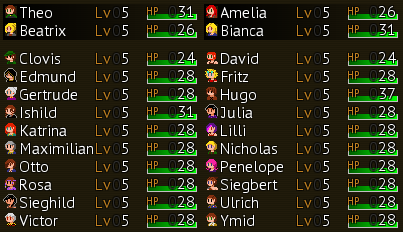
I think we know where I stand right now.

As long as there aren't more characters than I care about, I like it.
The Tales series does a pretty good job of giving ~6-8 characters that are all very developed and have interactions that further development even more. I might not use every char, but I can at least be glad they exist.
I do not like the 'deluge of characters' style where, even if everyone had been interesting, there wasn't enough time in the game to get to know them. A single bland character can ruin a cast.
The Tales series does a pretty good job of giving ~6-8 characters that are all very developed and have interactions that further development even more. I might not use every char, but I can at least be glad they exist.
I do not like the 'deluge of characters' style where, even if everyone had been interesting, there wasn't enough time in the game to get to know them. A single bland character can ruin a cast.
I think very large casts can be really fun when done well. The Suikoden games, for instance, have huge casts of protagonists, where not all of them may have the time to be developed much, but some of them are, many of them have their own subplots you can pursue at your discretion, and they're rarely dull.
On the other hand, you have games like Chrono Cross, where most members, once joining your party, basically cease to be characters, and don't even get any more unique dialogue, just pieces of shared dialogue passed through an idiolect filter.
On the other hand, you have games like Chrono Cross, where most members, once joining your party, basically cease to be characters, and don't even get any more unique dialogue, just pieces of shared dialogue passed through an idiolect filter.
Eh, I should mention that a Fire Emblem style large cast is ok with me. Everyone gets a bit of development and I can pick and choose who I want to see more of. The important thing is that each character is fully built, so if I wanted to get to know them, I could.
I haven't played Suikoden, but from what you've said, it's similar to that?
I haven't played Suikoden, but from what you've said, it's similar to that?
Kind of? There's a lot more gameplay out of combat in the Suikoden games than the Fire Emblem games, and a lot of recruitable characters serve functions other than battle roles, as well as simply livening up the home base with their presence. But they're similar in broad strokes.
Gotta love that they give lines in most important events to the extra characters. Since in Suikoden (bar fucking four which can go die in a fire, thanks) you can have 6 characters in your party at a time, there's a lot of combinations with what people can say when stuff happens. Sometimes they'll force you to take people with you. Even then, not all characters can be taken around - some just hang out in your castle (having a place really helps actually - CC didn't have a home base (as far as I recall) where you could interact with the masses, and building up said home base is a big part of Suikoden games) can lead to a lot of interaction, especially with people who have actual jobs like shop keepers, guards, chefs (dat cooking game~<3 II was the best), bath house attendants and the like.
...I like Suikoden, okay?
...I like Suikoden, okay?

I actually LIKE it when there are NO extra characters. I really hate having to decide which one to take into my main group.
I like it when the story is designed so that you never exceed the maximum party limit. There can be more characters, but someone leaves before a new one joins. I really liked the first half of FFVI because of that for example. You never have more than 4 characters in your group at once. The moment there are more something happens and you get split up.
I like it when the story is designed so that you never exceed the maximum party limit. There can be more characters, but someone leaves before a new one joins. I really liked the first half of FFVI because of that for example. You never have more than 4 characters in your group at once. The moment there are more something happens and you get split up.

author=RyaReisender
I actually LIKE it when there are NO extra characters. I really hate having to decide which one to take into my main group.
Oh yes. Though I enjoy extra characters a lot (since I can then pick and choose the ones I like and have them with me) I rarely have encountered a game where it hasn't also frustrated me since the available characters I want in my party are more than the party limit. In the end I always feel bad because I leave characters out and often I also stick with the same guys throughout.
For example Mass Effect is brimming with awesome characters but you can only have two with you on a mission and it always feels a bit bad to have some of the awesome characters on a mission and not others. I mean sure, one or two of the Mass Effect's characters are horrible and I'd never want them on my team but that's one or two.
Of course I guess there are worse problems than having too many good characters in a game...
I'm not sure having extra characters is important even if they aren't very customizable. I've found that in situations such as these, I often stick to a certain setup of characters. If I do switch around characters, it's usually because I find more characters appealing as characters than what fits the active party slots. I rarely switch around characters because of gameplay reasons.
I may be the minority of course, but I suspect not. I have noticed from several forums that sticking to one set of characters is a common approach.
I may be the minority of course, but I suspect not. I have noticed from several forums that sticking to one set of characters is a common approach.
No one's mentioned the SaGa series yet... ...which is an open book as far as player characters are concerned. The character development is left near-entirely up to the player.
It depends on what you want and who you want your audience to be.
It depends on what you want and who you want your audience to be.
In pretty much all SaGa games you are fine with never switching out characters and just stick with the first 5 you found. As every character can become anything, it's just about which ones you think look best.
The only game I found myself switching characters out of gameplay reason was Child of Light and that's only because there are only 2 character slots in the active party and you sometimes need magical attacks and sometimes physical attacks and you can just switch them in battle without even losing a turn.
The only game I found myself switching characters out of gameplay reason was Child of Light and that's only because there are only 2 character slots in the active party and you sometimes need magical attacks and sometimes physical attacks and you can just switch them in battle without even losing a turn.
Pages:
1

