

 Full Games List
 Featured Games
 New Games
 Reviews
 Media
Media Images
 Blogs
Blogs Game Updates
 Images Feedback Summary
 Game Design Highlights
 Tutorials
 Articles
 Scripts
 Utilities / Plugins
 Resources
 Engines
 Engine Bulletins
 What is Makerscore?
 Past Events
 Achievements
 Misaos
 Forums
 Post History
 Chat
Chat New to RMN?
 Full Store List
 RMN Music Pack (free)



WHAT GAMEPLAY DOES ACCURACY AND EVASION PROVIDE?
Posts

 LouisCyphre
 View playlists
 Close
CloseThis is something I haven't given a lot of thought of until recently. It's easier to dodge the question and just scrap evasion as a mechanic, but what can be gained from including it in your game?
Rambling:
To take the idea from the top, accuracy and evasion in RPGs has its roots in tabletop wargames like Chainmail, where players would roll dice to determine the success or failure of an attack performed by their units. In the context of personal gaming, randomness is looked upon less disapprovingly--sometimes even favorably--by the player in question, as the results "belong" more to the player who rolled the die. Often, there's a sense of ownership for a player over their strong or poor die rolls. Randomness was a positive gameplay element for two kinds of tabletop gamers. For the realism purist, randomness reflected the uncertainty of combat and created legitimate tension in the scenario at hand. For the stats analyst, actions whose outcomes were random presented a dilemma of risk and reward to the player.
Conversely, the reaction to RNG in many video gaming circles is largely negative. Players assign ownership of the die rolls to the game itself, insisting that the game is "cheating" when a character goes down to a critical hit, or when their attack fails arbitrarily. This has prompted many games to adopt various forms of "smart RNG," such as succeeding a 50%-effective action every other attempt as opposed to actually randomizing success, or simply adjusting the success rate until the player eventually succeeds. However, in the context of video games, well-done and clearly explained RNG can give the player that same powerful feeling of tension and risk found in tabletop randomness. It is unfun for all of a player's actions to fail randomly, but giving the player both accurate and inaccurate actions with appropriately powered rewards can create compelling decisions to make.
The point:
This brings me to the idea that accuracy and evasion, as a mechanic, has some level of inherent legitimacy in gaming. The phrase "risk versus reward" is mentioned at least once a week on this board alone! But what meaningful gameplay can we actually derive from accuracy?
There's no shortage of games where the mechanic is handled poorly. One the one hand, games biased towards evasion are frustrating by nature. Games on this side of the line may have some chance for any action to fail, regardless of circumstances. They might simply offer no counterplay to high-evasion enemies other than "try to attack it again." The success rates of certain (or many!) skills might simply be abysmal, leading to their disuse. Perhaps worse, enemies might be so inaccurate that the player is never in danger!
On the other side of the line exists games that are biased towards accuracy. For our purposes, games that don't have accuracy stats in the first place don't count. The most typical form of overt bias towards accuracy is an "accuracy cap"--a phenomenon where it's possible to eliminate the chance of missing by having enough accuracy. The issue with this is that every point of accuracy beyond this magic number is wasted; only accuracy up to that last magic point (the "cap") ever matters. This occurs in many MMOs, where gearing your character revolves around bringing your Accuracy as low as possible (to raise other combat stats) without dropping below the "accuracy floor."
These opposite game flaws both stem from the same mistake: Applying the same accuracy rules to every action. If everything has a miss chance, your game is annoying. If nothing has a miss chance, your game offers no risk/reward gameplay (outside of opportunity cost, which is a much higher level concept than this post is tackling).
But what gameplay benefits can we derive from treating skills differently? If I have Skill A which is a normal-damage 100% accurate attack, and Skill B is 50% accurate but deals double damage, I'm going to use Skill A to guarantee I kill the enemy in however many turns, since the average damage is the same. Better to kill an enemy in two hits for sure, than to maybe kill them in one swing, or three, or ten.
How can we encourage meaningful interaction with inaccurate skills? No matter what, their unreliability is a huge turnoff for many players. Making ways to skip accuracy checks (such as sleep preventing evasion) is one way, but that's kind of cheating because it reduces the skill's use case to "use this on sleeping enemies." The skill may as well be locked when sleep hasn't been applied. If accuracy and evasion exist in a game, the game needs to incentivize players to use both accurate and inaccurate actions. Perhaps Flamethrower deals 95 damage with 100% accuracy, but you can do 110 damage with the 85% accurate Fire Blast. If your enemies have 100 HP, you can kill those enemies a turn sooner fairly reliably with Fire Blast, and finish the stragglers with Flamethrower.
Other games may convert excess accuracy beyond the accuracy cap into some other combat stat, such as critical hit rate or a damage increase. That's only the tip of the iceberg, though. What are some other ways to squeeze gameplay out of this oft-ignored mechanic?
Rambling:
To take the idea from the top, accuracy and evasion in RPGs has its roots in tabletop wargames like Chainmail, where players would roll dice to determine the success or failure of an attack performed by their units. In the context of personal gaming, randomness is looked upon less disapprovingly--sometimes even favorably--by the player in question, as the results "belong" more to the player who rolled the die. Often, there's a sense of ownership for a player over their strong or poor die rolls. Randomness was a positive gameplay element for two kinds of tabletop gamers. For the realism purist, randomness reflected the uncertainty of combat and created legitimate tension in the scenario at hand. For the stats analyst, actions whose outcomes were random presented a dilemma of risk and reward to the player.
Conversely, the reaction to RNG in many video gaming circles is largely negative. Players assign ownership of the die rolls to the game itself, insisting that the game is "cheating" when a character goes down to a critical hit, or when their attack fails arbitrarily. This has prompted many games to adopt various forms of "smart RNG," such as succeeding a 50%-effective action every other attempt as opposed to actually randomizing success, or simply adjusting the success rate until the player eventually succeeds. However, in the context of video games, well-done and clearly explained RNG can give the player that same powerful feeling of tension and risk found in tabletop randomness. It is unfun for all of a player's actions to fail randomly, but giving the player both accurate and inaccurate actions with appropriately powered rewards can create compelling decisions to make.
The point:
This brings me to the idea that accuracy and evasion, as a mechanic, has some level of inherent legitimacy in gaming. The phrase "risk versus reward" is mentioned at least once a week on this board alone! But what meaningful gameplay can we actually derive from accuracy?
There's no shortage of games where the mechanic is handled poorly. One the one hand, games biased towards evasion are frustrating by nature. Games on this side of the line may have some chance for any action to fail, regardless of circumstances. They might simply offer no counterplay to high-evasion enemies other than "try to attack it again." The success rates of certain (or many!) skills might simply be abysmal, leading to their disuse. Perhaps worse, enemies might be so inaccurate that the player is never in danger!
On the other side of the line exists games that are biased towards accuracy. For our purposes, games that don't have accuracy stats in the first place don't count. The most typical form of overt bias towards accuracy is an "accuracy cap"--a phenomenon where it's possible to eliminate the chance of missing by having enough accuracy. The issue with this is that every point of accuracy beyond this magic number is wasted; only accuracy up to that last magic point (the "cap") ever matters. This occurs in many MMOs, where gearing your character revolves around bringing your Accuracy as low as possible (to raise other combat stats) without dropping below the "accuracy floor."
These opposite game flaws both stem from the same mistake: Applying the same accuracy rules to every action. If everything has a miss chance, your game is annoying. If nothing has a miss chance, your game offers no risk/reward gameplay (outside of opportunity cost, which is a much higher level concept than this post is tackling).
But what gameplay benefits can we derive from treating skills differently? If I have Skill A which is a normal-damage 100% accurate attack, and Skill B is 50% accurate but deals double damage, I'm going to use Skill A to guarantee I kill the enemy in however many turns, since the average damage is the same. Better to kill an enemy in two hits for sure, than to maybe kill them in one swing, or three, or ten.
How can we encourage meaningful interaction with inaccurate skills? No matter what, their unreliability is a huge turnoff for many players. Making ways to skip accuracy checks (such as sleep preventing evasion) is one way, but that's kind of cheating because it reduces the skill's use case to "use this on sleeping enemies." The skill may as well be locked when sleep hasn't been applied. If accuracy and evasion exist in a game, the game needs to incentivize players to use both accurate and inaccurate actions. Perhaps Flamethrower deals 95 damage with 100% accuracy, but you can do 110 damage with the 85% accurate Fire Blast. If your enemies have 100 HP, you can kill those enemies a turn sooner fairly reliably with Fire Blast, and finish the stragglers with Flamethrower.
Other games may convert excess accuracy beyond the accuracy cap into some other combat stat, such as critical hit rate or a damage increase. That's only the tip of the iceberg, though. What are some other ways to squeeze gameplay out of this oft-ignored mechanic?

Personally, I prefer if accuracy and evasion is handled like in Final Fantasy X main game, meaning that missing is a thing, but only if you do something wrong. Randomly missing is what enemies does.
As for risk vs reward, I think that works better with games based on resource management than with games where if you win, you're doing fine no matter how beat up you got. Taking a risk and performing extra well can conserve resources compared to choosing a safer way, but you can never "survive more".
As for risk vs reward, I think that works better with games based on resource management than with games where if you win, you're doing fine no matter how beat up you got. Taking a risk and performing extra well can conserve resources compared to choosing a safer way, but you can never "survive more".

author=Crystalgate
Personally, I prefer if accuracy and evasion is handled like in Final Fantasy X main game, meaning that missing is a thing, but only if you do something wrong. Randomly missing is what enemies does.
Yeah, I think FFX handled it really well, too :D
The accuracy problem is something I've noticed, myself. I haven't found a compelling way of dealing with it yet, however. The closest I have in my most recent game is that regular attacks can miss or be evaded, but most skills cannot, since it really bugs me when I spend a lot of MP or resources on a skill just for it to miss. But I agree that there's got to be more you can do with evasion than just that.

Evasion is useful for non-tank classes as a way to avoid damage. Frankly, it's very useful and worth using.
Accuracy can be an issue. To make it mean anything you have to allow the detrimental affects of it to occur but doing that is hella annoying for the player.
Personally, I like to make it count when it comes to skills that are very damaging or have more than one effect. For example: A death skill that works more often for someone with higher accuracy but doesn't for someone who doesn't is a neat idea. It allows for sharing skill sets a bit - do you give the death spell to the person who can use it more often (but have higher chance of missing) or who can make it connect more often (but use it less)?
Another example is a skill that does secondary damage - say a fire skill that can burn the enemy. Allow for accuracy to determine whether the status effect is applied or not gives a bit of a bonus to an attack that hits all the time. The skill will do base damage but someone with higher accuracy will have additional damages added to the attack. It's not penalising the player for not having accuracy, but does allow bonus if you did get the accuracy up.
That said, I swear to God, you had better not make your only healing skill based on accuracy. That shit should hit 100% every time or God help you (unless, you know, you make it hit more than once when used. I had a spell in one game that hit 5 times at 75% accuracy each time to heal a set amount. Depending on your accuracy - which could be both buffed and increased via equipment - you could get a heal of at least 20% (there was also a one-turn 100% status buff of regen for 20% in case you didn't get one hit).) I don't know, I was experimenting with skills. I do that sometimes. >.<;
Accuracy can be an issue. To make it mean anything you have to allow the detrimental affects of it to occur but doing that is hella annoying for the player.
Personally, I like to make it count when it comes to skills that are very damaging or have more than one effect. For example: A death skill that works more often for someone with higher accuracy but doesn't for someone who doesn't is a neat idea. It allows for sharing skill sets a bit - do you give the death spell to the person who can use it more often (but have higher chance of missing) or who can make it connect more often (but use it less)?
Another example is a skill that does secondary damage - say a fire skill that can burn the enemy. Allow for accuracy to determine whether the status effect is applied or not gives a bit of a bonus to an attack that hits all the time. The skill will do base damage but someone with higher accuracy will have additional damages added to the attack. It's not penalising the player for not having accuracy, but does allow bonus if you did get the accuracy up.
That said, I swear to God, you had better not make your only healing skill based on accuracy. That shit should hit 100% every time or God help you (unless, you know, you make it hit more than once when used. I had a spell in one game that hit 5 times at 75% accuracy each time to heal a set amount. Depending on your accuracy - which could be both buffed and increased via equipment - you could get a heal of at least 20% (there was also a one-turn 100% status buff of regen for 20% in case you didn't get one hit).) I don't know, I was experimenting with skills. I do that sometimes. >.<;

author=Liberty
Another example is a skill that does secondary damage - say a fire skill that can burn the enemy. Allow for accuracy to determine whether the status effect is applied or not gives a bit of a bonus to an attack that hits all the time.
I like this idea.
That said, I swear to God, you had better not make your only healing skill based on accuracy. That shit should hit 100% every time or God help you
I could not agree with this more. I played a game recently where not only could healing spells miss, but your accuracy degraded as you leveled. Meaning you either needed to grind for +Hit gear or your healer - the life blood of the party, as non-healer based health restoration was risky or hard to come by - would be worthless.
You would get worse at using your skills as you leveled, which is the worst possible way to handle accuracy in any game I have seen. If it were a case of enemy evasion improving based on their tier, it wouldn't be quite so bad. But if you leveled up in a dungeon, you'd have a harder time hitting the exact same enemies you were just fighting.
Suffice to say that I stopped playing that game. On top of healing missing, the resurrection penalties were massive. It would take several dungeon runs to pay off the debt incurred.
author=Liberty
Evasion is useful for non-tank classes as a way to avoid damage. Frankly, it's very useful and worth using.
I think the problem is that avoiding damage isn't a priority in most modern RPGs, only avoiding death is. Evading 30% of all attacks is equally good at avoiding damage as negating 30% of the damage via defense is, but the latter does a better job at avoiding death due to not being vulnerable to unlucky RNG. For the majority of RPGs starting from the playstation era, running out of healing isn't practically plausible, so avoiding damage isn't important.
LockeZ

I'd really like to get rid of LockeZ. His play style is way too unpredictable. He's always like this too. If he ran a country, he'd just kill and imprison people at random until crime stopped.
5958
author=LouisCyphreExcuse me! This is not a flaw! This is a really neat way of making the player pay attention to which equipment/skills/buffs he or she uses and have more complex upsides and downsides to picking different options. Especially when a single piece off equipment gives multiple stats, and accuracy is only one of those stats. It creates a whole puzzle to solve and makes gear selection way more engaging than your typical RPG that's just "this has higher numbers, use it on whoever."
The most typical form of overt bias towards accuracy is an "accuracy cap"--a phenomenon where it's possible to eliminate the chance of missing by having enough accuracy. The issue with this is that every point of accuracy beyond this magic number is wasted; only accuracy up to that last magic point (the "cap") ever matters. This occurs in many MMOs, where gearing your character revolves around bringing your Accuracy as low as possible (to raise other combat stats) without dropping below the "accuracy floor."
I don't know if I can name a game where you had a chance to miss with damaging skills, you couldn't reduce that chance to zero by increating your accuracy, and I didn't hate the result. Give me a day or two and I can probably imagine a theoretical game where it would make sense, but it's not coming to me right now.
I will say that the difference between a hit and a miss is the same as the difference between a crit and a hit. So if all you're looking for is the randomness, make it so enemies can miss but not crit, while players can crit but not miss. This will have almost exactly the same end result balance-wise as treating enemies and players the same, but it will feel way better to the player.
Accuracy on non-damaging skills is a totally different beast, obviously. The chance to miss with Sleep, Demi or Instant Death serves such a completely different purpose that it should get a separate thread.
author=LockeZ
I will say that the difference between a hit and a miss is the same as the difference between a crit and a hit. So if all you're looking for is the randomness, make it so enemies can miss but not crit, while players can crit but not miss. This will have almost exactly the same end result balance-wise as treating enemies and players the same, but it will feel way better to the player.
Oooh! I may steal this idea for a future game :DDDD You could still do fun things with character's evasion and just not worry about enemy evasion.
Actually, when using evasion the percent amount is going to be higher than damage (if you're smart in any case).
Evasion is very worth playing with and using. A class with low defences is given the chance to survive by giving them higher evasion. For a rogue class with 20% less defence I would give double that of evasion to make it count... but it would still count. And we're not starting from 0 here - it starts from a number already assigned. So I'd never make a game where it's a case of either 30 defence OR 30 evasion. That would be stupid. Instead it'd be a case of a default amount (say 10 because I like small numbers) with the addition of either/or, as well as a subtraction. So it would be more 70% defence/130% evasion or 130% defence/70% evasion.
Besides, not getting hit at all is just as good as negating damage as being hit for less. Remember, we're talking one attack per enemy as a base. In an enemy group of, say, 4, the chances of the speedster taking a hit is pretty low (depending on enemy accuracy of course) while the defender will take hits but for less damage. Either way, if the speedster gets hit once, it's about as much damage as the defender getting hit each time but the chances of a hit connecting are a lot lower. It's basically the same thing but played out in a different way.
It gives a different feel to the characters and can work for the different skills they have, too, making them functional, but different.
Evasion is very worth playing with and using. A class with low defences is given the chance to survive by giving them higher evasion. For a rogue class with 20% less defence I would give double that of evasion to make it count... but it would still count. And we're not starting from 0 here - it starts from a number already assigned. So I'd never make a game where it's a case of either 30 defence OR 30 evasion. That would be stupid. Instead it'd be a case of a default amount (say 10 because I like small numbers) with the addition of either/or, as well as a subtraction. So it would be more 70% defence/130% evasion or 130% defence/70% evasion.
Besides, not getting hit at all is just as good as negating damage as being hit for less. Remember, we're talking one attack per enemy as a base. In an enemy group of, say, 4, the chances of the speedster taking a hit is pretty low (depending on enemy accuracy of course) while the defender will take hits but for less damage. Either way, if the speedster gets hit once, it's about as much damage as the defender getting hit each time but the chances of a hit connecting are a lot lower. It's basically the same thing but played out in a different way.
It gives a different feel to the characters and can work for the different skills they have, too, making them functional, but different.
author=unity
Oooh! I may steal this idea for a future game :DDDD You could still do fun things with character's evasion and just not worry about enemy evasion.
That's only a half-answer to the mechanic, though. What's stopping you from giving an accurate character ways to lower enemy evasion, to make them vulnerable to inaccurate characters?
Other posters have already suggested stuff like making accuracy govern the ailment rate of otherwise-accurate attacks; improving the frequency of bonus effects or bonus damage surely always feels good to the player. But how can we make inaccuracy work for us? In what ways can an inaccurate character feel good to use?
Is it as easy as simply cheating the mechanic by, say, putting an enemy to sleep with someone else for Miss-a-lot to pummel freely? There's definitely more too it that we just haven't thought of yet.

Places where evasion/accuracy work:
-Abstracted battle systems, like a front-view Etrian Odyssey or Dragon Quest, or a simple side-view system like Breath of Fire or Final Fantasy 1-10. It's very easy to have hit/miss animations, or show a hit animation and just say it missed.
-Long-term missions. A game where a mission requires you to fight through ten or more battles that each take a few rounds is going to have more leeway for hit/misses than a game that is nothing but skirmishes -- basically, the more total hits, the less each miss feels terrible.
-Mitigating potential. In my current game, Wardens are great tanks but aren't meant to be able to put out decent damage unless they expend a lot of Energy. Their basic/free ability is a Sweep that deals low damage to all foes. With their "meh" Skill stat, they'll miss the average enemy ~15% of the time. What this means is that Sweep definitely has uses, but against a single major target? Focus on tanking, bud. Compare to Rogues and Scoundrels, which hit multiple times with most abilities and the way accuracy overflow works means crit% = how "overly" accurate they are.
Places where accuracy/evasion are poor choices:
-Player-controlled attacks. As in, the player aims and presses the X button. Think of Morrowind, where you can clearly hit and yet you've missed. Feels bad, man.
-Short-term gameplay. If your missions are a five-turn skirmish, or you're making an arena fighter, or something like that, missing due to RNG feels pretty awful. Try abilities that focus on enemy weaknesses or "evade" in the sense that if you believe the enemy will use a spell soon, throw up your Magic Barrier. Prevention, not reaction!
-Simple games. Missing can be frustrating, especially in a game that's meant to be light and breezy.
LockeZ, off-topic but I loathe the idea of accuracy caps in the equipment-juggling sense. I'd much rather pick between the staff that gives +2 magic missile bolts or the staff that lets me use Wall of Fire -- let me affect my playstyle, not worry about fucking miss rates.
-Abstracted battle systems, like a front-view Etrian Odyssey or Dragon Quest, or a simple side-view system like Breath of Fire or Final Fantasy 1-10. It's very easy to have hit/miss animations, or show a hit animation and just say it missed.
-Long-term missions. A game where a mission requires you to fight through ten or more battles that each take a few rounds is going to have more leeway for hit/misses than a game that is nothing but skirmishes -- basically, the more total hits, the less each miss feels terrible.
-Mitigating potential. In my current game, Wardens are great tanks but aren't meant to be able to put out decent damage unless they expend a lot of Energy. Their basic/free ability is a Sweep that deals low damage to all foes. With their "meh" Skill stat, they'll miss the average enemy ~15% of the time. What this means is that Sweep definitely has uses, but against a single major target? Focus on tanking, bud. Compare to Rogues and Scoundrels, which hit multiple times with most abilities and the way accuracy overflow works means crit% = how "overly" accurate they are.
Places where accuracy/evasion are poor choices:
-Player-controlled attacks. As in, the player aims and presses the X button. Think of Morrowind, where you can clearly hit and yet you've missed. Feels bad, man.
-Short-term gameplay. If your missions are a five-turn skirmish, or you're making an arena fighter, or something like that, missing due to RNG feels pretty awful. Try abilities that focus on enemy weaknesses or "evade" in the sense that if you believe the enemy will use a spell soon, throw up your Magic Barrier. Prevention, not reaction!
-Simple games. Missing can be frustrating, especially in a game that's meant to be light and breezy.
LockeZ, off-topic but I loathe the idea of accuracy caps in the equipment-juggling sense. I'd much rather pick between the staff that gives +2 magic missile bolts or the staff that lets me use Wall of Fire -- let me affect my playstyle, not worry about fucking miss rates.

I've always liked games where you could buff your evasion up to 50-100% and just be able to dance through a large number of battles taking very few hits.
In general, it should really be more about what's good for the player though. I concur with the FFX example/ having only enemies capable of randomly missing/ having a secondary effect with an accuracy chance as good design.
In general, it should really be more about what's good for the player though. I concur with the FFX example/ having only enemies capable of randomly missing/ having a secondary effect with an accuracy chance as good design.
A lot of what I am reading is "I like risk and reward, but only when it doesn't apply to me."
edit: im dumb
edit: im dumb
I like risk vs reward when I have the option to take the risk or not.
In Fire Emblem, for example, I frequently have to ask myself "Do I use the weaker but more accurate weapon to kill the enemy in two hits, but take one myself, or do I use the stronger weapon to kill them in one shot and avoid damage, but with the risk of missing?" Though this is simplified, since I usually have to consider if the character can survive getting attacked multiple times in a turn from one-rounding enemies.
But regardless, if I have a choice, and I win the choices I make, then it feels good. If I don't have a choice and I win, it's not fulfilling. If I don't have a choice and I lose, then it's frustrating. Which happens on some early maps in Fire Emblem games, as I may only have one or two characters even capable of harming a boss, due to a lack of options to train or outfit my group.
In Fire Emblem, for example, I frequently have to ask myself "Do I use the weaker but more accurate weapon to kill the enemy in two hits, but take one myself, or do I use the stronger weapon to kill them in one shot and avoid damage, but with the risk of missing?" Though this is simplified, since I usually have to consider if the character can survive getting attacked multiple times in a turn from one-rounding enemies.
But regardless, if I have a choice, and I win the choices I make, then it feels good. If I don't have a choice and I win, it's not fulfilling. If I don't have a choice and I lose, then it's frustrating. Which happens on some early maps in Fire Emblem games, as I may only have one or two characters even capable of harming a boss, due to a lack of options to train or outfit my group.
author=LouisCyphre
A lot of what I am reading is "I like risk and reward, but only when it doesn't apply to me."
edit: im dumb
People like it when good things happen to them and bad things happen to not them?
There's a lot to be said about meaningful trade-offs with different ways to measure success, though.
If you're trying to conserve limited resources, such as SP in a dungeon (whole other thread), the lure of one-hitting an enemy over two-hitting can be a powerful decision point! That's one less skill you pay for, and one less hit from the enemy that you have to heal later.
A lot of people posting seem to have glossed over the bit where treating every action the same is bad. Of course a universal miss rate is bad; that's not up for debate. Offering the player a mix of accurate and inaccurate options is just like offering them both damaging and non-damaging options--it creates skill differentiation and gives each of those skills unique use cases. Careful application of that strong, inaccurate spell over the course of the dungeon can mean the difference between arriving at the boss with no MP remaining, or most of it.
As a variant of that, you can make inaccurate skills cheaper (even free) than their accurate counterparts and the gameplay payoff is the same. The player has to make decisions each turn on the value of accuracy. If they use cheap skills and miss, they may have to spend MP to undo the damage they take--a net loss. If they use cheap skills and hit, they come out ahead of the curve in MP conservation. If they use the pricier accurate skills, they're cutting their losses and accepting that they'll have less MP for the rest of the dungeon for other things. In this case, there's a strong and healthy relationship between the two kinds of skill--a guaranteed drawback (higher cost) versus a drawback that is not guaranteed. In that light, the somewhat inaccurate attack can certainly seem more attractive in some situations, and less so in others.
Which is the whole point of having inaccurate actions in the player's arsenal. It's a drawback you can assign to a skill that, often, doesn't even occur. By introducing this drawback, you can add other forms of power to the action in question. It's another axis of advantage or drawback you can use to create interesting sets of options for your players. Surely more diverse forms of power can help craft compelling gameplay.
In that context, then, what are some ways it's been done well? We all know eight million games where it's been done poorly.
If you're trying to conserve limited resources, such as SP in a dungeon (whole other thread), the lure of one-hitting an enemy over two-hitting can be a powerful decision point! That's one less skill you pay for, and one less hit from the enemy that you have to heal later.
A lot of people posting seem to have glossed over the bit where treating every action the same is bad. Of course a universal miss rate is bad; that's not up for debate. Offering the player a mix of accurate and inaccurate options is just like offering them both damaging and non-damaging options--it creates skill differentiation and gives each of those skills unique use cases. Careful application of that strong, inaccurate spell over the course of the dungeon can mean the difference between arriving at the boss with no MP remaining, or most of it.
As a variant of that, you can make inaccurate skills cheaper (even free) than their accurate counterparts and the gameplay payoff is the same. The player has to make decisions each turn on the value of accuracy. If they use cheap skills and miss, they may have to spend MP to undo the damage they take--a net loss. If they use cheap skills and hit, they come out ahead of the curve in MP conservation. If they use the pricier accurate skills, they're cutting their losses and accepting that they'll have less MP for the rest of the dungeon for other things. In this case, there's a strong and healthy relationship between the two kinds of skill--a guaranteed drawback (higher cost) versus a drawback that is not guaranteed. In that light, the somewhat inaccurate attack can certainly seem more attractive in some situations, and less so in others.
Which is the whole point of having inaccurate actions in the player's arsenal. It's a drawback you can assign to a skill that, often, doesn't even occur. By introducing this drawback, you can add other forms of power to the action in question. It's another axis of advantage or drawback you can use to create interesting sets of options for your players. Surely more diverse forms of power can help craft compelling gameplay.
In that context, then, what are some ways it's been done well? We all know eight million games where it's been done poorly.
author=Liberty
Actually, when using evasion the percent amount is going to be higher than damage (if you're smart in any case).
Evasion is very worth playing with and using. A class with low defences is given the chance to survive by giving them higher evasion. For a rogue class with 20% less defence I would give double that of evasion to make it count... but it would still count. And we're not starting from 0 here - it starts from a number already assigned. So I'd never make a game where it's a case of either 30 defence OR 30 evasion. That would be stupid. Instead it'd be a case of a default amount (say 10 because I like small numbers) with the addition of either/or, as well as a subtraction. So it would be more 70% defence/130% evasion or 130% defence/70% evasion.
Besides, not getting hit at all is just as good as negating damage as being hit for less. Remember, we're talking one attack per enemy as a base. In an enemy group of, say, 4, the chances of the speedster taking a hit is pretty low (depending on enemy accuracy of course) while the defender will take hits but for less damage. Either way, if the speedster gets hit once, it's about as much damage as the defender getting hit each time but the chances of a hit connecting are a lot lower. It's basically the same thing but played out in a different way.
It gives a different feel to the characters and can work for the different skills they have, too, making them functional, but different.
So instead of 30% damage reduction vs 30% evasion, let's make it 25% damage reduction and 50% evasion vs 50% damage reduction and 25% evasion. It's the same here, the one with the higher damage reduction has the better deal. In average, they take the same amount of damage, but the one with higher damage reduction gets KO'ed less. The reason for that is while the average damage taken is the same, the fluctuation of damage taken is higher for the evasive one. The evasive one eats more damage spikes (while also being more likely to get away completely unscathed from a couple of attacks).
That said, you can indeed make a game where evasion is very valuable. It just takes more thought than defense since evasion means RNG gambling.

author=LouisCyphre
To take the idea from the top, accuracy and evasion in RPGs has its roots in tabletop wargames like Chainmail, where players would roll dice to determine the success or failure of an attack performed by their units. In the context of personal gaming, randomness is looked upon less disapprovingly--sometimes even favorably--by the player in question, as the results "belong" more to the player who rolled the die. Often, there's a sense of ownership for a player over their strong or poor die rolls. Randomness was a positive gameplay element for two kinds of tabletop gamers. For the realism purist, randomness reflected the uncertainty of combat and created legitimate tension in the scenario at hand. For the stats analyst, actions whose outcomes were random presented a dilemma of risk and reward to the player.
This is a reasonable and reasonably cogent summary. But personally--and indeed I am biased by the fact that my bread-and-butter pays-the-bills day job is as a professional designer of tabletop RPGs--I treasure this heritage even in digitized RPGs and would hate to see it removed. Remove miss chances and accuracy and evasion? Might as well remove STATS!
That said, even in Tabletop RPGs, whiffing an attack is a source of GREAT frustration for the player. Especially players with godawful dice luck (i.e. my GF). The better Tabletop RPGs either have their RNG balanced so that whiffing is a RARITY for moderately competent and better characters, or have some kind of reroll mechanic, or (in the case of my games) some combination of the two. A hallmark of a poorly designed TTRPG is its tendency to be a goddamn whiff festival. Even going back to the source (OD&D) actually whiffing an attack against a level-appropriate enemy was fairly rare.
In vidyagames, I think Accuracy and Evasion are great additional sliders to add depth to battles by adding additional granularity and tradeoffs to strategic choices made out of battle. Choosing weapons or abilities that have low accuracy but high damage or spec'ing a character to be an agile, nimble high-evasion build instead of a more traditional tank build are neat options to have. Even if they aren't player customization options, just having these factors in the game lets you mechanically represent characters that are dangerous because they are fast or accurate as distinct from characters that are dangerous because they are tough or strong, and that's super great. Same thing for enemies: it lets you mechanically characterize that some enemies are dangerous cause they're tough and strong, others because they're fast and nimble, and the scariest of enemies might even be both.
Evasion and Accuracy give fun sliders for status effects, too. Besides the obvious things (Blind, Sleep, et al.) what about a buff ('Blur') that gives you a +50% Evasion chance for a short time, or a buff ('Focus') that gives you +100% Accuracy and +25% Critical Rate for a short time.
They let you mechanically describe the meaningful differences between sword and mace and axe and spear (or if you like between pistol and shotgun and sniper rifle and SMG) in a better way than "damage and more damage" although of course EVA and ACC are only ONE OF MANY tools the designer has in his toolbox for this.
author=Neok
I've always liked games where you could buff your evasion up to 50-100% and just be able to dance through a large number of battles taking very few hits.
Front Mission IV comes to mind for this. Watching the RNG go on a 'no you can't hit me' spree made even the computer's turn extremely satisfying to watch play out for my EVA-based Russian wanzer pilot.
author=LouisCyphre
But what gameplay benefits can we derive from treating skills differently? If I have Skill A which is a normal-damage 100% accurate attack, and Skill B is 50% accurate but deals double damage, I'm going to use Skill A to guarantee I kill the enemy in however many turns, since the average damage is the same. Better to kill an enemy in two hits for sure, than to maybe kill them in one swing, or three, or ten.
It's funny because I had this literal problem and the related skills underwent a sort of evolution in the Iron Gaia series, including its unfinished, unreleased spiritual sequels. I think that Headshot might have started out in Iron Gaia 1 as 50% Accuracy, 200% Damage. I think by Iron Gaia: Virus it might have been something like 60% Accuracy, 300% damage. And I think in some of the unfinished, unreleased spiritual sequels it wound up being something like 70% Accuracy, 400% Damage.
author=LouisCyphre
How can we encourage meaningful interaction with inaccurate skills? No matter what, their unreliability is a huge turnoff for many players. Making ways to skip accuracy checks (such as sleep preventing evasion) is one way, but that's kind of cheating because it reduces the skill's use case to "use this on sleeping enemies." The skill may as well be locked when sleep hasn't been applied.
Generally speaking, I think you need to plan for more cases where the player in question isn't you. Personally I would frequently use a higher-damage "gamble" skill even on non-sleeping enemies, even if it might not always hit, and simultaneously really appreciate the opportunity to set up a guaranteed hit with Sleep. But I do not play video games like a robot programmed to win.
What I am saying is, some players are ok with gambling on a flashy skill even if it isn't terribly mathematically efficient. And that's fine. Games can have enough different skills to support many styles of play.
I would state that in games where you CAN'T meaningfully adjust Accuracy and Evasion, miss chances are stupid and add nothing.
My experience so far with Xenosaga ("only" 12 hours in) could be described this way. When one of my characters misses an attack--which can happen even with tech attacks that require a turn of borderline inaction to set up beforehand--I feel nothing but frustration. And in large part I feel like that's because there were no choices I could have made to either mitigate or opt into this. (I did notice one piece of equipment that grants +2 Evasion, but I have no idea what that means. Is it +2% Evasion? If so, that hardly seems worth using up one of three accessory slots.)
Anyway, does anyone know of any scripts for VX Ace that allow for easy but in-depth configuration of EVA and ACC stats and how they interact?
You kind of missed all of the points I made in favor of accuracy gameplay. Was that intended
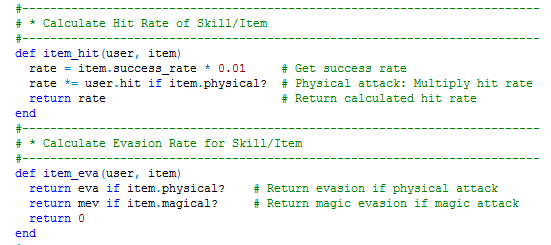
acc/eva vxa code:
acc/eva vxa code:
author=Max McGee
Anyway, does anyone know of any scripts for VX Ace that allow for easy but in-depth configuration of EVA and ACC stats and how they interact?
I just open the script editor and do that myself. I'm able to do so without having done any programming prior to RMXP, so give it a try even if programming isn't your thing. It's one of the easier things to edit.