Full Games List
 Featured Games
 New Games
 Reviews
 Media
Media Images
 Blogs
Blogs Game Updates
 Images Feedback Summary
 Game Design Highlights
 Tutorials
 Articles
 Scripts
 Utilities / Plugins
 Resources
 Engines
 Engine Bulletins
 What is Makerscore?
 Past Events
 Achievements
 Misaos
 Forums
 Post History
 Chat
Chat New to RMN?
 Full Store List
 RMN Music Pack (free)



HELP ME COME UP WITH (BIG) CREATURES
Posts

 nhubi
nhubi View playlists
 Close
Closeauthor=ExtremeDevelopment
(I know it's a slime in the picture just pretend it's a slug). They are harmless but gross, so you don't wanna get near one.
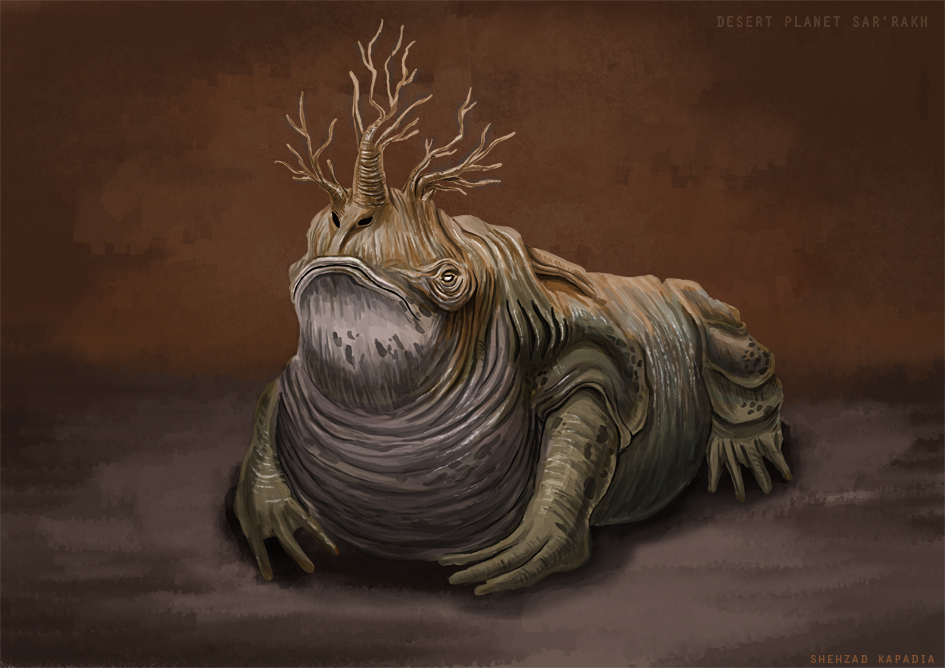
Something more like this, visually?
treeslug

Oh yes I guess, but that looks more like a toad than a slug. It's more like a snail, but instead of a shell with an object on it's head :P
Oh and I forgot to mention, to disguise they go underground and leave the object above ground,pretending to be an object.
Oh and I forgot to mention, to disguise they go underground and leave the object above ground,pretending to be an object.
I feel that you'e not really following what I want, ExtremeDevelopment. I guess it's fine if you're just making the creatures for fun, but I feel that the "slime that turns into building isn't very realistic. Dunno how many times I have to say this, but the creatures need to be realistic. Fantastic, mystic, weird, yes. Unrealistic, no.
A creature like that don't really get any advantage from being able to grow a building on their head. It would be better if it just blended in with the ground, like a hill or something. Growing a tree on their head is just too complicated and quite frankly, looks kinda stupid. I also want a creature that has nothing to do with humanity, so them having buildings on their head would be impossible. Technically there could be other intelligent creatures on the planet but I still don't see how it would benefit the creature to have a building on its head.
@nhubi
So if I understand it right, the females sometimes go in herds together with other females? Pretty neat creature, very well thought out. Somewhat reminiscient of bears, I suppose?
A creature like that don't really get any advantage from being able to grow a building on their head. It would be better if it just blended in with the ground, like a hill or something. Growing a tree on their head is just too complicated and quite frankly, looks kinda stupid. I also want a creature that has nothing to do with humanity, so them having buildings on their head would be impossible. Technically there could be other intelligent creatures on the planet but I still don't see how it would benefit the creature to have a building on its head.
@nhubi
So if I understand it right, the females sometimes go in herds together with other females? Pretty neat creature, very well thought out. Somewhat reminiscient of bears, I suppose?
Dangit! How come Nhubi's stuff is always good and mine isn't ;n;
author=SnowOwl
@nhubi
So if I understand it right, the females sometimes go in herds together with other females? Pretty neat creature, very well thought out. Somewhat reminiscient of bears, I suppose?
Yes the females come together just after they come out of hibernation with their young. The newborns have been born in the den (like Polar bears) and the year-old's have shared the den with their mother (they only do this for the first two years of life, then they are on their own). Though the males are slightly smaller they are more aggressive so the females band together during the mating time to ensure the survival of the cubs and to scare immature males away from females who are not in season. Older males know not to bother them.
The females probably emerge slightly earlier, it gives them the opportunity to have banded together and be around to watch the dominance battles and choose the males they consider able to give them the strongest cubs.
Once the mating period is over however they all disperse because they need to build up bulk for the coming hibernation and they know there isn't enough resources in a smaller area to feed them all. It ensure the survival of the species.
SnowOwl have you designed any insectoid types yet? I was thinking for a low gravity high oxygen world they could easily be tall and massive (especially if they have evolved lungs).
@ED
Well, it has to do with his creatures making sense while yours doesn't, I guess?
You could do it too if you would just put more effort into it than just coming up with something that sounds cool in your head and instantly going for it.
@nhubi
Go for it.
Well, it has to do with his creatures making sense while yours doesn't, I guess?
You could do it too if you would just put more effort into it than just coming up with something that sounds cool in your head and instantly going for it.
@nhubi
Go for it.
OK, will do. I need to review a couple of games first and then I'll see what I can come up with.
At this rate you'll have to add me to your game as 'Creature Consultant' - that's a joke, Snow
At this rate you'll have to add me to your game as 'Creature Consultant' - that's a joke, Snow
I don't mind putting you and anyone that come up with a couple of creatures that I use as "creature designer".
I really was joking, SnowOwl, but I would consider it an honour to be so named.
I'm still nutting out an insectoid type, but low gravity got me to this, so have another possible entrant
Strider (or Stiltsquid?)

Size: 25-30 meters high, 20 metres long
Diet: Omnivore, predominantly herbivore
Habitat: Swamp and forest environments, low gravity world.
Description: Evolving on a world that was mostly covered in water the Striders were originally marine predators, however as the oceans dried up leaving vast swamps the Striders migrated and evolved into giant land based creatures. Their diet likewise changed to meet the needs of their new environment and whilst they still favour the fish that live in the multitude of streams that dominate their damp homes they are predominantly herbivorous. Their great height and powerful tentacular mouthpieces, (a remnant of their days in the oceans, and still useful in catching fish) enable them to reach the fresh young shoots and fruits that grow at the tips of the massive swamp trees.
The Striders form small family units, generally consisting of a dominant male and a small harem of females as well as their infant and juvenile offspring. Infant striders are subject to the predation by a number of species within the swamp environment and infant mortality is quite high, and the lifespan of the species is low at approximately 15 years. This means that females will produce litters of three to four pups each year to compensate as usually only one makes it to adulthood.
Whilst the low gravity of their homeworld allows them to grow to impressive heights, their low bone density means that fractures and breaks of their extended limbs is a common occurrence and a frequent cause of death. If not from the original injury then from the inability to feed themselves afterwards. Family members have been observed feeding sick or injured individuals but this is usually futile and starvation or predation is generally the end result.
I'm still nutting out an insectoid type, but low gravity got me to this, so have another possible entrant
Strider (or Stiltsquid?)
Size: 25-30 meters high, 20 metres long
Diet: Omnivore, predominantly herbivore
Habitat: Swamp and forest environments, low gravity world.
Description: Evolving on a world that was mostly covered in water the Striders were originally marine predators, however as the oceans dried up leaving vast swamps the Striders migrated and evolved into giant land based creatures. Their diet likewise changed to meet the needs of their new environment and whilst they still favour the fish that live in the multitude of streams that dominate their damp homes they are predominantly herbivorous. Their great height and powerful tentacular mouthpieces, (a remnant of their days in the oceans, and still useful in catching fish) enable them to reach the fresh young shoots and fruits that grow at the tips of the massive swamp trees.
The Striders form small family units, generally consisting of a dominant male and a small harem of females as well as their infant and juvenile offspring. Infant striders are subject to the predation by a number of species within the swamp environment and infant mortality is quite high, and the lifespan of the species is low at approximately 15 years. This means that females will produce litters of three to four pups each year to compensate as usually only one makes it to adulthood.
Whilst the low gravity of their homeworld allows them to grow to impressive heights, their low bone density means that fractures and breaks of their extended limbs is a common occurrence and a frequent cause of death. If not from the original injury then from the inability to feed themselves afterwards. Family members have been observed feeding sick or injured individuals but this is usually futile and starvation or predation is generally the end result.

It's been a while since my previous thingy, and I come back to see that nhubi has already dominated the thread with a bunch of (really awesome) creations.
Well, here's a little something:
Pillbug (it really is a pillbug)

Size: They should be about the size of a mini-bus.
Habitat: Dense (tropical) rainforests.
Diet: Pillbugs will eat pretty much anything; plants, animals, metals, rocks, name it. The highly corrosive acids in their stomachs can easily cope for it.
Description: Pillbugs live in well-organized mini-colonies of 10 to 20 individuals; constructing intricate, underground tunnels that usually encompasses the entirety of the forest they live in. Pillbugs are scavengers, feeding on pretty much anything that is within their territory.
Their mini-colony's members are divided into three main castes: breeders, soldiers, and gatherers.
Breeders don't have shells, have frail legs, and are born blind. They are also notably smaller than those of the other caste. Thanks to that, they are completely dependent on the mini-colony's gatherers for food, and the soldiers for protection. Their main task is to reproduce, and manage the colony members (give them instructions, settle conflicts, and etc). Each mini-colony has at most 4 breeders.
Soldiers are distinguishable from gatherers by their thicker, spiky carapace. Their mandibles are also larger, and their antennae are short and stubby. The soldiers have two main tasks: first is to defend the colony and ensure the safety of its members from hostile species, second is to create and maintain the colony's tunnel network. Each colony has two soldiers for each breeder.
Gatherers are lighter armoured, and fleeter-footed than soldiers. Their specially-developed legs allow them to reach running speeds that could easily overtake more lightly-built creatures. Paired with their heavy bodies, their signature body slams used when hunting is the last thing that the prey will experience. The gatherers are the ones that go up to the surface to bring food for the colony. Gatherers make up the rest of the mini-colony.
Pillbugs never leave their territory; except on extreme circumstances (the forest died out, or they ran out of food in their territory, or something).
Well, here's a little something:
Pillbug (it really is a pillbug)
Size: They should be about the size of a mini-bus.
Habitat: Dense (tropical) rainforests.
Diet: Pillbugs will eat pretty much anything; plants, animals, metals, rocks, name it. The highly corrosive acids in their stomachs can easily cope for it.
Description: Pillbugs live in well-organized mini-colonies of 10 to 20 individuals; constructing intricate, underground tunnels that usually encompasses the entirety of the forest they live in. Pillbugs are scavengers, feeding on pretty much anything that is within their territory.
Their mini-colony's members are divided into three main castes: breeders, soldiers, and gatherers.
Breeders don't have shells, have frail legs, and are born blind. They are also notably smaller than those of the other caste. Thanks to that, they are completely dependent on the mini-colony's gatherers for food, and the soldiers for protection. Their main task is to reproduce, and manage the colony members (give them instructions, settle conflicts, and etc). Each mini-colony has at most 4 breeders.
Soldiers are distinguishable from gatherers by their thicker, spiky carapace. Their mandibles are also larger, and their antennae are short and stubby. The soldiers have two main tasks: first is to defend the colony and ensure the safety of its members from hostile species, second is to create and maintain the colony's tunnel network. Each colony has two soldiers for each breeder.
Gatherers are lighter armoured, and fleeter-footed than soldiers. Their specially-developed legs allow them to reach running speeds that could easily overtake more lightly-built creatures. Paired with their heavy bodies, their signature body slams used when hunting is the last thing that the prey will experience. The gatherers are the ones that go up to the surface to bring food for the colony. Gatherers make up the rest of the mini-colony.
Pillbugs never leave their territory; except on extreme circumstances (the forest died out, or they ran out of food in their territory, or something).
I like the pillbug! They would work on a higher gravity world being stocky and low to the ground, one thing though, the world needs to have a high oxygen (or whatever gas these things breathe) count because bugs don't have lungs so they'd need ways to get enough breathable atmosphere to their muscles to grow to mini-bus size, unless these guys have evolved some. Speaking of, perhaps Busbug (since they are much bigger than pills now) for a name?
Thanks!
The name's just a generic place-holder, since I thought it would be stealing the fun of naming away from SnowOwl if I give one.
About the breathing I... never really thought about that aspect. It'll be strange if they have lungs, since that would require an inner skeleton or at least a rib cage (I think. Correct me if I'm wrong on this assumption). Maybe they could absorb air through their skin (like frogs), or maybe they don't breathe at all in the first place. Given their highly varied diet, they could also "breathe" through the food they ingest. They'll absorb the gaseous by-products of their own digestion. Though the final option would mean that they would have to keep eating and eating and eating (and eating).
What do you think?
The name's just a generic place-holder, since I thought it would be stealing the fun of naming away from SnowOwl if I give one.
About the breathing I... never really thought about that aspect. It'll be strange if they have lungs, since that would require an inner skeleton or at least a rib cage (I think. Correct me if I'm wrong on this assumption). Maybe they could absorb air through their skin (like frogs), or maybe they don't breathe at all in the first place. Given their highly varied diet, they could also "breathe" through the food they ingest. They'll absorb the gaseous by-products of their own digestion. Though the final option would mean that they would have to keep eating and eating and eating (and eating).
What do you think?
Insects on Earth 'breathe' through openings in their exoskeleton called spiracles which basically just allow air into internal trachea, the % of breathable atmosphere (oxygen for us) determines how deep into the body that air goes and how much of the internal muscle can therefore be powered. The higher the percentage the higher the pressure, the further it travels. It's why back in the Carboniferous you got 3 metre long centipedes because the oxygen content was around 33% as opposed to 21% now. Since it's alien biology there is no reason why they couldn't have developed lungs (I'm looking at that for a low gravity version) or some other form of atmospheric intake. Perhaps you are right they could eat a particular plant that absorbs gasses and metabolise that internally, or they could have a series of bladders running along the inside of their exoskeleton that act like bellows and sucks in 'air' with movement and then disperses that to muscles and organs.
You really don't need an endoskeleton for lungs, we're just used to the idea because it's what we've got. xD.
Oh and yeah, probably should leave the naming to SnowOwl. It's his game after all.
You really don't need an endoskeleton for lungs, we're just used to the idea because it's what we've got. xD.
Oh and yeah, probably should leave the naming to SnowOwl. It's his game after all.
The more exotic, the better. Do away with lungs altogether and go with the option where it eats stuff to get air, I say. Heck have them eat oxygen, and breathe methane.
@nhubi> Well, I assumed that ribs (along with the diaphragm <- did I spell this right?) were required for lungs to function...
@SnowOwl> I was preferring that option too, since it seems to be the strangest among them. Though I don't know about how them breathing out methane would work. I mean, they live underground, and that would make their tunnels kinda prone to (violent) explosions. A little spark caused when tunnelling through rock, for example, would be catastrophic.
@SnowOwl> I was preferring that option too, since it seems to be the strangest among them. Though I don't know about how them breathing out methane would work. I mean, they live underground, and that would make their tunnels kinda prone to (violent) explosions. A little spark caused when tunnelling through rock, for example, would be catastrophic.
The could always tunnel via other means than digging, or have some counter-measure against sparks. I figure that creatures that live on a planet with a methane-rich atmosphere would have to develop other means for alot of stuff. For example, it could release a foam when digging that would make sparks very unlikely.
Now that you mention it, they *could* do the tunnelling by puking out the corrosive acids from their stomachs. A bit like some termites.

I've been making these for all the creatures that I implemented into the game so far, which will also be appearing in the demo I'll release. I didn't have to change much at all from the original text, which is great.
Oh that's brilliant SnowOwl. I really like these.
In regard to the Pillbug , KS, nope ribs are to protect the vital organs it's the diaphragm (yes you spelt it right) that aids in respiration, but that's all muscle no bone involved.
I like the idea of using body fluids to eat through the rock and if the stomach acid (or waste product) of the bug are sulphuric (as opposed to hydrochloric) then that mixed with methane could produce something like Methanesulfonic acid, which can dissolve stuff pretty easily.
In regard to the Pillbug , KS, nope ribs are to protect the vital organs it's the diaphragm (yes you spelt it right) that aids in respiration, but that's all muscle no bone involved.
I like the idea of using body fluids to eat through the rock and if the stomach acid (or waste product) of the bug are sulphuric (as opposed to hydrochloric) then that mixed with methane could produce something like Methanesulfonic acid, which can dissolve stuff pretty easily.