



 Full Games List
 Featured Games
 New Games
 Reviews
 Media
Media Images
 Blogs
Blogs Game Updates
 Images Feedback Summary
 Game Design Highlights
 Tutorials
 Articles
 Scripts
 Utilities / Plugins
 Resources
 Engines
 Engine Bulletins
 What is Makerscore?
 Past Events
 Achievements
 Misaos
 Forums
 Post History
 Chat
Chat New to RMN?
 Full Store List
 RMN Music Pack (free)



GAME LENGTH AND MAINTAINING PLAYER INTEREST
Posts

 slash
slash View playlists
 Close
CloseYup yup! I was definitely ready to be invested in Skyrim, so I didn't mind kinda chugging along through the intro - and once the dragon shows up and then you can explore, it gets way better. I just got antsy in the cart :P
Hahahaha, that's fantastic! That sounds like a great intro :P At least the player gets to go "oh shit!" right away.
But yea, I wonder if maybe Skyrim should've kicked off more like Minecraft, where you kinda just appear in a field with a dagger nearby, or something. They're both open-world games, sorta, so it makes sense that you could just chuck a player into it and let them figure it out... although with Skyrim you'd have to reveal a dragon somehow pretty quick after they start. Then they could chase after it, or wander wherever else they wanted.
EDIT: For what it's worth, I think Elder Scrolls games (and the like) are the kind of games that do benefit from throwing in tons of content, even the kind of stuff that would be "padding" anywhere else. For most genres I'd suggest cutting as much as possible and polishing what's left like a precious sapphire. However, Skyrim is generally a pretty relaxed game, and people play it to kinda just explore at their own pace, so having the world filled with stuff is part of the core. Even if a lot of the stuff is small and janky and unpolished, someone will find it and have fun with it.
author=Liberty
(Ask me about the time I randomised and got stuck in an ice cavern with a fucking redguard healer. There was an ice troll. I had a fucking dagger. Fun times. ;p )
Hahahaha, that's fantastic! That sounds like a great intro :P At least the player gets to go "oh shit!" right away.
But yea, I wonder if maybe Skyrim should've kicked off more like Minecraft, where you kinda just appear in a field with a dagger nearby, or something. They're both open-world games, sorta, so it makes sense that you could just chuck a player into it and let them figure it out... although with Skyrim you'd have to reveal a dragon somehow pretty quick after they start. Then they could chase after it, or wander wherever else they wanted.
EDIT: For what it's worth, I think Elder Scrolls games (and the like) are the kind of games that do benefit from throwing in tons of content, even the kind of stuff that would be "padding" anywhere else. For most genres I'd suggest cutting as much as possible and polishing what's left like a precious sapphire. However, Skyrim is generally a pretty relaxed game, and people play it to kinda just explore at their own pace, so having the world filled with stuff is part of the core. Even if a lot of the stuff is small and janky and unpolished, someone will find it and have fun with it.
LockeZ

I'd really like to get rid of LockeZ. His play style is way too unpredictable. He's always like this too. If he ran a country, he'd just kill and imprison people at random until crime stopped.
5958
I think that if your game is good, then the longer you can make it, the better it will be. If people are having fun then they'll want to keep playing. Why would they want to stop? And in RPGs the length is doubly important, because the ramping RPG-style progression and leveling up become a cheap imitation of what they're supposed to be if the game isn't at least like a dozen dungeons or so. In a four hour RPG, there's no room for depth, you can't build and plan your party's stats and abilities and classes and talents, and there's no time for any of your choices to actually matter. There's no short term vs. long term tradeoff because there's no long term at all.
This isn't an excuse for the beginning of your game sucking balls. Designers are afraid to introduce complexity early in a game, but complexity is absolutely required to make RPG mechanics actually fun. This is in contrast to action and adventure game mechanics which can be fun even if they're very simple. In RPGs, there's no skill involved in timing or execution - 100% of the skill is in noticing details and figuring things out. So if there's nothing to learn, then the player never experiences the feeling of success, and there's no fun.
RPGs, more than any other genre except strategy games, need to start out complex. Not, like, "first time playing Final Fantasy Tactics" level complex, but... if you're not making games for people who've never played an RPG before, then I'd say probably they need to start out at about the point FF4 ends at, and ramp up from there. And I assume none of you are making games for people who've never played RPGs before. Since those people are not going to be playing retro indie RPGs. Retro indie games are for people who are nostalgic, or who have burned through all of their modern games.
Anyway the intro to Skyrim is action-packed:
This isn't an excuse for the beginning of your game sucking balls. Designers are afraid to introduce complexity early in a game, but complexity is absolutely required to make RPG mechanics actually fun. This is in contrast to action and adventure game mechanics which can be fun even if they're very simple. In RPGs, there's no skill involved in timing or execution - 100% of the skill is in noticing details and figuring things out. So if there's nothing to learn, then the player never experiences the feeling of success, and there's no fun.
RPGs, more than any other genre except strategy games, need to start out complex. Not, like, "first time playing Final Fantasy Tactics" level complex, but... if you're not making games for people who've never played an RPG before, then I'd say probably they need to start out at about the point FF4 ends at, and ramp up from there. And I assume none of you are making games for people who've never played RPGs before. Since those people are not going to be playing retro indie RPGs. Retro indie games are for people who are nostalgic, or who have burned through all of their modern games.
Anyway the intro to Skyrim is action-packed:

It was not fantastic. Fun fact - You cannot beat an ice troll with a dagger on level one. I had to throw myself off a mountain to get away. Not fun times. My poor Redguard has the highest death count in an RPG that I've ever played. ;.;
*a short prayer for Libby's redguard*
I rented Final Fantasy Tactics when I was a kid and I gave up immediately. Never beat the first battle. Still haven't :P
I definitely agree that RPGs can afford to be a little more complex because they give you time to think, but you can ease people into that. Hell, even for players who've never RPG'd before, you could have a short battle where players just auto-attack (to teach them the menu) and then start giving them skills pretty quick (because it doesn't take that long to learn a menu).
This I kinda disagree with. In a traditional JRPG, the long gameplay makes sense, and fits well with both: the slow growth of your party, skills, andequipment and the winding, epic tale. But hell, there's a few examples of games on this site that make your choices matter within a few hours - Remnants of Isolation did a great job, Wine & Roses did a great job. They both focused on short stories, customization, and battle tactics. I think their battle systems might have seen trouble if stretched over the course of 40 hours, but for these short games, they're perfect.
I think I'd like to see more short story RPGs! Certainly, I think that's where the devs on this site would excel. We don't have million dollar teams, and we're individuals with heart and personality - we're gonna be better at telling a very unique, human story than an company that has to run it by producers and a board of directors.
---
EDIT: I am losing it at the cart tumbling, LockeZ.
author=LockeZ
RPGs, more than any other genre except strategy games, need to start out complex. Not, like, "first time playing Final Fantasy Tactics"
I rented Final Fantasy Tactics when I was a kid and I gave up immediately. Never beat the first battle. Still haven't :P
I definitely agree that RPGs can afford to be a little more complex because they give you time to think, but you can ease people into that. Hell, even for players who've never RPG'd before, you could have a short battle where players just auto-attack (to teach them the menu) and then start giving them skills pretty quick (because it doesn't take that long to learn a menu).
author=LockeZ
In a four hour RPG, there's no room for depth, you can't build and plan your party's stats and abilities and classes and talents, and there's no time for any of your choices to actually matter.
This I kinda disagree with. In a traditional JRPG, the long gameplay makes sense, and fits well with both: the slow growth of your party, skills, andequipment and the winding, epic tale. But hell, there's a few examples of games on this site that make your choices matter within a few hours - Remnants of Isolation did a great job, Wine & Roses did a great job. They both focused on short stories, customization, and battle tactics. I think their battle systems might have seen trouble if stretched over the course of 40 hours, but for these short games, they're perfect.
I think I'd like to see more short story RPGs! Certainly, I think that's where the devs on this site would excel. We don't have million dollar teams, and we're individuals with heart and personality - we're gonna be better at telling a very unique, human story than an company that has to run it by producers and a board of directors.
---
EDIT: I am losing it at the cart tumbling, LockeZ.

Same with games like Fire Emblem which are essentially very similar in gameplay from stage to stage.
No they're not. In fact, Fire Emblem is one of the games where (almost) each stage is a unique and memorable scenario. From that hostage situation where one of the enemy cavaliers decides to join you to the romp through the volcano. There's always something new the stage throws at you. It does fall short sometimes with those padding stages where its just a bunch of enemies and 2 pairs of reinforcements through several stages of the same chapter. The game tries to involve you in each chapter's conflict as the battle unfolds and events occur.
You can have fun grinding for hours on end if you feel the pay-off is worth it and it doesn't bore the ever-loving hell out of you. I mean, how else do you explain games where grinding is the main draw?
I can explain how they became obsolete with newer games having much less grinding in them, various MMOs constantly accelerating their XP rate over time, etc.
It doesn't matter how good the gameplay is, if it gets repetitive it starts to overstay its welcome. If the game is short enough, "it was as long as it needed to be" is usually the response.
LockeZ
I'd really like to get rid of LockeZ. His play style is way too unpredictable. He's always like this too. If he ran a country, he'd just kill and imprison people at random until crime stopped.
5958
I would say Wine & Roses had great potential as a game. And if it'd had about seven more dungeons the size of the first one, it could have realized that potential. In order to function as a game with so little content, it had to abuse a lot of shortcuts that cheapened the gameplay, like a lack of level ups, tiny stages with boring exploration, very few strategic choice of how to build your characters, and a style of pacing that just cut out all the "normal enemies" and therefore had no hills and valleys of excitement, just constant nail-grinding.
Please don't take this as me not liking Wine & Roses, as I think it's probably got the best gameplay of any RPG I've ever played. I mostly just wanted way, way more of it.
Please don't take this as me not liking Wine & Roses, as I think it's probably got the best gameplay of any RPG I've ever played. I mostly just wanted way, way more of it.

I think the problem with a dull, stretched out game is mostly felt at the early part of the game - but I often feel convinced that later parts in the game don't get better or only improve from bad to mediocre. I often feel this way when playing Final Fantasy - it's alright regarding the plot and characters, but it's mind blowing how the game is devoid of any form of challenge.
PS: If you think Fire Emblem is bad about padding, try Shining Force - that game makes you spend 10+ turns just to get in range of the enemies!
PS: If you think Fire Emblem is bad about padding, try Shining Force - that game makes you spend 10+ turns just to get in range of the enemies!
If you think Fire Emblem is bad about padding
I don't, there's only that forest level in one game and that plains level in the other..
But yeah, I actually liked Shining Force too, but forcing you to move a specific unit at a time (you can't cycle) and making you move by walking around a flashing L1 Normal Distance Area gets annoying. I remember the Sega CD one being the least annoying and having the most content, but I never finished it. Shining Force II was also incredibly grindy.
I really don't know if I like the Shining Force series or not. I dig the epic YM2612 FM synth soundtracks, but it is safe to stick with the Sega CD version in terms of gameplay.
I played the GBA version of Shining Force - the second mission has you walk around on a map that's bigger than any Fire Emblem map ever, most of the terrain is so heavy that your units can only move one tile across each turn, enemies are spread across the whole map AND it's a rout mission!
author=LockeZ
I would say Wine & Roses had great potential as a game. And if it'd had about seven more dungeons the size of the first one, it could have realized that potential. In order to function as a game with so little content, it had to abuse a lot of shortcuts that cheapened the gameplay, like a lack of level ups, tiny stages with boring exploration, very few strategic choice of how to build your characters, and a style of pacing that just cut out all the "normal enemies" and therefore had no hills and valleys of excitement, just constant nail-grinding.
Please don't take this as me not liking Wine & Roses, as I think it's probably got the best gameplay of any RPG I've ever played. I mostly just wanted way, way more of it.
I'm personally super glad Wine & Roses was as short as it was - that's probably the only reason I actually finished it. I think it did a good job with a small but clever system, and I don't think that system could've been stretched out over 7 dungeons. In theory, it could have kept going by slowly introducing new elements to work with (equipment types, party members, battle options) but 7 times the length would've been far past its limit, and what little story there was would have fell to pieces. I think the level-ups worked great as well: beating a battle gives you a new skill to play with, or maybe a stat up. No repeat battles, no grinding - the game doesn't waste a drop of your time. I do agree that the highs and lows could've been meted out with more (any) coordination, however.
Still, I am happy with taking a break from 20 hour RPGs to play a 2 hour one. I understand wanting more, of course, but not if the "more" would've been weak and forced.

author=Lockez
I think that if your game is good, then the longer you can make it, the better it will be. If people are having fun then they'll want to keep playing. Why would they want to stop?
Because you can always have too much of a good thing. You have to have variety in order to maintain quality. However the more different things you try the harder it is to maintain the game being good. There are numerous problems in keeping a game constantly fresh and I've never witnessed a 40+ hour game do that.
author=Lockez
In a four hour RPG, there's no room for depth, you can't build and plan your party's stats and abilities and classes and talents, and there's no time for any of your choices to actually matter. There's no short term vs. long term tradeoff because there's no long term at all.
Seems like that's the case because no one really tried. Most of this is all rooted in conventions. I mean an RPG is basically just character customization along with resource management, that can make for depthful re-playability as opposed to depthful longevity. This gets pretty hypothetical though.

I think is wrong to have a lot of skills when you start the game, I will just pick the strongest one and spam it, (This is worse with games that are "creative" with the skill names or skills with debuffs that aren't explained very clearly) I think is better to have a few (2-4) skills but with specific uses (Healing, Damage, Buff, AoE, etc.) and you get more playing the game, (to keep interested the player) if a skill is very different to conventional skills (How about reducing by 20% the HP of the party and deal the amount as damage to enemies?) is better to add a very short tutorial, a good description, or if you learn the skill with levels make sure that is the only skill you will learn at that level...

I feel like game length shouldn't be a major consideration when planning a game. Instead, it should be an inevitable outgrowth of narrative and gameplay. If your game is 30 hours long but you're still offering the player mechanics that are enjoyable and evolving, then keep going, the game's not done. If your story requires a set amount of locations that equates to 50 hours, then that's how long your game needs to be--just make sure that your gameplay stays fresh and interesting.
If you start planning games out like, "Kids these days have no attention span, so I need to design a game that's less than five hours," or "If I'm marketing towards twenty-somethings, I need keep it short in order to accommodate their schedules," then you're thinking more like a businessman than a creative. Those self-imposed limitations will still allow you to make good games (assuming you design a game that's MEANT to be that short), but you're also limiting the games you can make, which kind of blows.
If you start planning games out like, "Kids these days have no attention span, so I need to design a game that's less than five hours," or "If I'm marketing towards twenty-somethings, I need keep it short in order to accommodate their schedules," then you're thinking more like a businessman than a creative. Those self-imposed limitations will still allow you to make good games (assuming you design a game that's MEANT to be that short), but you're also limiting the games you can make, which kind of blows.
Sooz

They told me I was mad when I said I was going to create a spidertable. Who’s laughing now!!!
5354
author=Housekeeping
I feel like game length shouldn't be a major consideration when planning a game. Instead, it should be an inevitable outgrowth of narrative and gameplay. If your game is 30 hours long but you're still offering the player mechanics that are enjoyable and evolving, then keep going, the game's not done. If your story requires a set amount of locations that equates to 50 hours, then that's how long your game needs to be--just make sure that your gameplay stays fresh and interesting.
Problem here is, it becomes very easy to just let the scope creep expand your game into an unwieldy mass of stuff. At some point in the design, you're going to need to take a look at your plans and say, "OK, here's the general limit of what this absolutely requires." Otherwise, you'll just keep coming up with fantastic ideas that are awesome and cool but not actually necessary for the work you're making.
If you start planning games out like, "Kids these days have no attention span, so I need to design a game that's less than five hours," or "If I'm marketing towards twenty-somethings, I need keep it short in order to accommodate their schedules," then you're thinking more like a businessman than a creative. Those self-imposed limitations will still allow you to make good games (assuming you design a game that's MEANT to be that short), but you're also limiting the games you can make, which kind of blows.
There are a lot of other reasons to limit the amount of game time tho. Not every limitation comes from cynical business stuff.
It's actually not that much of an issue if your playerbase can't dedicate a lot of time to your game - you don't need to make the game short, just that the game is also enjoyable if you only play ~30 minutes at a time. Games with clearly defined stages can easily fit this as one can play one level per day and finish the game in one month.
author=Sooz
Otherwise, you'll just keep coming up with fantastic ideas that are awesome and cool but not actually necessary for the work you're making.
I'm saying, though, that you build the game so that you include everything that is necessary. Tacking stuff on that isn't necessary is adding length rather than substance, so, yeah, of course you wouldn't add that. It all needs to feed into the whole.
author=Sooz
There are a lot of other reasons to limit the amount of game time tho. Not every limitation comes from cynical business stuff.
Well, if you have reasons like, "I can't spend enough time to make this into a 50-hour epic" or "my development tools aren't enough," then of course that's valid. But, in that case, you change your idea rather than make concessions. You'll just end up regretting the fact that your game didn't match that initial vision.
My post was more in response to the apparent demand that games shouldn't be lengthy. I was just saying that games should be as long as they need to be; sometimes that's fifty hours, sometimes that's ten minutes.
Sooz
They told me I was mad when I said I was going to create a spidertable. Who’s laughing now!!!
5354
author=Housekeeping
I feel like game length shouldn't be a major consideration when planning a game.
author=Housekeeping
I'm saying, though, that you build the game so that you include everything that is necessary. Tacking stuff on that isn't necessary is adding length rather than substance, so, yeah, of course you wouldn't add that. It all needs to feed into the whole.
So... would you say you need to... plan the game's length?
My post was more in response to the apparent demand that games shouldn't be lengthy. I was just saying that games should be as long as they need to be; sometimes that's fifty hours, sometimes that's ten minutes.
I seriously do not get where y'all are getting the idea that anyone is demanding short games. Like, I explicitly said I'm not doing that. It's just a thing I've seen a LOT: people say a game should be "as long as it needs to be," but then a lot of the time there's complaint about games being "too short." It seems there's an idea that RPGs in particular need to take multiple sessions to complete, or else they're not really long enough. And I find that as arbitrarily limiting as the idea that any game should only be an hour or so long.
There are no sides to take here. It is just talking about how we think about game length.

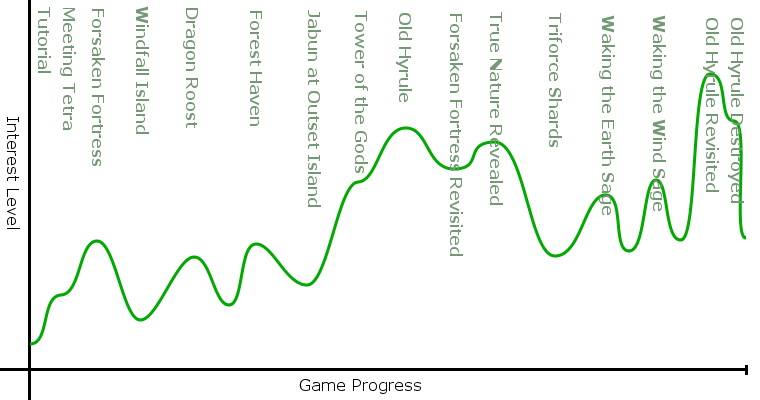
How long/short a game tends to be depends on the rise/fall of interest in it. There's actually a lot of studies into how to keep someone interested in a game, and finishing it at a satisfying point. It is not always that a game is too short because they want to play more...but because you ended it when the player's interest was still peaking, and without a satisfying cool off. Usually for games, the final boss fight is the final 'peak' of action, and the cool off is the ending sequence (Final Fantasy 6 for example, killing off Kefka's final form is the peak, and the escape from the tower is the declining action portion).
In the same vein, if there's not enough peaks between start and finish, the game feels overly long and dull. Whether it be story moments, interesting boss fights, or the like, you have to keep the player interested. At the same time, you have to give them cool-off periods, calm times, less strenuous encounters, character building, etc. If you have too many peaks, and are just constantly ramping it up, the player gets overly stressed...and thinks the game is going on too long.
Here's an interesting graphic showing it for Wind Waker, to give you guys an idea:
In the same vein, if there's not enough peaks between start and finish, the game feels overly long and dull. Whether it be story moments, interesting boss fights, or the like, you have to keep the player interested. At the same time, you have to give them cool-off periods, calm times, less strenuous encounters, character building, etc. If you have too many peaks, and are just constantly ramping it up, the player gets overly stressed...and thinks the game is going on too long.
Here's an interesting graphic showing it for Wind Waker, to give you guys an idea:
author=Rine
Here's an interesting graphic showing it for Wind Waker, to give you guys an idea:
Wow, didn't know ants could play Wind Waker too!
Good point, that's probably why many games open new sidequests just after you finish a main dungeon, or why some dungeons feels like filler
Well, if a dungeon feels like filler, you're probably doing the valleys wrong. Dungeons should never feel like you're wasting time, but maybe its a bit less important, like a dungeon to get through a mountain range. If every single dungeon is fighting to save the world versus the end boss, you may be relying too much on peaks.
The side quest point is definitely on the nose though, often after major events, you'll notice side quests open up in games. As a note though, the same interest/cool off curve should also apply to side quests and the like. Hell, should apply to every aspect of a game.
The side quest point is definitely on the nose though, often after major events, you'll notice side quests open up in games. As a note though, the same interest/cool off curve should also apply to side quests and the like. Hell, should apply to every aspect of a game.

