



 Full Games List
 Featured Games
 New Games
 Reviews
 Media
Media Images
 Blogs
Blogs Game Updates
 Images Feedback Summary
 Game Design Highlights
 Tutorials
 Articles
 Scripts
 Utilities / Plugins
 Resources
 Engines
 Engine Bulletins
 What is Makerscore?
 Past Events
 Achievements
 Misaos
 Forums
 Post History
 Chat
Chat New to RMN?
 Full Store List
 RMN Music Pack (free)



VILLIANS: HOW DO YOU MAKE THEM UNIQUE?
Posts

 Sailerius
 View playlists
 Close
Closeauthor=RyaReisender
From what I know, Kefka was globally very well received as villain.
Well, The Joker is a pretty popular character, so it shouldn't be a surprise that a carbon copy was also popular, but I wouldn't really hold it as a shining example of uniqueness.

Ehh I don't think Kefka is that great, either. I find his dialogue to be pretty corny.
Now to contribute to the topic:
You can have multiple villains in the one game, as well - as obvious as that sounds. It can potentially create a lot more dynamism to your story by having villains who not only oppose your protagonist, but also each other. Each villain could be a different manifestation of your game's theme, for example (if your game has an inherent theme). The protag could ally with one villain against the other for some "greater good"(presuming you have only two, but obviously there could be many more).
A further way of fleshing out characters & plot is to have these many conflicting characters star in their own chapters throughout the game, so you get an intimate idea for each of their motives and worldviews. You can employ protagonist-centred morality to great effect this way.
Perhaps another obvious thing to point out is does your protagonist fit the villain? Just as you think of a villain from the protagonist's POV, you can reverse it to see what the most effective type of protagonist could be.
Looking at your game's plot & characters from as many angles as possible can only serve to help your project, I think.
Now to contribute to the topic:
You can have multiple villains in the one game, as well - as obvious as that sounds. It can potentially create a lot more dynamism to your story by having villains who not only oppose your protagonist, but also each other. Each villain could be a different manifestation of your game's theme, for example (if your game has an inherent theme). The protag could ally with one villain against the other for some "greater good"(presuming you have only two, but obviously there could be many more).
A further way of fleshing out characters & plot is to have these many conflicting characters star in their own chapters throughout the game, so you get an intimate idea for each of their motives and worldviews. You can employ protagonist-centred morality to great effect this way.
Perhaps another obvious thing to point out is does your protagonist fit the villain? Just as you think of a villain from the protagonist's POV, you can reverse it to see what the most effective type of protagonist could be.
Looking at your game's plot & characters from as many angles as possible can only serve to help your project, I think.
Sooz

They told me I was mad when I said I was going to create a spidertable. Who’s laughing now!!!
5354
Kefka was a little punk who did nothing and I have no idea why anyone ever took him seriously as a villain. I'm going to assume it's plain old nostalgia in 99% of the cases,* because as a complete outsider who witnessed the game as an adult, there was absolutely nothing interesting or well-written about him: he was the poster boy of "BOY AM I EVIL! DO I HAVE GOALS? YEAH, BEING EVIL! DUH!"
Dude had no personality outside of "just evil," had no goals outside of "be spiteful 100% of the time," and appeared only to survive because everyone around him was unbelievably stupid and never once thought, "Hmm, this little punkass pipsqueak is constantly being cartoonishly spiteful for no apparent reason. Perhaps I, the respected representative of a heavily fascist and authoritarian government, should just end his miserable life for the safety of everyone around him."
The only reason he had any measure of actual power was because he pushed a thing. He pushed a thing solely because someone told him not to, and this made him the final boss of the game.
I am not going to say that a cartoonishly spiteful and lucky villain can't work, because it can and has, many times. My point is that the game was intended as a grand, epic, heroic narrative, with serious subject matter and conflicts affecting the world, and the chosen final villain works about as well as if you replaced Lord of the Rings's Sauron with a schoolyard bully. And also changed the motive from "conquer Middle Earth" to "I dunno, give people swirlies, I guess? Wait, I can kill people? Yeah, do that!"
It doesn't work, for the same reason that trying to bake a cake with cocaine instead of sugar doesn't work: it's not a modular thing, and you can't just swap ingredients around with no thought to how they fit with other ingredients. The end result is a weird lump that doesn't actually work.
*My favorite part is the SPINE CHILLING LAUGH that I kept hearing about. Even in context, it's super clear that this is only scary to children, in the same way that this terrified some kids, but is unlikely to affect any normal adult.
Dude had no personality outside of "just evil," had no goals outside of "be spiteful 100% of the time," and appeared only to survive because everyone around him was unbelievably stupid and never once thought, "Hmm, this little punkass pipsqueak is constantly being cartoonishly spiteful for no apparent reason. Perhaps I, the respected representative of a heavily fascist and authoritarian government, should just end his miserable life for the safety of everyone around him."
The only reason he had any measure of actual power was because he pushed a thing. He pushed a thing solely because someone told him not to, and this made him the final boss of the game.
I am not going to say that a cartoonishly spiteful and lucky villain can't work, because it can and has, many times. My point is that the game was intended as a grand, epic, heroic narrative, with serious subject matter and conflicts affecting the world, and the chosen final villain works about as well as if you replaced Lord of the Rings's Sauron with a schoolyard bully. And also changed the motive from "conquer Middle Earth" to "I dunno, give people swirlies, I guess? Wait, I can kill people? Yeah, do that!"
It doesn't work, for the same reason that trying to bake a cake with cocaine instead of sugar doesn't work: it's not a modular thing, and you can't just swap ingredients around with no thought to how they fit with other ingredients. The end result is a weird lump that doesn't actually work.
*My favorite part is the SPINE CHILLING LAUGH that I kept hearing about. Even in context, it's super clear that this is only scary to children, in the same way that this terrified some kids, but is unlikely to affect any normal adult.
Ugh, I agree with everything you just said, including the attribution of his popularity to nostalgia. I did not play FF VI as a child, either, so his effect was lost on me.
I personally think there are far better FF villains (strictly within the context of the series) such as Seifer (albeit a minor/illusory villain), Seymour, Kuja, uhh Hojo - if only because he is rather creepy.
I personally think there are far better FF villains (strictly within the context of the series) such as Seifer (albeit a minor/illusory villain), Seymour, Kuja, uhh Hojo - if only because he is rather creepy.
author=Sooz
It doesn't work, for the same reason that trying to bake a cake with cocaine instead of sugar doesn't work: it's not a modular thing, and you can't just swap ingredients around with no thought to how they fit with other ingredients. The end result is a weird lump that doesn't actually work.
No, I always wanted to try that. Maybe baking it with cocaine instead of flour would work.
I was thinking if I got a favorite Villain and couldn't come up with anything. Wario maybe? Or that guy in your head in Ultima 7? No, not really.

author=Rya
Cyril is great because he isn't just another side boss, but also goes all like "Now I just have to kill the final boss and then I can destroy everyone all by myself!" and he has very cool battle quotes too like "Well, guess I buy a one-way ticket to hell for your lives.", "What's wrong? Weren't you coming to get me?", "I hope you let me enjoy it some more." and "Try a little harder, before you die."
Not to mention he's the only boss than can render himself completely invincible if he just wants to.
Cyril is great because he has corny anime dialogue?

author=Feldschlacht IVauthor=RyaCyril is great because he has corny anime dialogue?
Cyril is great because he isn't just another side boss, but also goes all like "Now I just have to kill the final boss and then I can destroy everyone all by myself!" and he has very cool battle quotes too like "Well, guess I buy a one-way ticket to hell for your lives.", "What's wrong? Weren't you coming to get me?", "I hope you let me enjoy it some more." and "Try a little harder, before you die."
Not to mention he's the only boss than can render himself completely invincible if he just wants to.
I love star ocean 2 and would by no measure call Cyril great. The guy only speaks in like one scene. Probably the most interesting thing about him is that he's completely out of his depth. He harbors impotent ambitions of overthrowing Indalecio and controlling the universe, but he's not even 1/10 as powerful as Indalecio and is basically just dreaming out loud whenever he talks.
Kefka was a little punk who did nothing and I have no idea why anyone ever took him seriously as a villain. I'm going to assume it's plain old nostalgia in 99% of the cases,* because as a complete outsider who witnessed the game as an adult, there was absolutely nothing interesting or well-written about him: he was the poster boy of "BOY AM I EVIL! DO I HAVE GOALS? YEAH, BEING EVIL! DUH!"
people who praise kefka do so because he's sort of one-dimensional, not in spite of it. in a genre littered with badguys with really complex motivations and tragic backstories, it was kind of refreshing to see this one game where the villain was just a dog (magitek dog) chasing his tail, caught his tail, and couldn't figure out what to do with it. Yeah, he doesn't deserve power. that's probably what I like most about him. Almost nothing he gained (or lost) was due to his own power, and he essentially becomes a god almost by accident. people become fall into positions of power using nothing but luck all the time, but I can't think of many times that this has been portrayed to such a grand extent in video game writing.
Incidentally, his impact is severely lessened if you know he's the big bad of ff6 before you play the game. because half the reason he 'works' is because a player going in blind is rarely going to take this dork initially presented as comic relief seriously.
everyone around him was unbelievably stupid and never once thought, " "Hmm, this little punkass pipsqueak is constantly being cartoonishly spiteful for no apparent reason. Perhaps I, the respected representative of a heavily fascist and authoritarian government, should just end his miserable life for the safety of everyone around him."
so...true to life?
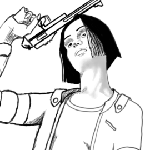
I don't know if an unique villain should be the goal of a writer. The most compelling villains tend to be the least unique and are almost always reflections of the hero. I'm thinking Moriarty to Holmes, the Master to the Doctor, Khan to Kirk, Sephiroth to Cloud, Big Boss to Solid Snake. The villain, the madman of the story, the monster that infects our minds shows us the worst aspects of the hero. Whenever I write a villain, I don't think of him or her as the bad guy or someone to create conflict for the hero to overcome; I think of the villain as someone who's purpose is to expose the hero's flaws. Joker and Kefka work so well because they're agents of chaos. They don't just reflect the worst aspects of the hero, but they reflect the worst in everyone. One could say that they're cop outs, that the only reason they're even villains in their stories is because it was easier to write an irrational lunatic than to write a character that actually makes us question the morals of the hero. Of course, this is the classic Manichean story-telling method. Good people good: bad people bad. This method of story-telling pervades Western culture.
All that making a character unique does is instigates a game of oneupmanship. One writer's characters have unique aspects, so other writers have to make their characters more unique. The next thing you know, writing isn't about making a compelling story but about doing what other writers haven't done. This is almost universally bad writing. We should be more interested in telling our story than in being different from the other guys. Seriously, we've had written language for 5000 years; you can't honestly believe you're going to come up with something that hasn't been done before. Nor should you try. Trying to be unique robs your other tasks of the creative energy they need. It's one of the most creatively draining things you can do, because while you're busy coming up with brilliant ideas, it's easiest to forget that you have to make your audience care about these brilliant ideas.
The most successful stories are the least unique. Star Wars and the Man With No Name trilogies are both essentially retellings of The Hidden Fortress. Dune is essentially a retelling of the New Testament. Akira and Blade Runner are both retellings of Metropolis. Brigit Jones' Diary is a retelling of Pride and Prejudice. Forbidden Planet is a retelling of Shakespeare's The Tempest. Inglorious Bastards is a retelling of The Dirty Dozen. The Lion King is a retelling of Hamlet. Edward Scissorhands is a retelling of Frankenstein. I can go on and on and on and on ad infinitum. Kipling has this to say about his Jungle Book: "I am afraid that all that code in its outlines has been manufactured to meet 'the necessities of the case': though a little of it is bodily taken from (Southern) Esquimaux rules for the division of spoils." "In fact, it is extremely possible that I have helped myself promiscuously but at present cannot remember from whose stories I have stolen." And almost every hero story can trace their lineage back to the likes of Heracles and Gilgamesh, with Samson and Delilah, Noah's Ark, Heracles, and Odin being essentially retellings of the stories of Gilgamesh.
Might I suggest that instead of trying to make characters unique, which takes a tremendous amount of creative energy that is wholly unnecessary to spend, do a bit of research and try and do something that hasn't been done in awhile. My best suggestion would be to not worry about the uniqueness of your villain and simply write your hero first, and then write the villain as a foil for the hero. They could be brothers, sisters, or friends who have fallen out or maybe the hero doesn't even realize that x/er friend/sibling even is the villain. Maybe your hero is actually the bad guy and doesn't realize it, and the villain is the one that's right.
All that making a character unique does is instigates a game of oneupmanship. One writer's characters have unique aspects, so other writers have to make their characters more unique. The next thing you know, writing isn't about making a compelling story but about doing what other writers haven't done. This is almost universally bad writing. We should be more interested in telling our story than in being different from the other guys. Seriously, we've had written language for 5000 years; you can't honestly believe you're going to come up with something that hasn't been done before. Nor should you try. Trying to be unique robs your other tasks of the creative energy they need. It's one of the most creatively draining things you can do, because while you're busy coming up with brilliant ideas, it's easiest to forget that you have to make your audience care about these brilliant ideas.
The most successful stories are the least unique. Star Wars and the Man With No Name trilogies are both essentially retellings of The Hidden Fortress. Dune is essentially a retelling of the New Testament. Akira and Blade Runner are both retellings of Metropolis. Brigit Jones' Diary is a retelling of Pride and Prejudice. Forbidden Planet is a retelling of Shakespeare's The Tempest. Inglorious Bastards is a retelling of The Dirty Dozen. The Lion King is a retelling of Hamlet. Edward Scissorhands is a retelling of Frankenstein. I can go on and on and on and on ad infinitum. Kipling has this to say about his Jungle Book: "I am afraid that all that code in its outlines has been manufactured to meet 'the necessities of the case': though a little of it is bodily taken from (Southern) Esquimaux rules for the division of spoils." "In fact, it is extremely possible that I have helped myself promiscuously but at present cannot remember from whose stories I have stolen." And almost every hero story can trace their lineage back to the likes of Heracles and Gilgamesh, with Samson and Delilah, Noah's Ark, Heracles, and Odin being essentially retellings of the stories of Gilgamesh.
Might I suggest that instead of trying to make characters unique, which takes a tremendous amount of creative energy that is wholly unnecessary to spend, do a bit of research and try and do something that hasn't been done in awhile. My best suggestion would be to not worry about the uniqueness of your villain and simply write your hero first, and then write the villain as a foil for the hero. They could be brothers, sisters, or friends who have fallen out or maybe the hero doesn't even realize that x/er friend/sibling even is the villain. Maybe your hero is actually the bad guy and doesn't realize it, and the villain is the one that's right.
Well, someone at some point in time has to write unique villains. Though I don't tend to think of "unique" in terms of "doing what other writers haven't done" or originality in the truest sense; more in terms of making that character necessary to your story and not easily interchangeable with a character from someone else's... like, making them fit into place, with the other characters, the themes, world, or whatever else. So that if you took them out, there would be a hole there shaped like that character.
Sometimes simplicity does work well enough, but then again there's no reason why you can't have a simple villain and a complex villain in the same story.
Sometimes simplicity does work well enough, but then again there's no reason why you can't have a simple villain and a complex villain in the same story.
Well, I wasn't saying to make them simple. I was saying to not try to be different or unique. Concern yourself more with meeting the needs of the story than with trying to be unique.
Piano reminded me of an aspect nobody mentioned so far. Visuals. Appearance is more important for some of us than the actual character.
Sooz
They told me I was mad when I said I was going to create a spidertable. Who’s laughing now!!!
5354
author=CAVE_DOG_IS_BACK
people who praise kefka do so because he's sort of one-dimensional, not in spite of it. in a genre littered with badguys with really complex motivations and tragic backstories, it was kind of refreshing to see this one game where the villain was just a dog (magitek dog) chasing his tail, caught his tail, and couldn't figure out what to do with it.
I'm not sure that was such an issue at the time the game came out. IDK, maybe there were a bunch of examples on SNES I missed, but my recollection of the time is mostly pretty simplistic Bad Guys Who Are Just Bad.
Yeah, he doesn't deserve power. that's probably what I like most about him. Almost nothing he gained (or lost) was due to his own power, and he essentially becomes a god almost by accident. people become fall into positions of power using nothing but luck all the time, but I can't think of many times that this has been portrayed to such a grand extent in video game writing.
I don't think it was portrayed all that well, it was just kind of there. Of course, that could be said for p. much all of the game; the writing was tremendously scattershot.
so...true to life?
True-to-life and factual details aren't always good for stories. I mean, if we were going to portray actual real-life fighting, everything would either be a few moments of posturing and then someone leaving, or a couple of seconds and then someone's down.
If you're going to include an element like that, you NEED to focus on melding that element into the story in a way that works for the story. You can't just throw shit together and assume that it'll work, any more than you can just put in a bunch of random powers for a battle and then just assume it'll be a good battle.
ETA: Forgot to include a thank you for explaining the twist aspect, which makes the whole thing make a lot more sense. I still think it's bad, but then I tend to think most of Square's writing is fairly toss.
I'm not sure that was such an issue at the time the game came out. IDK, maybe there were a bunch of examples on SNES I missed, but my recollection of the time is mostly pretty simplistic Bad Guys Who Are Just Bad.
I also don't really think that that was an issue when the game came out, and I don't think kefka was created in an attempt to solve any kind of perceived problem. I don't really think it's so much of an issue now either. That's just my take on why a lot of people find him refreshing even now.
I don't disagree that this all could have been done a lot better. I just think that there's more to appreciate about kefka than "he's a nihilistic force of nature."
That said, he's not really a favorite of mine. if I were to make a list of top ten video game villains, he wouldn't end up there, I don't think. I love ff6 but the antagonists are not really what I like about it.
True-to-life and factual details aren't always good for stories. I mean, if we were going to portray actual real-life fighting, everything would either be a few moments of posturing and then someone leaving, or a couple of seconds and then someone's down.
If you're going to include an element like that, you NEED to focus on melding that element into the story in a way that works for the story. You can't just throw shit together and assume that it'll work, any more than you can just put in a bunch of random powers for a battle and then just assume it'll be a good battle.
Well, all I'm saying is, the Emperor was wrong to keep Kefka around, and people like Celes and Leo were wrong to not recognize him as the threat he was, but mistakes like that are pretty common irl and I wouldn't necessarily categorize them as stupid. Celes kind of bounces from the Empire earlyish, and Leo DOES eventually decide to do something about him....but at the point he tries, it's too late. i really feel dirty for some reason, comparing video game characters to real life monsters, but it does bring to mind how fascists tend to be viewed as a 'joke' until they've gained way too much power.
It also kind of works thematically that they don't take him seriously because, most of the people playing ff6 in 199x didn't really take him all that seriously at first either.
author=pianotm
Well, I wasn't saying to make them simple. I was saying to not try to be different or unique. Concern yourself more with meeting the needs of the story than with trying to be unique.
Then I think... I meant the same thing as you?
I used unique as in remarkable/unusual, not one-of-a-kind. But I'm going to concede I missed your point and leave it at that ^_^;
Personally I like Kefka because he actually is an over-the-top, in-your-face, always-there character. Even when he's 'God' he's destroying stuff for shits and giggles. He actually is a very big presence in the game, you run into him a lot and see a lot of him. He does things you want to just slap him for (like poisoning Doma castle) and the scenes he is in are all infused with good show and character.
He's an evil crazy bastard, but he pulls the trope off very, very well - better than any other of the same, afaik. Every time he shows up, it's entertaining in some way, shape or form, even if you're horrified by the shit he does.
I'm sick atm so I can't find the exact words I'm trying to use, but something like there's a showmanship type thing there that was in every scene he was in that made him the focus. He stole the attention and they put a lot of work into making him into a character you want to punch but can't help but enjoy watching?
Also, this: http://tindeck.com/listen/zbyfm
He's an evil crazy bastard, but he pulls the trope off very, very well - better than any other of the same, afaik. Every time he shows up, it's entertaining in some way, shape or form, even if you're horrified by the shit he does.
I'm sick atm so I can't find the exact words I'm trying to use, but something like there's a showmanship type thing there that was in every scene he was in that made him the focus. He stole the attention and they put a lot of work into making him into a character you want to punch but can't help but enjoy watching?
Also, this: http://tindeck.com/listen/zbyfm
LockeZ
I'd really like to get rid of LockeZ. His play style is way too unpredictable. He's always like this too. If he ran a country, he'd just kill and imprison people at random until crime stopped.
5958
author=Feldschlacht IVauthor=Libertyauthor=Feldschlacht IVYeah, but see - that's their reason. To them everything is practically nothing, so that's their reason for not caring and for shit going on. It's a reason. ;p
snipauthor=LockeZ
If you think that's enough of a reason to qualify as "a reason" then I wonder what is even the point of telling people to make sure their villains have a reason for their actions. I can't think of a single example, or even imagine a theoretical one, where the villain's actions have any less purpose than that.
Edit: Other than, like, comedy games where the villain refers to himself as a villain.
I think both of these thoughts are missing the point of H.P. Lovecraft inspired themes; it's not that their reason is 'nothing', their reason is utterly incomprehensible to mortal thought, and any 'reason' we assign is just us trying to make sense of the unknowable and projecting that onto forces we can't possibly understand.
Even copping out and saying "lol their reason is nothing/they don't have one" isn't true either, nobody said they don't have a reason or that their reason is nothing, it's just that their actions are totally unknowable to us. Maybe they do, maybe they don't, whatever, the result is the same, and that's what's important. There's no way to know either way, to the point of it almost not mattering, because we don't matter, and that's terrifying.
I'm not sure what you're telling me to do. Liberty was getting on here first saying that your villain needs a reason for their actions, and then started expounding that having no discernable reason was still a reason. What part of this is actionable advice? It just sounds like you guys are saying that anything and everything is okay to do. Good reason, bad reason, no reason, doesn't matter.
You missed my follow-up (and better explanation as to what I meant), LockeZ.
author=Libertyauthor=Feldschlacht IVBut that's what I was meaning - they do have their reason. The characters in the game (and players) can't comprehend it so it comes off as no reason, but a reason is there.
sniiiiiip
As a writer you have to know that reason even if the player never knows it. This is about writing a good villain and you, as a writer, need to at least have an inkling about what your eldritch horror's reason for pulling the shit they do is. If you don't know, if they don't have one, then they come off as shallow and empty shells. There's a huge difference between the player not knowing the reason and there not being one 'just cos'. You can feel the difference between the two.

LockeZ
I'd really like to get rid of LockeZ. His play style is way too unpredictable. He's always like this too. If he ran a country, he'd just kill and imprison people at random until crime stopped.
5958
I don't buy that. From the player's perspective, there's no discernable difference between a villain having no discernable reason for their actions and having no reason at all for their actions.
I can always claim I came up with stuff that didn't actually make the final cut into the game; that doesn't make the writing any better. The player has no legitimate idea whether or not the writer was imagining a better reason for Exdeath or Diablo or Andross or Ganondorf's actions than "because EEEEEEVIL." That's the only reason they can see.
If they're the kind of player who imagines unexplained reasons existing, they'll imagine them whether you intended them or not. They'll fill in the blanks and invent ones you didn't even think of. If they're the kind of player who assumes that the writer probably just didn't think it through, they'll assume that whether you thought it through or not. Anything you didn't bother to spell out will be thought of as a plot hole.
I can always claim I came up with stuff that didn't actually make the final cut into the game; that doesn't make the writing any better. The player has no legitimate idea whether or not the writer was imagining a better reason for Exdeath or Diablo or Andross or Ganondorf's actions than "because EEEEEEVIL." That's the only reason they can see.
If they're the kind of player who imagines unexplained reasons existing, they'll imagine them whether you intended them or not. They'll fill in the blanks and invent ones you didn't even think of. If they're the kind of player who assumes that the writer probably just didn't think it through, they'll assume that whether you thought it through or not. Anything you didn't bother to spell out will be thought of as a plot hole.

