



 Full Games List
 Featured Games
 New Games
 Reviews
 Media
Media Images
 Blogs
Blogs Game Updates
 Images Feedback Summary
 Game Design Highlights
 Tutorials
 Articles
 Scripts
 Utilities / Plugins
 Resources
 Engines
 Engine Bulletins
 What is Makerscore?
 Past Events
 Achievements
 Misaos
 Forums
 Post History
 Chat
Chat New to RMN?
 Full Store List
 RMN Music Pack (free)



ANOTHER WRITING TOPIC: CHARACTER ASSUMPTIONS
Posts
Pages:
1

 Mitsuhide_The_Vagrant
 View playlists
 Close
CloseI have another question...
Is it okay (or rather, is it a bad idea) to have a character openly assume (as in say something out loud or think it) something about another character, or just in general, and whole-heartedly believe it, even if it turns out later that they assumed incorrectly?
For example: one of my characters assumes that another has gone to a costume party, and continues to say things like, "it's weird that he'd bring that to a costume party." In actuality, he doesn't know if he'd really gone to said party or not...he's just assuming. Also, it turns out later that the 2nd character did not actually go to a costume party, and so the 1st character's assumption (and probably the reader's) is incorrect.
I pondered this because I thought it may mislead the reader, and I wasn't sure if that was okay or not.
Is it okay (or rather, is it a bad idea) to have a character openly assume (as in say something out loud or think it) something about another character, or just in general, and whole-heartedly believe it, even if it turns out later that they assumed incorrectly?
For example: one of my characters assumes that another has gone to a costume party, and continues to say things like, "it's weird that he'd bring that to a costume party." In actuality, he doesn't know if he'd really gone to said party or not...he's just assuming. Also, it turns out later that the 2nd character did not actually go to a costume party, and so the 1st character's assumption (and probably the reader's) is incorrect.
I pondered this because I thought it may mislead the reader, and I wasn't sure if that was okay or not.
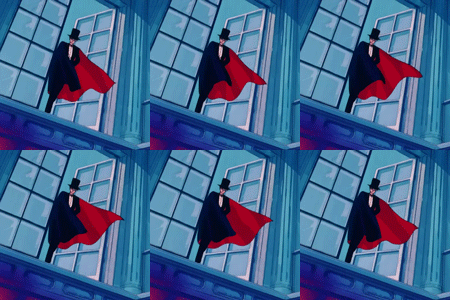


W-What?
That's funny-looking but I don't get it... >.>
EDIT: Red herring - n. - something intended to divert attention from the real problem or matter at hand; a misleading clue.
I don't think that applies to the situation then. My character is blindly assuming this, only to be corrected later, and, as far as I can see, there is no significance in his incorrect assumption.
That's funny-looking but I don't get it... >.>
EDIT: Red herring - n. - something intended to divert attention from the real problem or matter at hand; a misleading clue.
I don't think that applies to the situation then. My character is blindly assuming this, only to be corrected later, and, as far as I can see, there is no significance in his incorrect assumption.

Ever assumed something and turned out that you were wrong? Yeah, 'nuff said.

I have a question, mitsu.
Have you ever assumed something about somebody and been wrong?
Let that sink in a little so that you can realize how inane a question this is.
Have you ever assumed something about somebody and been wrong?
Let that sink in a little so that you can realize how inane a question this is.
post=112293
Have you ever assumed something about somebody and been wrong?.
EDIT: Okay then...now I need to think of some alternate internal and external monologue for him then. >.>
EDIT2: Of course, you should realize I'm slow to think, I'm always in need of these "UH YOUR STUPID FOR ASKING THAT QUESTION" responses. =D

I blame jRPGs where everything has a 100% concrete reason for happening because it is a world where everything is determined by prophecy.
post=112295
I blame jRPGs where everything has a 100% concrete reason for happening because it is a world where everything is determined by prophecy.
I do find myself irritated by this same concept.
What's wrong with chance? What's wrong with randomness? Can't something happen for no reason every once in a while?
post=112296post=112295I do find myself irritated by this same concept.
I blame jRPGs where everything has a 100% concrete reason for happening because it is a world where everything is determined by prophecy.
What's wrong with chance? What's wrong with randomness? Can't something happen for no reason every once in a while?
That's absurd.
post=112295
Can't something happen for no reason every once in a while?
You know now even if something happens seemingly at random, you won't be able to shake the feeling that you prompted it with thoughts like these.

post=112296post=112295I do find myself irritated by this same concept.
I blame jRPGs where everything has a 100% concrete reason for happening because it is a world where everything is determined by prophecy.
What's wrong with chance? What's wrong with randomness? Can't something happen for no reason every once in a while?
Here's the thing. When you watch TV shows, or movies, or read books (typically), you're not given every single thought or every single action a character does. Throughout a given day, you think about a lot of things, mostly mundane things like going to the store, homework, work, whatever.
The point is this: if it has no impact on the story or character development, leave it out. If the character is making a false assumption, something better happen. Take sitcoms, for example. A man finds something strange and assumes his wife is cheating on him. What does he do? He starts doing completely crazy and comical things to get her to confess to it, while maintaining a sardonically nice-y demeanor when his wife is around, and contempt when she's not around. Towards the end of the episode, he finds out he's wrong, and everyone laughs when his wife makes a fool of him (See above: Red herring).
If there's no consequence for the assumption, it doesn't belong in the story. Very crafty writers can use a character's thoughts as a means to build character or make the reader draw conclusions about them, but this is really only for strongly character-oriented stories with superb writing. If you're going with a nuts and bolts anime or video game-like story, I'd stick to a simpler formula.
Keep in mind, the consequence doesn't need to be major for making a false assumption, it just has to be there. If the character does things that they would not otherwise do because they made the assumption, that's a consequence (then again it's a boring consequence unless the character's actions or words make bad or important things happen).
EDIT: Also, what uh said is important, too. If readers get the feeling that you start doing things at random without having an effect later in the story (see: chekov's guns), then they will think your story is just that: random and incoherent.

Pages:
1

