



 Full Games List
 Featured Games
 New Games
 Reviews
 Media
Media Images
 Blogs
Blogs Game Updates
 Images Feedback Summary
 Game Design Highlights
 Tutorials
 Articles
 Scripts
 Utilities / Plugins
 Resources
 Engines
 Engine Bulletins
 What is Makerscore?
 Past Events
 Achievements
 Misaos
 Forums
 Post History
 Chat
Chat New to RMN?
 Full Store List
 RMN Music Pack (free)



ACCEPTING CRITICISM
Posts
 NewBlack
 View playlists
 Close
CloseI don't like the good/bad criticism thing all that much anymore. I see it said all the time. The "quality of criticism" says nothing about its accuracy. Bad criticism such as "YOUR GAME FUCKING SUCKS" =! incorrect criticism necessarily, sure they could have put it better, but what if they're right?
Similarly it's not that hard to imagine a well-reasoned opinion/critique from somebody who entirely misses the point. (in which case your job would be to see if you're doing something wrong which is causing them to miss the point, rather than trying to fix the thing they complained about - or it could be that they just missed the point of their own accord, this can happen, but people never talk about it).
So I guess I think accurate criticism is more valuable in the long term than the quality of the criticism given. It's all-too-easy to be derailed by a well-meant observation just as much as it's easy to be discouraged by negative or abusive feedback. Determining the validity of feedback is a whole other thing and then you get into the whole problem of taste and subjectivity and basically end up back at square one ._.
I think that a goal of chasing after "an absence of negative feedback" is probably a terrible goal to have in the long-term. Feedback is probably best suited to two things. Either remedying small-scale problems in otherwise solid work, or addressing large-scale oversights in your entire creative process which requires both a clear idea of why/what you're doing and the potential of a total return to the drawing board whilst keeping your creative intentions in mind - but it's very hard to walk the middle line and try to please everyone whilst being true to your "artistic vision" or whatever.
The best thing to do is probably to have a really clear sense of why your project is what it is and why you're making it (whatever that may be) when deciding who and what to listen to in terms of critique and feedback. It's a tough one ._.
Taste and subjectivity is such a huge factor that gets ignored in a lot of conversations like this but it plays a larger role than it gets credit for. Too often the attitude seems to be "if only I could figure out x then my work would be perfect" - which ignores things like, what if the legitimate critiques a person had of your work were potentially things that attacked the very core of your work, or elements of your work that were symptoms of the entire genre that your work is in. Should you try to "fix" those things? Who knows? Maybe trying to would go against the entire motivation behind your work (and be an exercise in futility), or maybe trying would open up interesting new ideas that break you out of, or beyond, your old ideas. Whereee to draw the line?
Similarly it's not that hard to imagine a well-reasoned opinion/critique from somebody who entirely misses the point. (in which case your job would be to see if you're doing something wrong which is causing them to miss the point, rather than trying to fix the thing they complained about - or it could be that they just missed the point of their own accord, this can happen, but people never talk about it).
So I guess I think accurate criticism is more valuable in the long term than the quality of the criticism given. It's all-too-easy to be derailed by a well-meant observation just as much as it's easy to be discouraged by negative or abusive feedback. Determining the validity of feedback is a whole other thing and then you get into the whole problem of taste and subjectivity and basically end up back at square one ._.
I think that a goal of chasing after "an absence of negative feedback" is probably a terrible goal to have in the long-term. Feedback is probably best suited to two things. Either remedying small-scale problems in otherwise solid work, or addressing large-scale oversights in your entire creative process which requires both a clear idea of why/what you're doing and the potential of a total return to the drawing board whilst keeping your creative intentions in mind - but it's very hard to walk the middle line and try to please everyone whilst being true to your "artistic vision" or whatever.
The best thing to do is probably to have a really clear sense of why your project is what it is and why you're making it (whatever that may be) when deciding who and what to listen to in terms of critique and feedback. It's a tough one ._.
Taste and subjectivity is such a huge factor that gets ignored in a lot of conversations like this but it plays a larger role than it gets credit for. Too often the attitude seems to be "if only I could figure out x then my work would be perfect" - which ignores things like, what if the legitimate critiques a person had of your work were potentially things that attacked the very core of your work, or elements of your work that were symptoms of the entire genre that your work is in. Should you try to "fix" those things? Who knows? Maybe trying to would go against the entire motivation behind your work (and be an exercise in futility), or maybe trying would open up interesting new ideas that break you out of, or beyond, your old ideas. Whereee to draw the line?
LockeZ

I'd really like to get rid of LockeZ. His play style is way too unpredictable. He's always like this too. If he ran a country, he'd just kill and imprison people at random until crime stopped.
5958
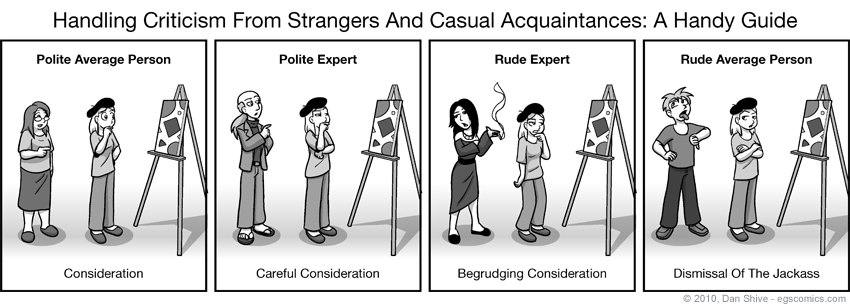

Optimally, the criticism should be both detailed and accurate. I can't really do much with "YOUR GAME SUCKS" except redo the whole game, and I wouldn't even know where to start.
author=ShortStarI thought as much!
I don't accept your criticism.

author=Alichains
Yeah, part of the problem is that even when people are trying to be constructive, they have a tendency to be overly caustic (probably in an attempt to be funny), which puts people on the defensive. A little empathy goes a long way.
author=LockeZ
Yes.
And yes.
Criticism is fine. But remember, the sunk cost fallacy is in full effect when creating video games. If someone has spent five or more years on some project (and it was actual effort vs just working every few weeks, then quitting for a month), and then someone comes along, won't even give you the courtesy of finishing the game, then yea, you can get pissed.
Here is how you do criticism.
http://rpgmaker.net/games/4761/reviews/2729/
(Despite the low rating, they go into depth on each category, explain their thinking without being brutal, discuss good points, and keep it gentle. Granted, this is not always possible, but a little honey with vinegar helps keep the reviewer from getting trolled by the creator)
Corfaisus

"It's frustrating because - as much as Corf is otherwise an irredeemable person - his 2k/3 mapping is on point." ~ psy_wombats
7874
author=bulmabriefs144
Criticism is fine. But remember, the sunk cost fallacy is in full effect when creating video games. If someone has spent five or more years on some project (and it was actual effort vs just working every few weeks, then quitting for a month), and then someone comes along, won't even give you the courtesy of finishing the game, then yea, you can get pissed.
The thing is, this post is the very antithesis to the purpose of this thread. Sure, you spend forever working on something and you're bound to become connected to it - this happens to everyone - but what matters is not caving and turning into a screaming baby the second the work is given anything but a thumbs up. You have to understand that you and your work are two separate entities, and that you owe it to your work to take in critique humbly and do what you can to improve your work because your work can't improve itself.
It's all about expression. These can be both good and bad, but for the sake of society, you'd do best to strive for good.

I think it's really hard to take criticism sometimes. Because you're putting a whole lot of yourself into the work, and it's like the work is a part of you. So by criticizing the piece, they're criticizing you as a person. But you just have to learn that, if the criticism is good, and you can honestly evaluate it and say that it may be correct, then you can change for the better. And don't get disheartened. Always create!
If inspiration is the lifeblood of an artist, criticism is his food and drink.
1) If you are being criticized, then your critic took the time to play your game/read your work/listen to your music.
2) If your critic didn't like what he or she took the time to play/read/or listen to, then odds are, he or she is not going to waste more time writing about it.
Criticism is not an attack to be repelled; it is a gift to be cherished.
1) If you are being criticized, then your critic took the time to play your game/read your work/listen to your music.
2) If your critic didn't like what he or she took the time to play/read/or listen to, then odds are, he or she is not going to waste more time writing about it.
Criticism is not an attack to be repelled; it is a gift to be cherished.

The problem with criticism is to get the timing right.
If you are not experienced and need to improve, expose yourself to critisism.
The important thing is to get it early on and to get lots of it.
Sure, you can work for 3 years, release a game and learn from your mistakes, to make your next project better, but thats a very inefficient way to go.
You should get it early on, so you can still redo or give a makeover to your first dozen maps/events/scripts, based on what you have learned from the feedback.
You should get lots of it, so you can get a somewhat more objective viewpoint.
Sometimes you only get 1-2 replies on a single site/forum which can be entirely biased in one direction, telling you its great, when there is still a lot to improve, or picking on some little detail, when its something 95% of the population wouldn't even notice.
If you are not experienced and need to improve, expose yourself to critisism.
The important thing is to get it early on and to get lots of it.
Sure, you can work for 3 years, release a game and learn from your mistakes, to make your next project better, but thats a very inefficient way to go.
You should get it early on, so you can still redo or give a makeover to your first dozen maps/events/scripts, based on what you have learned from the feedback.
You should get lots of it, so you can get a somewhat more objective viewpoint.
Sometimes you only get 1-2 replies on a single site/forum which can be entirely biased in one direction, telling you its great, when there is still a lot to improve, or picking on some little detail, when its something 95% of the population wouldn't even notice.

author=pianotm
2) If your critic didn't like what he or she took the time to play/read/or listen to, then odds are, he or she is not going to waste more time writing about it.
Unless they really didn't like in, in which case they'll vent about it to "recoup" the lost time. There's probably a lot more reviews out there for Sonic '06 than Sonic Heroes for that very reason. It helps that people can point out what went wrong a lot easier than what went right.

Get criticism as early as possible. The earlier you become aware of the problems, the easier it will be to fix them.
I do not think that all criticism is good though. Sometimes the critic has destructive motives behind the criticism. Examples I can think off includes:
1) Alpha male bullshit. The critic for one or another reason feels elevated by going down hard on the game.
2) The critic want the game to fail and is trying to sap the creator's energy. Some players will get angry enough about things such as the game having a cheap romance that they want it to not exist.
3) The critic is simple in a bad mood and vents.
Usually, in those cases the critic itself will think it's criticism as being fair and "just saying how things are" or something. If the critic apologizes for being blunt, it's a bad sign.
It seems to me that rather than simple accepting all criticism, it's more about being able to sort it properly. Not all negative criticism should be dismissed, but some maybe should after a little consideration. If you get upset by a certain piece of criticism, my advice would be to wait with responding or making a decision at all until you can approach it calmly. Lashing out at criticism will make you look bad, just not responding is usually a better idea. Note however that while you can get away with just responding to polite criticism, it will look bad if you only respond to praise. This goes back to the point that you need to be able to sort the criticism properly, taking destructive criticism to your heart will sap your energy while dismissing negative, but still constructive criticism, will harm the quality of your game.
I do not think that all criticism is good though. Sometimes the critic has destructive motives behind the criticism. Examples I can think off includes:
1) Alpha male bullshit. The critic for one or another reason feels elevated by going down hard on the game.
2) The critic want the game to fail and is trying to sap the creator's energy. Some players will get angry enough about things such as the game having a cheap romance that they want it to not exist.
3) The critic is simple in a bad mood and vents.
Usually, in those cases the critic itself will think it's criticism as being fair and "just saying how things are" or something. If the critic apologizes for being blunt, it's a bad sign.
It seems to me that rather than simple accepting all criticism, it's more about being able to sort it properly. Not all negative criticism should be dismissed, but some maybe should after a little consideration. If you get upset by a certain piece of criticism, my advice would be to wait with responding or making a decision at all until you can approach it calmly. Lashing out at criticism will make you look bad, just not responding is usually a better idea. Note however that while you can get away with just responding to polite criticism, it will look bad if you only respond to praise. This goes back to the point that you need to be able to sort the criticism properly, taking destructive criticism to your heart will sap your energy while dismissing negative, but still constructive criticism, will harm the quality of your game.

author=Crystalgate
Usually, in those cases the critic itself will think it's criticism as being fair and "just saying how things are" or something. If the critic apologizes for being blunt, it's a bad sign.
Even a critic needs criticism, especially when they give a shitty review. I'm not the best reviewer around, but I generally try to be fair and cover every area of the gaming experience. I also try to look at each segment of the game individually, and focus on the average player so my own bias doesn't show too much.
One thing I'd like to say is that game developers should look more at the written review and not so much the score. The score really negates the purpose of the review, I think, and has a tendency to create a rift between players and developers.
As a player, I've come across plenty of games that I liked that received bad reviews. Had I focused on the score, I may have missed some gems.
It's alot harder to improvise your game and make the necessary
changes without criticism. Alot of the latest reviews
tend to be too subjective.
changes without criticism. Alot of the latest reviews
tend to be too subjective.
Don't rely too heavily on reviews for feedback, the project pages allows for people to simple post their opinions without having to adhere to a review format. There is one big advantage with the reviews though, people are more likely to voice their agreement or disagreement of a review than a single post. Even so, if you want feedback, you want to encourage people who don't want to make the effort of writing a review to still post their opinions.

The whole topic is very difficult because there are very complex mechanism behind it and it seems to be especially complex with game developers (I read some articles how game developers become mental trainwrecks from criticism, up to the point of blog entries from game developers begging to not criticize games and comparing it to stuff like rape).
Regarding reviews - this depends strongly on how the review is written. If a write a review solely for the game developer (posting it in the game's forums usually) it will be COMPLETELY different than a review I write for other gamers.
And in fact if I write it for developers, it will be a lot more critical up to the point where my review for gamers is like "Game is really addictive and only has very few minor flaws, you really should play it! It made my world a bit better." and my criticism I give to the developer is a 3+ pages long list of possible improvements.
When I do criticism I do it FOR the developer. Not for other gamers, not to hurt the developer's feeling, but because I do see potential and don't want it to be wasted by minor problematic design decisions.
If I don't really like a developer, I won't even give him any criticism, so just receiving criticism from me is already a compliment.
Too bad most developers can't really accept it and always go into the defensive.
It's really hard for me to communicate with developers because of this. It feels like they have to tell me why they did what on everything I suggest. I never really feel they are even in need to defend it, so it's really strange when a developer really tries to hard explaining me why something is faulty. It always feels like he puts me into the center of the world and his whole life depends on me liking every single aspect of his game while I don't even see myself as that important and just wanted to help by giving a bunch of suggestions.
I'm not too much better myself, though. If someone criticizes my game I usually reply with a passive aggressive comment, then I go to bed and think about it and then I end up applying the suggestion to the game anyway (at least if it was a plausible one).
I remember back when I released a demo of my biggest project and people complained about how it's not fun to play because of the controls and I tried for 3-5 forum pages to explain to them that it's a design decision and intended that way and over the past years I slowly applied almost all of the suggestions that were originally given. All that criticism actually influenced me a lot and make me think about it and it helped me to improve the game from a player's viewpoint. The people who gave the suggestions will never know that I actually applied them because the replies I gave on that forum all go more into the "That's stupid, I won't change that." direction.
This should also answer the "how to you know when criticism is good and when it is not" question. Criticism isn't an instruction on what to change. You as a game developer will always decide yourself what to change. Criticism is instead a way to see your game from a gamer's viewpoint. What you need to do is to undestand the gamers and it's very hard if you just make your game and ignore all criticism. Even if you have 100% the same personality as the gamer, the impression will still be completely different. He doesn't know the dungeon structure, he doesn't know the story, he doesn't know gameplay tricks, he doesn't know which monster is weak to what element, he doesn't know about shortcut keys that you've forgotten to put into the readme file, he doesn't play the game in debug mode which you do because you're too lazy to play through your game 50+ times with no cheats, etc.
When you receive criticism, it will be at first hard to understand for you. You are not the player and you will never be able to be a player of your own game, even if you play it. What you need to do with criticism is asking yourself why the player perceived the game in a way he expressed. You need to understand this first. You need to become the player.
Even really "low constructive" criticism such a "your game is too hard" has a lot of hidden information in it. Start wondering why the player thinks the game is too hard. Realize, it's much easier for you as a developer. Think about why it's easier for you as a developer. Because the player has less information than you. So this does mean he played the game differently. Maybe the way he played it made the game too hard and not enjoyable. But solving this by just lowering monster stats might not be the best way. Maybe that player simply played the game "wrong". But we shouldn't blame him for doing so. If he played it wrong the game doesn't really seem to steer players into playing it right. Maybe more information needs to be given to the players that you as the developer know.
This is what I do all the time. Thinking about it. At first it hurts, then the hurting stops and then when you think about it, you might get a good idea how to solve it.
It actually helps when talking to players. I don't think someone is able to make a really good game without listening to players. I guess he can make an interesting game, but not one that sells well or that is 100% intuitive.
Regarding reviews - this depends strongly on how the review is written. If a write a review solely for the game developer (posting it in the game's forums usually) it will be COMPLETELY different than a review I write for other gamers.
And in fact if I write it for developers, it will be a lot more critical up to the point where my review for gamers is like "Game is really addictive and only has very few minor flaws, you really should play it! It made my world a bit better." and my criticism I give to the developer is a 3+ pages long list of possible improvements.
When I do criticism I do it FOR the developer. Not for other gamers, not to hurt the developer's feeling, but because I do see potential and don't want it to be wasted by minor problematic design decisions.
If I don't really like a developer, I won't even give him any criticism, so just receiving criticism from me is already a compliment.
Too bad most developers can't really accept it and always go into the defensive.
It's really hard for me to communicate with developers because of this. It feels like they have to tell me why they did what on everything I suggest. I never really feel they are even in need to defend it, so it's really strange when a developer really tries to hard explaining me why something is faulty. It always feels like he puts me into the center of the world and his whole life depends on me liking every single aspect of his game while I don't even see myself as that important and just wanted to help by giving a bunch of suggestions.
I'm not too much better myself, though. If someone criticizes my game I usually reply with a passive aggressive comment, then I go to bed and think about it and then I end up applying the suggestion to the game anyway (at least if it was a plausible one).
I remember back when I released a demo of my biggest project and people complained about how it's not fun to play because of the controls and I tried for 3-5 forum pages to explain to them that it's a design decision and intended that way and over the past years I slowly applied almost all of the suggestions that were originally given. All that criticism actually influenced me a lot and make me think about it and it helped me to improve the game from a player's viewpoint. The people who gave the suggestions will never know that I actually applied them because the replies I gave on that forum all go more into the "That's stupid, I won't change that." direction.
This should also answer the "how to you know when criticism is good and when it is not" question. Criticism isn't an instruction on what to change. You as a game developer will always decide yourself what to change. Criticism is instead a way to see your game from a gamer's viewpoint. What you need to do is to undestand the gamers and it's very hard if you just make your game and ignore all criticism. Even if you have 100% the same personality as the gamer, the impression will still be completely different. He doesn't know the dungeon structure, he doesn't know the story, he doesn't know gameplay tricks, he doesn't know which monster is weak to what element, he doesn't know about shortcut keys that you've forgotten to put into the readme file, he doesn't play the game in debug mode which you do because you're too lazy to play through your game 50+ times with no cheats, etc.
When you receive criticism, it will be at first hard to understand for you. You are not the player and you will never be able to be a player of your own game, even if you play it. What you need to do with criticism is asking yourself why the player perceived the game in a way he expressed. You need to understand this first. You need to become the player.
Even really "low constructive" criticism such a "your game is too hard" has a lot of hidden information in it. Start wondering why the player thinks the game is too hard. Realize, it's much easier for you as a developer. Think about why it's easier for you as a developer. Because the player has less information than you. So this does mean he played the game differently. Maybe the way he played it made the game too hard and not enjoyable. But solving this by just lowering monster stats might not be the best way. Maybe that player simply played the game "wrong". But we shouldn't blame him for doing so. If he played it wrong the game doesn't really seem to steer players into playing it right. Maybe more information needs to be given to the players that you as the developer know.
This is what I do all the time. Thinking about it. At first it hurts, then the hurting stops and then when you think about it, you might get a good idea how to solve it.
It actually helps when talking to players. I don't think someone is able to make a really good game without listening to players. I guess he can make an interesting game, but not one that sells well or that is 100% intuitive.
The foolproof solution is to say "thanks" to anything they say and take everything with a pinch of salt, before discarding it all and doing it the way you think it should be done.
Essentially, the point of criticism if so people can improve. The point is also to advertise. As in, well let's use my game review as an example. My very first game, The New Earth got pretty horrible reviews (and they were deserved, is there any way to get a link ppl can see?) and essentially faded into obscurity.
Oracle of Tao got one review, which put it as not bad but really flawed. The difference? Oracle of Tao is potentially a good game, despite its numerous bugs, and it had a good reviewer.
http://rpgmaker.net/games/1760/reviews/2210/
I'd like a better review, since I have done some work since then, but the good thing about this review, despite the fact that it was part of his game, and yea, I decided to back out but he didn't (sorry, run on sentence, I'm having trouble with upside-down punctuation) is this simple difference...
He told me what I could fix.
What is the difference between a jerk reviewer just looking for an ego trip, and an actual reviewer? The real reviewer tells what you can improve. Now, there are some things you have to keep, or else you're just trying to please a fanbase, and driving yourself nuts. But if yes, there are flaws, pointing out exactly the bug or issue turns a crappy game into at least an average one.
Oracle of Tao got one review, which put it as not bad but really flawed. The difference? Oracle of Tao is potentially a good game, despite its numerous bugs, and it had a good reviewer.
http://rpgmaker.net/games/1760/reviews/2210/
I'd like a better review, since I have done some work since then, but the good thing about this review, despite the fact that it was part of his game, and yea, I decided to back out but he didn't (sorry, run on sentence, I'm having trouble with upside-down punctuation) is this simple difference...
He told me what I could fix.
What is the difference between a jerk reviewer just looking for an ego trip, and an actual reviewer? The real reviewer tells what you can improve. Now, there are some things you have to keep, or else you're just trying to please a fanbase, and driving yourself nuts. But if yes, there are flaws, pointing out exactly the bug or issue turns a crappy game into at least an average one.

Pretty much what bulma said. I've had a couple reviews (one actually on the game, and another done in a thread), and both never even got past beta1 because of the mapping (I don't even recall anything else being an issue to them outside of the mapping sans some miscellaneous things like filesize and whantot). I've been taking that feedback and slowly fixing things up that were wrong (though some things are staying the same, sorry people!), and hope that whenever I get the next review, it'll be better than the last two. Maybe even get some more feedback on later parts of the game outside of the first 3 dungeons...>_>;;
Not much else for me to say though, as everyone else pretty much hit it straight on the nail.
Not much else for me to say though, as everyone else pretty much hit it straight on the nail.
author=turkeyDawgauthor=pianotmUnless they really didn't like in, in which case they'll vent about it to "recoup" the lost time. There's probably a lot more reviews out there for Sonic '06 than Sonic Heroes for that very reason. It helps that people can point out what went wrong a lot easier than what went right.
2) If your critic didn't like what he or she took the time to play/read/or listen to, then odds are, he or she is not going to waste more time writing about it.
Well, let's be realistic. This is RMN. Any one of us, from the best to the worst, can have a bad day and act like a juvenile ninny. It's not like we're getting paid to make games or review them in most cases. The reviewers for Sonic '06: the ones that were paid journalists had to write those reviews, and the ones that weren't paid were, odds are, already fans of Sonic the Hedgehog in general. In either case, the critics were in some way compelled to write. Chances are, the paid journalists were fans of Sonic the Hedgehog because the magazine would want someone who had experience with the series.
In a case like that, if I am a fan of a series and find a game in it that I loathe, I will be compelled to say something? Why? Because I've been let down and I want to tell the developer exactly why I'm upset.
You've all made such points as: Some reviewers hate you and have singled out your game, some reviewers want to destroy the game, they want to see it fail...why? If I hate a game, I'm not going to waste my time writing about it. What you are all talking about--there's something behind behavior like this. There's a history here. Nobody just appears out of left field obsessively stalking a perfect stranger's game like a serial killer unless he or she is severely mentally unbalanced (and even then, it's not very probable).
If you write a review telling me that my eyeballs should be sliced with razor blades, my mind is going to skip logic entirely and instinctively jump to the conclusion that my work is not what you have a problem with. There is something else going on here and it has nothing to do with the game or the review. The review is simply the vehicle for the antagonism.
Now, there are good reviews and there are bad reviews. Such is the nature of life. Nevertheless, I stick to my guns. There is a compulsion for writing a review. Where there is no compulsion, there is no criticism. If a critic plays a game by a developer that he or she doesn't know and has no expectation from, and he or she does not like that game, what on Earth is going to compel him or her to terrorize a perfect stranger, other than schizophrenia?
Even if the most inept and irrational critic write's his or her drivel on the bathroom wall, there is always value in criticism. It is a gift I say. The critic has taken his or her time and spent energy on you.
What's going to drive someone to write destructive criticism is easy, it's his/her own psychological issues. I will however note that such people are likely to choose a lower effort route, the destructive criticism will probably come in the form of a mean post rather than a review.
A game could contain sexism, feminism, be too much pro/against religion, imply that a certain political stance is wrong or in other ways tick people off. Alternatively, the game could simple give a person who has problems an opportunity to do some alpha-maling.
A game could contain sexism, feminism, be too much pro/against religion, imply that a certain political stance is wrong or in other ways tick people off. Alternatively, the game could simple give a person who has problems an opportunity to do some alpha-maling.

it's really lazy and disingenuous to dismiss negative criticism as a manifestation of mental illness, crystalgate.
e: you too, pianotm!
receiving criticism and extracting the salient points is just as important a skill as structuring that criticism in a useful manner. you need to be willing to meet critics halfway in these situations -- this incredibly childish and adversarial standpoint many of you seem to have is going to stunt your ability for introspection and further development, and that's a promise.
if you give yourself carte blanche to dismiss criticism that you feel isn't complimentary enough, or simply ignore uncomfortable points because 'oh, this person obviously has an agenda', you're ultimately only making yourself into a brittle reactionary who has no path forward but to stagnate.
e: you too, pianotm!
receiving criticism and extracting the salient points is just as important a skill as structuring that criticism in a useful manner. you need to be willing to meet critics halfway in these situations -- this incredibly childish and adversarial standpoint many of you seem to have is going to stunt your ability for introspection and further development, and that's a promise.
if you give yourself carte blanche to dismiss criticism that you feel isn't complimentary enough, or simply ignore uncomfortable points because 'oh, this person obviously has an agenda', you're ultimately only making yourself into a brittle reactionary who has no path forward but to stagnate.

