



 Full Games List
 Featured Games
 New Games
 Reviews
 Media
Media Images
 Blogs
Blogs Game Updates
 Images Feedback Summary
 Game Design Highlights
 Tutorials
 Articles
 Scripts
 Utilities / Plugins
 Resources
 Engines
 Engine Bulletins
 What is Makerscore?
 Past Events
 Achievements
 Misaos
 Forums
 Post History
 Chat
Chat New to RMN?
 Full Store List
 RMN Music Pack (free)



HELP ME COME UP WITH (BIG) CREATURES
Posts
LockeZ

I'd really like to get rid of LockeZ. His play style is way too unpredictable. He's always like this too. If he ran a country, he'd just kill and imprison people at random until crime stopped.
5958
 LockeZ
 View playlists
 Close
CloseCramshell
An artificial organism, built with extremely advanced bioengineering techniques, developed as a deep-sea housing facility. An intelligent species once lived as a community inside the large creature's body.
The shell looks like a clam shell, but has a small opening out of which its "head" emerges, like a conch.
Some conchs for reference:

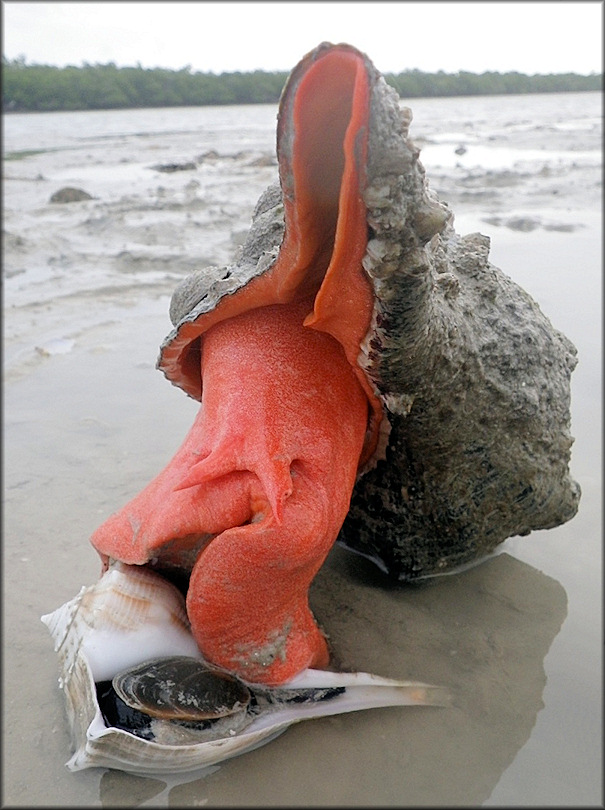

I'm imagining it having a much, much smaller "head" in proportion to its shell, though.
On the inside, which is the interesting part, it looks more like a clam.

This is what the inside of a normal clam looks like. For the Cramshell, imagine that there are about six thousand times as many of each organ, layered like this to create "platforms" with some space in between. Only a few dozen organs at a time are actually in use.
The creature's organs naturally dry up and die over time and become hard and brittle, and it grows new ones to replace them. The dead, hardened tissue is stable and flat, and works as a large platform on which it's easy to stand and walk around. When it's in the process of dying it can be easily shaped into walls and more complex structures as well. The inside of the Cramshell's body was thus formed into a series of "buildings" by an intelligent race, with artificial stairs created to allow walking from one platform to the next.
The exterior shell is extremely hard and looks similar to a typical seashell. Part of the massive creature pokes out of a (relatively) small opening in the shell like a snail. The Cramshell is immobile, but the creature was engineered to survive indefinitely on algae and waste mater that exist abundantly in the water naturally on this planet. The shell gradually grows as needed to expand the space inside it as it creates more redundant organs to replace the ones that dried up. A series of sphincters work as water-locks and allow ships to travel in and out of the creature without flooding its insides, since the race that bioengineered it require air to breathe.
The habitat inside the Cramshell is now deserted. Despite the expectations of science fiction tropes, nothing ever went wrong with its behavior or its life cycle. But the people inside depended on trade with other colonies to survive, and all of those other colonies were destroyed long ago.
The cramshell has survived eons since the fall of the civilization that created it, and has continued to grow. Its shell is now over two hundred kilometers in diameter.
An artificial organism, built with extremely advanced bioengineering techniques, developed as a deep-sea housing facility. An intelligent species once lived as a community inside the large creature's body.
The shell looks like a clam shell, but has a small opening out of which its "head" emerges, like a conch.
Some conchs for reference:
I'm imagining it having a much, much smaller "head" in proportion to its shell, though.
On the inside, which is the interesting part, it looks more like a clam.
This is what the inside of a normal clam looks like. For the Cramshell, imagine that there are about six thousand times as many of each organ, layered like this to create "platforms" with some space in between. Only a few dozen organs at a time are actually in use.
The creature's organs naturally dry up and die over time and become hard and brittle, and it grows new ones to replace them. The dead, hardened tissue is stable and flat, and works as a large platform on which it's easy to stand and walk around. When it's in the process of dying it can be easily shaped into walls and more complex structures as well. The inside of the Cramshell's body was thus formed into a series of "buildings" by an intelligent race, with artificial stairs created to allow walking from one platform to the next.
The exterior shell is extremely hard and looks similar to a typical seashell. Part of the massive creature pokes out of a (relatively) small opening in the shell like a snail. The Cramshell is immobile, but the creature was engineered to survive indefinitely on algae and waste mater that exist abundantly in the water naturally on this planet. The shell gradually grows as needed to expand the space inside it as it creates more redundant organs to replace the ones that dried up. A series of sphincters work as water-locks and allow ships to travel in and out of the creature without flooding its insides, since the race that bioengineered it require air to breathe.
The habitat inside the Cramshell is now deserted. Despite the expectations of science fiction tropes, nothing ever went wrong with its behavior or its life cycle. But the people inside depended on trade with other colonies to survive, and all of those other colonies were destroyed long ago.
The cramshell has survived eons since the fall of the civilization that created it, and has continued to grow. Its shell is now over two hundred kilometers in diameter.

Moving Forest
This is the result as it moves (Yes it's the WWF lungs of the planet ad)

but the surface of the moon looks more like this

Size: Individually each tree at the end of a cycle is about the size of a mature English oak, 3-4 metres wide and 30 metres high. As a 'forest' it can encompass around 1000 acres (imagine NY's Central Park)
Habitat: Verdant moon in a binary star system
Diet: Being plants their primary food source is via photosynthesis.
Description: The moving forest gets its name from the fact it relocates to follow fresh water sources. The moon on which it thrives orbits a barren iron rich rocky world whose gravitational forces as well as the binary star system create a geologically unstable surface, as such water courses do not stay constant from season to season and seismic activity can drain or fill an area overnight. To combat this the plants have developed a method of travel. Sending out feeler roots to locate more nutrient and water rich areas and then budding saplings. Simultaneously the parent forest is drained of all nutrients and resources leaving behind a barren and desolate patch on the landscape. Being in such water competitive system the plants have also developed deadly responses to predatory animals in toxic plant materials (both in consumption and via deadly spores that are ejected when movement is detected) and thick brambles and razor sharp thorns to trap land and air based animals and use their decomposing bodies as additional nutrient sources. These thorns are sharp enough to damage most environmental protection suits so staying clear of them is vital.
This may be too much of a plant for your needs but I thought I'd put it in anyway.
This is the result as it moves (Yes it's the WWF lungs of the planet ad)
but the surface of the moon looks more like this
Size: Individually each tree at the end of a cycle is about the size of a mature English oak, 3-4 metres wide and 30 metres high. As a 'forest' it can encompass around 1000 acres (imagine NY's Central Park)
Habitat: Verdant moon in a binary star system
Diet: Being plants their primary food source is via photosynthesis.
Description: The moving forest gets its name from the fact it relocates to follow fresh water sources. The moon on which it thrives orbits a barren iron rich rocky world whose gravitational forces as well as the binary star system create a geologically unstable surface, as such water courses do not stay constant from season to season and seismic activity can drain or fill an area overnight. To combat this the plants have developed a method of travel. Sending out feeler roots to locate more nutrient and water rich areas and then budding saplings. Simultaneously the parent forest is drained of all nutrients and resources leaving behind a barren and desolate patch on the landscape. Being in such water competitive system the plants have also developed deadly responses to predatory animals in toxic plant materials (both in consumption and via deadly spores that are ejected when movement is detected) and thick brambles and razor sharp thorns to trap land and air based animals and use their decomposing bodies as additional nutrient sources. These thorns are sharp enough to damage most environmental protection suits so staying clear of them is vital.
This may be too much of a plant for your needs but I thought I'd put it in anyway.
LockeZ
I'd really like to get rid of LockeZ. His play style is way too unpredictable. He's always like this too. If he ran a country, he'd just kill and imprison people at random until crime stopped.
5958
I like the idea of the forest, but plants rely on eating decayed material in the ground to survive. I guess it would work about the same as on Earth though, as long as they spend a while at each water source before moving on. They would shed leaves at one source of water while spending time there, and then move on to another. By the time the next group of plants got to that water source, the fallen leaves and branches would have decayed into dirt, so the ground would be fertile again.
On the other hand, it's not actually large. It's just a bunch of normal sized creatures.
SnowOwl, I'm a little tempted to just suggest that you steal the sapient electromagnetic field from this episode of star trek. I keep trying to think of ways to differentiate it from the one in the episode and make it more original, and failing.
On the other hand, it's not actually large. It's just a bunch of normal sized creatures.
SnowOwl, I'm a little tempted to just suggest that you steal the sapient electromagnetic field from this episode of star trek. I keep trying to think of ways to differentiate it from the one in the episode and make it more original, and failing.
Yes, it was definitely cyclic in nature, if the water returned to that area then the ground would have had time to recover. Like I said it might be too 'plant' for it to work, but if the travellers in the game SnowOwl is making are more of the tourist rather than the big game hunter variety the occasional 'ooh that's a cool evolutionary adaptation' may be called for, and yes it is a conglomerate entity of smaller parts but individuals don't survive on their own, they need the group to work together to provide not just the water seeking buds but the different defence mechanisms.
It's just fun to come up with these. Especially with the plethora of interesting creature designs there are out there in the web.
It's just fun to come up with these. Especially with the plethora of interesting creature designs there are out there in the web.
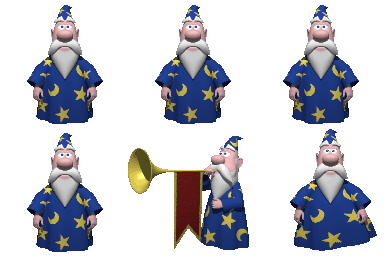
This one's a bit more creative
Lighthead Jellfish

Labeled version

(I did what snowowl does by combining different animals and adding some particle effects and also colorizing it a little bit)
Size: Around 3-5 metres as a baby and 10-15 metres as an adult.
Habitat: Around 20 kilo meters deep into the ocean
Diet: It doesn't eat. Instead, it generates it's own food.
Description: A rare jellyfish which lives deep in the ocean. It's head is half transparent so it is possible to see it's organs. It doesn't have a brain. Instead, it has an organ which generates light for seeing in the dark. If the weather is clear and it is night time, it swims to the surface and starts floating in the sky. It is harmless however it can also generate venom for self-defence. It doesn't eat and generates food by itself. It moves around randomly until it senses a female nearby(it can sense up to 50 meters), then it starts moving towards the female for reproduction. It reproduces by sending sex cells to the female by stinging her(female drops eggs to the nearest cave and abondons them).
Lighthead Jellfish
Labeled version
(I did what snowowl does by combining different animals and adding some particle effects and also colorizing it a little bit)
Size: Around 3-5 metres as a baby and 10-15 metres as an adult.
Habitat: Around 20 kilo meters deep into the ocean
Diet: It doesn't eat. Instead, it generates it's own food.
Description: A rare jellyfish which lives deep in the ocean. It's head is half transparent so it is possible to see it's organs. It doesn't have a brain. Instead, it has an organ which generates light for seeing in the dark. If the weather is clear and it is night time, it swims to the surface and starts floating in the sky. It is harmless however it can also generate venom for self-defence. It doesn't eat and generates food by itself. It moves around randomly until it senses a female nearby(it can sense up to 50 meters), then it starts moving towards the female for reproduction. It reproduces by sending sex cells to the female by stinging her(female drops eggs to the nearest cave and abondons them).
LockeZ
I'd really like to get rid of LockeZ. His play style is way too unpredictable. He's always like this too. If he ran a country, he'd just kill and imprison people at random until crime stopped.
5958
author=nhubiYeah, that's true of almost every single organism. By that logic, damn near every plant and animal on every planet qualifies. That's not what he's asking for. He's asking for huge individual creatures.
yes it is a conglomerate entity of smaller parts but individuals don't survive on their own, they need the group to work together to provide not just the water seeking buds but the different defence mechanisms.
About the Moving Forest: The game is certainly more touristy than huntery. But while it's a interesting concept, I don't think it would be usable. From the players perspective, all they would see most of the time would be a forest. Basically it's a bit lacking in the wow-factor I would like. It could perhaps feature on some planet, but not as the main attraction.
Cramshell:It has potential, walking around in one of these could be a cool experience and the backstory adds to it. The part that pokes out could look neat too, and makes for a good set-piece. I'll add it as a "maybe".
Lighthead Jellyfish: What does it generate this food from? You need to expend energy to live, and energy doesn't come from nowhere. It also seems to have some kind of strange power of flight? Plus why does it need to leave the sea? Other than that, it's mostly just a big jellyfish, isn't it? Needs work.
Edit:
Gasbag (nhubis)

Cramshell:It has potential, walking around in one of these could be a cool experience and the backstory adds to it. The part that pokes out could look neat too, and makes for a good set-piece. I'll add it as a "maybe".
Lighthead Jellyfish: What does it generate this food from? You need to expend energy to live, and energy doesn't come from nowhere. It also seems to have some kind of strange power of flight? Plus why does it need to leave the sea? Other than that, it's mostly just a big jellyfish, isn't it? Needs work.
Edit:
Gasbag (nhubis)
Dang I tought the concept was good :P
It doesn't really need to leave the sea I felt like ''Hmmm should I base it on a flying jellyfish or a normal underwater jellyfish? Why not both?''
It is true that animals need energy to live, but the idea of it emitting light sounded pretty cool :P
Here's a bit of what I had in mind:

It looks a little more original like this since it has some features normal jellyfish don't have.
*Edit*
And yes, I know that thing you made wasn't a jellyfish XD
It doesn't really need to leave the sea I felt like ''Hmmm should I base it on a flying jellyfish or a normal underwater jellyfish? Why not both?''
It is true that animals need energy to live, but the idea of it emitting light sounded pretty cool :P
Here's a bit of what I had in mind:
It looks a little more original like this since it has some features normal jellyfish don't have.
*Edit*
And yes, I know that thing you made wasn't a jellyfish XD
Yeah that's cool I thought it might be too plantlike, maybe have it as another feature on a world with something large and meaty on it.
Oh I like the gasbag, that looks great!
Oh I like the gasbag, that looks great!
Since you are looking for more gas giant type critters
Cloud Shark
A mix between these two, the mouth piece like this one that opens like a flower with a membrane connecting them...

and this one, for the vents, sheer size and the greenish blue methane clouds.

Size: 25 -30 metres (80-100ft)
Diet: This giant of the skies is actually in a symbiotic relationship with bacterial Methanotrophs. These microscopic creatures live inside the mouth and digestive tract of the Cloud Shark and harvest the methane that it swallows, converting it into simple but rich carbohydrates that then power the giant floating beast.
Habitat: High Methane gas giants
Description: The Cloud Shark coasts through the skies of methane rich gas giants, swallowing vast amounts of the atmosphere in a similar manner to Earth's basking shark and supplying the colony of Methanotrophs their food supply. The gases that cannot be harvested by the bacteria, hydrogen and helium, are then used by the creature as a form of propulsion. Vents on all sides of its body are connected internally to storage sacks, and the Cloud Shark expels the gasses from these vents in order to propel its massive bulk through the dense atmosphere in search of methane rich clouds and updrafts. These vents are incredibly precise and can enable the Cloud Shark to circle around a dense feeding stream until all the methane has been collected. These gentle giants have neither offensive nor defensive capabilities except for their great size and weight, though being in the path of one may get you swallowed inadvertently, and the blast from one of the gas vents can act in a manner similiar to turbulence in a storm, so a safe distance is recommended.
Cloud Shark
A mix between these two, the mouth piece like this one that opens like a flower with a membrane connecting them...
and this one, for the vents, sheer size and the greenish blue methane clouds.
Size: 25 -30 metres (80-100ft)
Diet: This giant of the skies is actually in a symbiotic relationship with bacterial Methanotrophs. These microscopic creatures live inside the mouth and digestive tract of the Cloud Shark and harvest the methane that it swallows, converting it into simple but rich carbohydrates that then power the giant floating beast.
Habitat: High Methane gas giants
Description: The Cloud Shark coasts through the skies of methane rich gas giants, swallowing vast amounts of the atmosphere in a similar manner to Earth's basking shark and supplying the colony of Methanotrophs their food supply. The gases that cannot be harvested by the bacteria, hydrogen and helium, are then used by the creature as a form of propulsion. Vents on all sides of its body are connected internally to storage sacks, and the Cloud Shark expels the gasses from these vents in order to propel its massive bulk through the dense atmosphere in search of methane rich clouds and updrafts. These vents are incredibly precise and can enable the Cloud Shark to circle around a dense feeding stream until all the methane has been collected. These gentle giants have neither offensive nor defensive capabilities except for their great size and weight, though being in the path of one may get you swallowed inadvertently, and the blast from one of the gas vents can act in a manner similiar to turbulence in a storm, so a safe distance is recommended.
Oh, another classic when it comes to scifi creatures. Well thought out how it eats and moves. It's such a cool creature I might end up using it even though it's somewhat unoriginal..
Well given gas giants you're going to get a bit of crossover with marine like creatures simply because of the environment, and the fact you are looking for something huge which means they have to swim in the atmosphere. I did find a picture that is probably closer to the shark end of the spectrum. It was created for an animated short film that I'm not sure ever got made.


I like it, but if I may offer a suggestion, perhaps flip the tail 90 degrees. Given it's not needed for propulsion like a whale's fluke through the water, it could be used more like a rudder to augment the directional manoeuvrability of the animal, like a those on an aircraft.
Wow that indeed is big. I would like to ride that bad boy <3
Maybe it could be a boss battle like something from Shadow of Colossus where you need to get on the Colossi and find it's weak point, so you would dodge enemies on the back of the whale while trying to find it's weak spot.
Maybe it could be a boss battle like something from Shadow of Colossus where you need to get on the Colossi and find it's weak point, so you would dodge enemies on the back of the whale while trying to find it's weak spot.
Ok, something more for solid ground
Snatcher
This is the sort of thing you see above the surface.

and this is what is below

Size: The primary 'flower' measures approx 6 metres across (20 ft) and 7 -8 metres high (26 ft). The bulk of the animal is rarely seen but has been estimated as a long (or deep) as 80 metres. However most of the animal's bulk is contained in a tight space to allow for rapid movement when it springs its trap.
Habitat: Semi-Arid plains where there is little competition from natural flower species.
Diet: Indiscriminate but mostly carrion eaters
Description: Much like the iceberg the snatcher only shows 10% of its bulk above the surface, appearing as a field of thickset flowers giving off the sweet smell of decaying flesh. This scent attracts roaming carrion eaters such as veldtbeasts and abarats who wander into the field, and even the occasional buzzer who flies down to investigate. The smaller flowers are dummies, with limited scent whose purpose is to funnel the prey towards the 'head' flower - the largest and most pungent. Once they make contact the flexible and resilient 'stamens' wrap around the hapless animal holding it in place and allow the killing portion of the creature to rise up to the surface. The fanged ripping claws make short work of whatever animal it catches and feeds the remains into the centrally located mouth. The snatcher then retracts back underground leaving not just the flowers to act as a lure for its next meal but the blood and uneaten entrails of the previous kill.
Snatcher
This is the sort of thing you see above the surface.
and this is what is below
Size: The primary 'flower' measures approx 6 metres across (20 ft) and 7 -8 metres high (26 ft). The bulk of the animal is rarely seen but has been estimated as a long (or deep) as 80 metres. However most of the animal's bulk is contained in a tight space to allow for rapid movement when it springs its trap.
Habitat: Semi-Arid plains where there is little competition from natural flower species.
Diet: Indiscriminate but mostly carrion eaters
Description: Much like the iceberg the snatcher only shows 10% of its bulk above the surface, appearing as a field of thickset flowers giving off the sweet smell of decaying flesh. This scent attracts roaming carrion eaters such as veldtbeasts and abarats who wander into the field, and even the occasional buzzer who flies down to investigate. The smaller flowers are dummies, with limited scent whose purpose is to funnel the prey towards the 'head' flower - the largest and most pungent. Once they make contact the flexible and resilient 'stamens' wrap around the hapless animal holding it in place and allow the killing portion of the creature to rise up to the surface. The fanged ripping claws make short work of whatever animal it catches and feeds the remains into the centrally located mouth. The snatcher then retracts back underground leaving not just the flowers to act as a lure for its next meal but the blood and uneaten entrails of the previous kill.
Swampie

Size: Huge. Between 25 - 30 metres (80-100ft) high, 35- 42 metres (120-140ft) long
Habitat: Swamp on high oxygen planet.
Diet: Herbivore. Trees, leaves, mosses, fungi.
Description: This slow moving herbivore lives exclusively in the swamps and rarely ventures beyond the extensive borders of its home territory, content to feed on the young and sweet saplings, leaves and mosses that are in plentiful supply on its oxygen rich world. Due to its sheer size, this giant cannot expend energy in high activity pursuits and spends most of its days grazing from one patch of its large domain to the next. Due to its mostly sedentary lifestyle Swampie has become the habitat for a multitude of smaller species both animal and vegetable who nest and grow in its long matted fur, and aid in camouflaging the animal during it's juvenile years when it is still possible prey for the larger swamp predators. Swampie's go through three stages in their life cycle, infants where they are no larger than a baby Earth elephant and are protected by their breeding herd. Juveniles where they are prey to other swamp denizens and are the favourite prey of Dracos (Crocodile like carnivores) and when they enter into mating partnerships and breed, and adults who strike out on their own and grow to massive size but live solitary lives.
Size: Huge. Between 25 - 30 metres (80-100ft) high, 35- 42 metres (120-140ft) long
Habitat: Swamp on high oxygen planet.
Diet: Herbivore. Trees, leaves, mosses, fungi.
Description: This slow moving herbivore lives exclusively in the swamps and rarely ventures beyond the extensive borders of its home territory, content to feed on the young and sweet saplings, leaves and mosses that are in plentiful supply on its oxygen rich world. Due to its sheer size, this giant cannot expend energy in high activity pursuits and spends most of its days grazing from one patch of its large domain to the next. Due to its mostly sedentary lifestyle Swampie has become the habitat for a multitude of smaller species both animal and vegetable who nest and grow in its long matted fur, and aid in camouflaging the animal during it's juvenile years when it is still possible prey for the larger swamp predators. Swampie's go through three stages in their life cycle, infants where they are no larger than a baby Earth elephant and are protected by their breeding herd. Juveniles where they are prey to other swamp denizens and are the favourite prey of Dracos (Crocodile like carnivores) and when they enter into mating partnerships and breed, and adults who strike out on their own and grow to massive size but live solitary lives.
I see you got right back on it. Nice. 1st is probably a bit too complicated to make something interesting of in the game but 2nd is definitely usable.
(This one is from the pack of battlers I am working on, but without the tree on his head)
http://i.imgur.com/YRbV6tS.png
(Large image)
Name: Camoslug
Size: Depends on how big the object on his head is. He is twice as big as it.
Habitat: It can live anywhere(the one I included is a forest type one)
Diet: Takes energy from the ground, just like a tree.
Description: The Camoslug comes in different variations depending on where it lives. They camoflague with the objects at the area and blend in to hide. The most common versions have trees, rocks, corals or even buildings on heads, but some rarer versions may have ores on their heads making them a great source of farming. They act like slugs and crawl through the floor. (I know it's a slime in the picture just pretend it's a slug). They are harmless but gross, so you don't wanna get near one.
http://i.imgur.com/YRbV6tS.png
(Large image)
Name: Camoslug
Size: Depends on how big the object on his head is. He is twice as big as it.
Habitat: It can live anywhere(the one I included is a forest type one)
Diet: Takes energy from the ground, just like a tree.
Description: The Camoslug comes in different variations depending on where it lives. They camoflague with the objects at the area and blend in to hide. The most common versions have trees, rocks, corals or even buildings on heads, but some rarer versions may have ores on their heads making them a great source of farming. They act like slugs and crawl through the floor. (I know it's a slime in the picture just pretend it's a slug). They are harmless but gross, so you don't wanna get near one.
That's cool, I just hadn't included a stealth predator. Since with the size, predators are a little more difficult as they usually have to be fast moving, hence the reason I though of something that didn't expend it's energy and lay in wait instead.
OK, something for the ice world types.
Shaggy Boarbear

Size: Massive 15-18 metres tall, 25 meters snout to tail (females) or tusktip to tail (males)
Habitat: Subarctic (Winter lasts half a year, Spring and Autumn a month each and Summer 4 months)
Diet: Omnivore
Description: Living on frozen worlds this hairy ice dweller is a voracious omnivore, eating everything it can catch or scavenge in order to build up its bulk for its long hibernation period. Active during the short-lived spring and summer on its homeworld, it spends the month long spring of its emergence cycle engaged in dominance and mating, and the longer summer foraging for food.
Females of the species congregate after emergence with their newborn or year-old cubs. Males are lone hunters who seek the females in the earliest part of the temperate seasons in order to mate. The larger females only mate every two years and will fight a male who attempts mating with a mother of newborns. For this reason sometimes the males will attempt to kill newborn pups not only for the chance to push the mother into a mating cycle but also for the protein. This attempt is predominantly unsuccessful and unfortunate males can be badly wounded or even killed in the response from the female herd. These battles do not employ the distinctive tusks which only the males grow; they are used in dominance displays with other males.
Once mating has ended the females packs disperse and like their male counterparts hunt for any and all food sources. These include smaller predatory species, their long snout enabling them to specialise in the plethora of subterranean species who live underground to avoid the worst of the climate , herbivores who feed on the trees and flowers that bloom during the warmer months, amphibians, fish and even the bark and fruits of the alpine trees.
The thick pelt of the Shaggy Boarbear is comprised of three layers, a thick underfur which is permanent, a middle layer to aid with insulation and protect the underfur and the outermost layer of longer, generally coarser hairs. These hairs are shed and re-grown during the summer and the discarded hair is used by other denizens of the Arctic world to build nests and insulate burrows.
OK, something for the ice world types.
Shaggy Boarbear
Size: Massive 15-18 metres tall, 25 meters snout to tail (females) or tusktip to tail (males)
Habitat: Subarctic (Winter lasts half a year, Spring and Autumn a month each and Summer 4 months)
Diet: Omnivore
Description: Living on frozen worlds this hairy ice dweller is a voracious omnivore, eating everything it can catch or scavenge in order to build up its bulk for its long hibernation period. Active during the short-lived spring and summer on its homeworld, it spends the month long spring of its emergence cycle engaged in dominance and mating, and the longer summer foraging for food.
Females of the species congregate after emergence with their newborn or year-old cubs. Males are lone hunters who seek the females in the earliest part of the temperate seasons in order to mate. The larger females only mate every two years and will fight a male who attempts mating with a mother of newborns. For this reason sometimes the males will attempt to kill newborn pups not only for the chance to push the mother into a mating cycle but also for the protein. This attempt is predominantly unsuccessful and unfortunate males can be badly wounded or even killed in the response from the female herd. These battles do not employ the distinctive tusks which only the males grow; they are used in dominance displays with other males.
Once mating has ended the females packs disperse and like their male counterparts hunt for any and all food sources. These include smaller predatory species, their long snout enabling them to specialise in the plethora of subterranean species who live underground to avoid the worst of the climate , herbivores who feed on the trees and flowers that bloom during the warmer months, amphibians, fish and even the bark and fruits of the alpine trees.
The thick pelt of the Shaggy Boarbear is comprised of three layers, a thick underfur which is permanent, a middle layer to aid with insulation and protect the underfur and the outermost layer of longer, generally coarser hairs. These hairs are shed and re-grown during the summer and the discarded hair is used by other denizens of the Arctic world to build nests and insulate burrows.
Re Ice-world, I would really have liked to come up with something for this gigantic thing, but I couldn't justify it without magic.
Ice Reptile


