



 Full Games List
 Featured Games
 New Games
 Reviews
 Media
Media Images
 Blogs
Blogs Game Updates
 Images Feedback Summary
 Game Design Highlights
 Tutorials
 Articles
 Scripts
 Utilities / Plugins
 Resources
 Engines
 Engine Bulletins
 What is Makerscore?
 Past Events
 Achievements
 Misaos
 Forums
 Post History
 Chat
Chat New to RMN?
 Full Store List
 RMN Music Pack (free)



 Profile
 Locker
 Play Lists
SVIEL'S PROFILE
Sviel

2006
 Close
Close
It turns out that I really dislike words. Not surprisingly, I recently switched from a CS Engineering major to Creative Writing; practically left my degree at the altar.
I like fine-tuning mechanics and writing long novels on the beach.
I like fine-tuning mechanics and writing long novels on the beach.
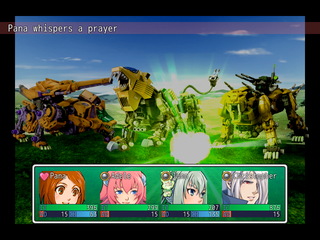
Zoids | Whisper
A healer tries to piece paradise back together after tragedy strikes...or at least keep the shards from slipping through her fingers.
A healer tries to piece paradise back together after tragedy strikes...or at least keep the shards from slipping through her fingers.
Search
Filter
 All
All Game Pages
 User Statuses
 Custom Battle System in progress
 An Oathguard Named Desire
author=mellytan
Going with a game: Oathguard was always mostly about the story/characters/world and as I made the RM2k3 game I always felt like I was shoehorning gameplay in, or otherwise twisting the story so that I could fit in another battle just so I could feel justified calling the whole experience a "game".
What about calling it a Visual Novel instead of a game so that you don't have to shoehorn anything in? That way, you could avoid the parts of novel writing that don't translate well from games.
 Design principles vol. 1: RPGs and strategy
Depth is not always borne of complexity. Though, adding more! systems on top makes it harder to see just how deep the pool is.
Not to say that other 'dimensions' are never good, just, that they won't fix the issue if the underlying problem remains.
Not to say that other 'dimensions' are never good, just, that they won't fix the issue if the underlying problem remains.
Design principles vol. 1: RPGs and strategy
I definitely want to help judge or participate, though, I think I'll wait a while to decide which. I won't be able to to do much RPG Maker wise until mid-august, if then, but I know I'll have full internet access back by the time judging rolls around.
Design principles vol. 1: RPGs and strategy
Ah, well if it helps, I tend not to get things anyway.
Going to be busy for a few days with work, probably, but I'll check back w/e you update. I hope.
Going to be busy for a few days with work, probably, but I'll check back w/e you update. I hope.
Design principles vol. 1: RPGs and strategy
What is Nature? Forgive me if I sound ignorant, but, I've been mostly offline for months so the only Nature I know consists of a very clean lake.
Even if built from the basic building blocks, iterative playtesting would still be time-consuming. I don't think that it'd be perfect(ish) right off.
Though, it sounds like you were not suggesting anything as arcane as what I was thinking. A 'little bit of algebra' is definitely a good investment; I was thinking more along the lines of a 'whole lot of discrete mathmatics.'
Even if built from the basic building blocks, iterative playtesting would still be time-consuming. I don't think that it'd be perfect(ish) right off.
Though, it sounds like you were not suggesting anything as arcane as what I was thinking. A 'little bit of algebra' is definitely a good investment; I was thinking more along the lines of a 'whole lot of discrete mathmatics.'
Design principles vol. 1: RPGs and strategy
I definitely agree that in order to create anything capable of any representation of strategy, we need to be aware of the first principles, so to speak.
But, taking everything to the patterns stage seems overzealous. On one hand, understanding the underlying principles can be very helpful (I've since forgiven my teachers for forcing me to learn processor commands), but (much like processor commands) making anything like a full scale game using those would require a gargantuan amount of time and effort. Once understood, it would be better to speak in more common-language terms.
So, a demonstration would be a very useful learning tool, but...I don't think it's practical for the games that people are trying to make today.
Fully realizing that my position has somewhat shifted over the course of this post, what say you about a contest in which people create a very short game (like 3-5 battles) in which they adhere strictly to these principles? Also, there's probably an article in here somewhere.
But, taking everything to the patterns stage seems overzealous. On one hand, understanding the underlying principles can be very helpful (I've since forgiven my teachers for forcing me to learn processor commands), but (much like processor commands) making anything like a full scale game using those would require a gargantuan amount of time and effort. Once understood, it would be better to speak in more common-language terms.
So, a demonstration would be a very useful learning tool, but...I don't think it's practical for the games that people are trying to make today.
Fully realizing that my position has somewhat shifted over the course of this post, what say you about a contest in which people create a very short game (like 3-5 battles) in which they adhere strictly to these principles? Also, there's probably an article in here somewhere.
Design principles vol. 1: RPGs and strategy
But, with how far you've simplified it, what could possibly not be recreated by some other combination? Unless we account for enemy damage and factors affecting the player characters beyond just damage (like, say, threat rate), then we can't really escape from the 'everything is really a bar juggling game' outlook.
That said, can't there be legitimate strategy in a game about juggling enemy/allied bars? At least, provided we observe some rules like not having Fire and Fire 2.
That said, can't there be legitimate strategy in a game about juggling enemy/allied bars? At least, provided we observe some rules like not having Fire and Fire 2.
Design principles vol. 1: RPGs and strategy
^^I tried to check out the vids, but I can't watch them in a high enough quality to really understand what's going on. The sheer number of skills is off-putting to me, but, that may be because I'm just getting a peek in the middle of the game.
When you say 'add something truly new that could be done otherwise in terms...' are you saying something that does not contribute to the bar juggling or are you referring to something else?
In the third paragraph, am I right in guessing that you meant 'do away entirely with some aspects' instead of 'do entirely with?'
Assuming I have assumed correctly...
What would be an example of something that doesn't boil down to the bars? And, as the bars are ultimately the goal of combat, how would that fit? Adding such a thing would make for a more varied meta-analysis, but I don't see how it is necessary to create a great game.
I'm all for doing away with stuff (Like dungeons...I hate dungeons), but there must be a very compelling reason to dump turns or hp. Such things make RPGs accessible, much like RPG Maker makes making/playing amateur games more accessible.
When you say 'add something truly new that could be done otherwise in terms...' are you saying something that does not contribute to the bar juggling or are you referring to something else?
In the third paragraph, am I right in guessing that you meant 'do away entirely with some aspects' instead of 'do entirely with?'
Assuming I have assumed correctly...
What would be an example of something that doesn't boil down to the bars? And, as the bars are ultimately the goal of combat, how would that fit? Adding such a thing would make for a more varied meta-analysis, but I don't see how it is necessary to create a great game.
I'm all for doing away with stuff (Like dungeons...I hate dungeons), but there must be a very compelling reason to dump turns or hp. Such things make RPGs accessible, much like RPG Maker makes making/playing amateur games more accessible.
Design principles vol. 1: RPGs and strategy
I think, perhaps, you're taking some things for granted that I am not quite wed to. I don't think that having multiple paths to victory means that any of them needs to be easy. Something like Strongest Skill Spam is a definite red flag in any combat system. Any design worthy of the tag 'decent' should not be subject to that.
Even so, I think you're right in that it's more of a projection than the real deal, but that seems fine to me. So long as there is enough strategy to keep the player on their toes throughout the game, there's no need to go all the way. The goal is to make the game fun and engaging, not create a new set of mechanics to last through the ages.
In addition, it's important that the system isn't too arcane. Like Go (or chess), the rules should be simple to pick up. It is a very small subset of players that want to have to study combat for ten minutes before engaging in it with any hope of success. Simply adding complexity is, in essence, like polishing the turd.
Since combat boils down to juggling those bars, it makes sense to trim redundancy in skills. Moving the bars should happen, yes, but there should be some other motivation to use at least 3 skills at any given time, all of which can make an impact in some way, even if it's just additional bar movement. There should never be a skill that does X damage and nothing else alongside a skill that does Y damage and nothing else. Instead, give one skill an incentive in certain situations and the other incentives elsewhere, but make sure that the situations either overlap or conflict, such as where one skill makes the other less useful (but perhaps you want it to be useful later).
To be concise (is it too late for that?!), I think that a turn-based set-up can be strategic. The problems you've mentioned are real and prevalent, but not unavoidable. Much like Othello, where the players are literally fighting over two 'bars' (black chips vs white chips), the method by which the juggling happens can bear sufficient strategy.
Even so, I think you're right in that it's more of a projection than the real deal, but that seems fine to me. So long as there is enough strategy to keep the player on their toes throughout the game, there's no need to go all the way. The goal is to make the game fun and engaging, not create a new set of mechanics to last through the ages.
In addition, it's important that the system isn't too arcane. Like Go (or chess), the rules should be simple to pick up. It is a very small subset of players that want to have to study combat for ten minutes before engaging in it with any hope of success. Simply adding complexity is, in essence, like polishing the turd.
Since combat boils down to juggling those bars, it makes sense to trim redundancy in skills. Moving the bars should happen, yes, but there should be some other motivation to use at least 3 skills at any given time, all of which can make an impact in some way, even if it's just additional bar movement. There should never be a skill that does X damage and nothing else alongside a skill that does Y damage and nothing else. Instead, give one skill an incentive in certain situations and the other incentives elsewhere, but make sure that the situations either overlap or conflict, such as where one skill makes the other less useful (but perhaps you want it to be useful later).
To be concise (is it too late for that?!), I think that a turn-based set-up can be strategic. The problems you've mentioned are real and prevalent, but not unavoidable. Much like Othello, where the players are literally fighting over two 'bars' (black chips vs white chips), the method by which the juggling happens can bear sufficient strategy.
 Games - Tester
 Games - Other
