



 Full Games List
 Featured Games
 New Games
 Reviews
 Media
Media Images
 Blogs
Blogs Game Updates
 Images Feedback Summary
 Game Design Highlights
 Tutorials
 Scripts
 Utilities / Plugins
 Resources
 Engines
 Engine Bulletins
 What is Makerscore?
 Past Events
 Achievements
 Misaos
 Forums
 Post History
 Chat
Chat New to RMN?
 Full Store List
 RMN Music Pack (free)



 Profile
 Locker
 Play Lists
HASVERS'S PROFILE
Hasvers

1298
 Close
Close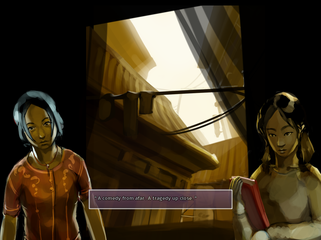
Exeunt Omnes
A game of strategic sophistry. Convince or crush the teenage girl who wants to end your reign of evil.
A game of strategic sophistry. Convince or crush the teenage girl who wants to end your reign of evil.
Search
Filter
 All
All Game Pages
 User Statuses
 Community Spotlight Interview: Something Classic
Good dog, LunC is on this? I had no idea, somehow. I'm very much done with retro, but I'll buy anyway, if only as belated thanks for The Way.
Detective Games - Risking the Unwinnable
The tricky thing about true detective stuff is that there's a discrepancy between the representation of the world that the (linearly written) story presupposes, and the one that is given to the player. There's a degree of guesswork that goes in translating what the story is trying to tell into something that the player can actually do (which is generally limited to walking around, or picking options from a menu). Handholding is just a way to limit the arbitrariness and painfulness of that guesswork for the player.
To avoid it, you must either tone down the story to fit the player's tools (e.g. narratives where it makes sense to just be walking around, like Gone Home or a horror game where you're being chased by a monster) or expand the tools to fit the story. The best is to end up somewhere in between: for instance, as in Clue, have a mechanism that can represent some actions, and limit the story to something that can be represented like that in a clear, unambiguous way.
The closer your mechanism for representing information is to how you actually designed the story, the more likely it will be to let the player express their own thoughts and insights in a productive way.
To avoid it, you must either tone down the story to fit the player's tools (e.g. narratives where it makes sense to just be walking around, like Gone Home or a horror game where you're being chased by a monster) or expand the tools to fit the story. The best is to end up somewhere in between: for instance, as in Clue, have a mechanism that can represent some actions, and limit the story to something that can be represented like that in a clear, unambiguous way.
The closer your mechanism for representing information is to how you actually designed the story, the more likely it will be to let the player express their own thoughts and insights in a productive way.
Detective Games - Risking the Unwinnable
Good luck on making the prototype, and please feel free to experiment with the idea! I've also been frustrated by how guided most detective games (or similarly insight-based games like Phoenix Wright) tend to be, so I'd be super happy to see what you come up with.
Detective Games - Risking the Unwinnable
You could a few generic actions that are always available for use in these formulas. Stuff that is sufficiently broad in meaning that it can be used in multiple contexts.
With stuff like get/take, give, see, say... you can cover a lot of ground ("mr X" "get" "cigarettes" "at the store"), and you avoid the problem with parser interactive fiction where you need to guess the verb the author was thinking about.
One way I'd visualize a system like this: you've got a box where you mix the recipe and you can drop in various elements from an inventory, like "subject: mr X", "action:give" , "object:cigarettes", "target: ms Y", "location:store", "time:yesterday" so that the order of the 'sentence' doesn't matter, and it's easy to add more or less elements (for instance location or time are not always part of the recipe). For elements that can occupy different roles you may need first to combine "mr X" with "subject" or "target" before throwing it into the mix.
If that turns out to be too complicated, you can also have a few templates where boxes have to be filled for each of these roles (a template for direct action, indirect action, action at a location, and so on...)
With stuff like get/take, give, see, say... you can cover a lot of ground ("mr X" "get" "cigarettes" "at the store"), and you avoid the problem with parser interactive fiction where you need to guess the verb the author was thinking about.
One way I'd visualize a system like this: you've got a box where you mix the recipe and you can drop in various elements from an inventory, like "subject: mr X", "action:give" , "object:cigarettes", "target: ms Y", "location:store", "time:yesterday" so that the order of the 'sentence' doesn't matter, and it's easy to add more or less elements (for instance location or time are not always part of the recipe). For elements that can occupy different roles you may need first to combine "mr X" with "subject" or "target" before throwing it into the mix.
If that turns out to be too complicated, you can also have a few templates where boxes have to be filled for each of these roles (a template for direct action, indirect action, action at a location, and so on...)
Detective Games - Risking the Unwinnable
I have a slightly different suggestion - it is not incompatible with what you suggest, but I feel it is a bit more elegant (as it does not force a dead end).
If you don't want the player to just find things at random, you can use combinatorial explosion.
Imagine an "insight crafting" system where you have to put multiple elements together, Clue-style ("Mr X" "bought" "cigarettes" "at the shop"), and if the recipe is successful, you obtain/unlock a new topic/action/something.
Even if you have only 5 characters, 5 actions, 10 objects and 4 places for the whole game, that gives you a thousand possibilities - more than any player should be willing to exhaust - while making the correct combination is obvious once you've inferred what was happening.
If there's more than a single template, or even almost freeform combination (X saw Y kill Z), exhaustive search is even less plausible. The only thing that a player might be able to brute force is one missing element when they're pretty sure of the rest of the formula, and that's really not so bad (even Sherlock sometimes proceeds by elimination!)
If you don't want the player to just find things at random, you can use combinatorial explosion.
Imagine an "insight crafting" system where you have to put multiple elements together, Clue-style ("Mr X" "bought" "cigarettes" "at the shop"), and if the recipe is successful, you obtain/unlock a new topic/action/something.
Even if you have only 5 characters, 5 actions, 10 objects and 4 places for the whole game, that gives you a thousand possibilities - more than any player should be willing to exhaust - while making the correct combination is obvious once you've inferred what was happening.
If there's more than a single template, or even almost freeform combination (X saw Y kill Z), exhaustive search is even less plausible. The only thing that a player might be able to brute force is one missing element when they're pretty sure of the rest of the formula, and that's really not so bad (even Sherlock sometimes proceeds by elimination!)
Using OODA to write battler AI
author=LouisCyphre
It's cute on paper but it is remarkably unsatisfying to play against
I wonder. That's definitely true if you also make enemies stronger and/or more numerous. I could see the appeal of a game where you are the guy with 5-digit HP fighting four puny humans who happen to be clever. Though of course they have to be able to fail in predictable ways.
Opinion: Stop Rating Demos, It's Unfair...To Completed Games
I agree, for people like you and me, stars are going to be a factor - but not the only one, which is what really counts in the end. If the title, screenshot and snippet are interesting enough you'll take a further look, see the gamepage, perhaps browse the reviews to see why there's such a contrast between the score and the apparent value. People who decide based on stars *only* are probably those who never opened a novel in a bookstore just because it looked interesting.
Anyway people are angry at rating systems all over the internet and yet if you allow enough people to cast a vote rather than try to limit it, scores can be quite robust (even to unfair attacks) across various systems and especially in terms of relative ranking.
Anyway people are angry at rating systems all over the internet and yet if you allow enough people to cast a vote rather than try to limit it, scores can be quite robust (even to unfair attacks) across various systems and especially in terms of relative ranking.
Opinion: Stop Rating Demos, It's Unfair...To Completed Games
Adon, you are assuming that people who don't even read reviews before ignoring a 3.5 (or 2.5, for that matter) star game would give relevant feedback on a demo. I'm not really convinced by this.
It's generally easy enough, from the title and the first few lines of a review, to know whether A) the demo might be worth trying after all (because it caters to my tastes if not to the reviewer's) or B) the reviewer is just being pretentious or hateful.
This minimal effort is the difference between random visitors who are pure consumers and care only about stars, and community members who may actually be helpful critiques. Apart from some hurt feelings (which are a factor, sure), I have yet to see how the system is so broken.
It's generally easy enough, from the title and the first few lines of a review, to know whether A) the demo might be worth trying after all (because it caters to my tastes if not to the reviewer's) or B) the reviewer is just being pretentious or hateful.
This minimal effort is the difference between random visitors who are pure consumers and care only about stars, and community members who may actually be helpful critiques. Apart from some hurt feelings (which are a factor, sure), I have yet to see how the system is so broken.
Opinion: Stop Rating Demos, It's Unfair...To Completed Games
Both you and I probably belong to the category of people who actually read reviews, which is not the entire population. That being said, stars do help detect really good or bad games and the measure of consensus about them in a single glance. All kinds of unfairness that may result from a scoring system can plausibly be avoided altogether by a very simple measure: the appropriate filtering of games (by genre, completion, length, good and bad traits...) so that those very different items are actually not in competition for our attention.
Overall, I could get behind an option for each game (whatever its state of completion) to make its score private or public, though I really think we give such a high weight to scores only because of years of Pavlovian conditioning by a terrible school system :P
Overall, I could get behind an option for each game (whatever its state of completion) to make its score private or public, though I really think we give such a high weight to scores only because of years of Pavlovian conditioning by a terrible school system :P
Opinion: Stop Rating Demos, It's Unfair...To Completed Games
As an afterthought:
I guess one way to try to go around it would be to further divide the first purpose you mention into two different aims: evaluation and diffusion, the first being less relevant for demos while the second one is actually important for feedback (and hype building I guess). But even then, it's not completely obvious.
"Pure" product evaluation is well separated from feedback for AAA games because there is no overlap between consumers and contributors, and few consumers are interested in versions < 1.0. It's less convincing for our community, or even for indie games in general (and open software too).
Another equivalent could be found in episodic material, including games that are released that way. Reviews for episodes in TV series cannot work exactly like movie reviews, especially as the TV series may very well be discontinued by producers before their intended conclusion, and it gets worse when the feedback loop between the making and the reviewing is even stronger, like in our format.
I guess one way to try to go around it would be to further divide the first purpose you mention into two different aims: evaluation and diffusion, the first being less relevant for demos while the second one is actually important for feedback (and hype building I guess). But even then, it's not completely obvious.
"Pure" product evaluation is well separated from feedback for AAA games because there is no overlap between consumers and contributors, and few consumers are interested in versions < 1.0. It's less convincing for our community, or even for indie games in general (and open software too).
Another equivalent could be found in episodic material, including games that are released that way. Reviews for episodes in TV series cannot work exactly like movie reviews, especially as the TV series may very well be discontinued by producers before their intended conclusion, and it gets worse when the feedback loop between the making and the reviewing is even stronger, like in our format.
 Games - Tester
 Games - Other
