



 Full Games List
 Featured Games
 New Games
 Reviews
 Media
Media Images
 Blogs
Blogs Game Updates
 Images Feedback Summary
 Game Design Highlights
 Articles
 Scripts
 Utilities / Plugins
 Resources
 Engines
 Engine Bulletins
 What is Makerscore?
 Past Events
 Achievements
 Misaos
 Forums
 Chat
Chat New to RMN?
 Full Store List
 RMN Music Pack (free)



 Profile
 Locker
 Play Lists
TRUJIN'S PROFILE
 Close
Close

Search
Filter
 All
All Game Pages
 User Statuses
 Schuld (English Translation)
I'm playing through the game at the moment, it's really good. Thanks for the translation! My German is getting rustier by the day XD.
However, I found one translation bug you might want to be made aware of:
Map: Anfang
Event: 0005 (the bottom one)
Message: Die Tür rührt sich kein Stück.
For anyone interested, it should be something in the lines of: The door doesn't move at all/for one bit.
Would be nice if you would translate it to: The door is rusted shut. The verb rühren reminds me of that =p.
Again, nice work!
However, I found one translation bug you might want to be made aware of:
Map: Anfang
Event: 0005 (the bottom one)
Message: Die Tür rührt sich kein Stück.
For anyone interested, it should be something in the lines of: The door doesn't move at all/for one bit.
Would be nice if you would translate it to: The door is rusted shut. The verb rühren reminds me of that =p.
Again, nice work!
 again, cool
Welcome to the forums and don't worry. I think there are still enough Rm2k3 users over here (me included).
To sum it up: I want to create something that is truly mine. XP and VX would give me enough reason to just add some scripts to my game. I keep those high resolution makers for a future project and just finish my rip graphic based game on rm2k3 =).
Have fun!
To sum it up: I want to create something that is truly mine. XP and VX would give me enough reason to just add some scripts to my game. I keep those high resolution makers for a future project and just finish my rip graphic based game on rm2k3 =).
Have fun!
Chipset problem
Well I must honestly say that from this point you just have to experiment with the information that was given to you. Nobody, including me, has done this properly in the first run.
If we are talking about ripping from games, you sometimes just have to sprite certain tiles yourself, leave them gone, or be inuitive with the rips you do have.
The icon isn't to be found in any game, it's just there to tell you which tile it is. It isn't even important for ingame graphics. Most people just tent to put a middle tile in there.
As for the dummy, they did put it in the RTP but it has absolutly no use whatsoever in the editor or in the game, you can leave this transparant, black, other tile etc, it just doesn't matter.
Inner corners are not used very much, so you have to look carfully. In this example you have to take part 4 from the top left tile (1 tile = block of 4 numbers):
{11}{33}
{12}{33}
{44}
{44}
So now your homework:
- Reread the info and look carefully at how the RTP handled it.
- Look at some other ripped tilesets avaible and see how people handled the tiles.
- Start small and try to do some stuff on your own, correst issues and learn from your experience.
Good luck =)!
If we are talking about ripping from games, you sometimes just have to sprite certain tiles yourself, leave them gone, or be inuitive with the rips you do have.
The icon isn't to be found in any game, it's just there to tell you which tile it is. It isn't even important for ingame graphics. Most people just tent to put a middle tile in there.
As for the dummy, they did put it in the RTP but it has absolutly no use whatsoever in the editor or in the game, you can leave this transparant, black, other tile etc, it just doesn't matter.
Inner corners are not used very much, so you have to look carfully. In this example you have to take part 4 from the top left tile (1 tile = block of 4 numbers):
{11}{33}
{12}{33}
{44}
{44}
So now your homework:
- Reread the info and look carefully at how the RTP handled it.
- Look at some other ripped tilesets avaible and see how people handled the tiles.
- Start small and try to do some stuff on your own, correst issues and learn from your experience.
Good luck =)!
Chipset problem
First off: here is the tree. I made it into a charset instead of a picture, because you would have to use a charset anyways to create the lower part of the three (pictures are always above the hero and that would look weird.
Anyways, be sure that you keep an image of the charset at hand when you try to use this in the editor. In the editor you have to put an event and set the graphic for it. Be sure to look for the part of the tree you want to show and click that piece of the character. After that be sure to set the event's "Animation Type" to "Fixed Graphic". If you don't do this it will not show the piece of the charset you wanted to show.

I will now post a better explanation about that chipset template.
Edit: here you go.

Anyways, be sure that you keep an image of the charset at hand when you try to use this in the editor. In the editor you have to put an event and set the graphic for it. Be sure to look for the part of the tree you want to show and click that piece of the character. After that be sure to set the event's "Animation Type" to "Fixed Graphic". If you don't do this it will not show the piece of the charset you wanted to show.
I will now post a better explanation about that chipset template.
Edit: here you go.
Revolutionizing Menu-Based Battle Systems
Don't forget Kotor in that list, I think they did a pretty good job in balancing real time action with preparing strategy to your battles =).
Looking for a modern or futuristic train..
I was actually looking for his inner tilesets a while ago and he made some for XP too. But Theodore made some really nice outer train/metro tilesets.
I assume you are capable enough to convert them to the VX format =).
They can be found here:
http://www.rpg-maker.fr/index.php?page=tilesets&type=theodore
I assume you are capable enough to convert them to the VX format =).
They can be found here:
http://www.rpg-maker.fr/index.php?page=tilesets&type=theodore
How to make a state buff add a flat value instead of percentage one?
It sounds as a pretty weird bug to me, but you could always try this:
The buff will be 100%
Store hero attack in variabel
Change hero attack to 5
Add the buff stuff
Set hero attack to variabel
The buff will be 100%
Store hero attack in variabel
Change hero attack to 5
Add the buff stuff
Set hero attack to variabel
Chipset problem
Hmm, you don't really descripe your problem properly, but I get the feeling that you are talking about the fact that one part of your tree stays blue instead of transparant and that the stuff you tried to line together is totally chattered around the mapeditor. Give me a view minutes and I'll explain with a pic.

Compare that and yours with this:
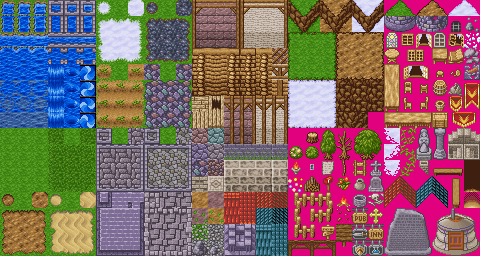
I would fix up yours, but I have to go to school, sorry.
Edit: Here is the chip your basicly use, only missing the tree. Please send me an image of that big tree (the one you use in your chipset is missing 3 to 4 tiles at the right and I'll explain how to use that as an picture or in charsets.
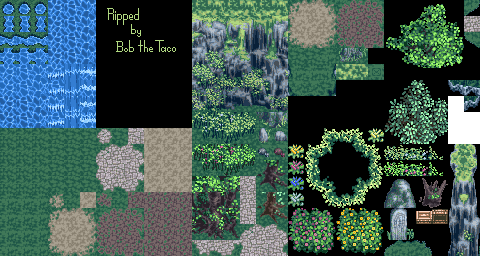
Compare that and yours with this:
I would fix up yours, but I have to go to school, sorry.
Edit: Here is the chip your basicly use, only missing the tree. Please send me an image of that big tree (the one you use in your chipset is missing 3 to 4 tiles at the right and I'll explain how to use that as an picture or in charsets.
 "Good" rm2k3 event coding
It's too bad there is a lot of personal taste here and most of the "rules" described is bound to the situation.
For example:
The stacking of conditional variables is handy if you want to copy and paste that block in one instance to alter it to other conditions. When you make them saparate you have to spent more time on copying them with the chance of forgetting one or two. It's sometimes also clearer if you have diffrent sets of them to use that stacking shape as some sort of pointer. If people don't use Cherry's RM2k9 (with colour codes for diffrent eventcommands) it's sometimes hard to see the boundry between one set and the other, even when comments are used.
Next to that your way of getting out of loops does look like a nice set up, but can also be confusing sometimes. Most of the times when I break a loop (with labels) I want to reset some variables or adjust them. By using the conditional branch, get out of loop I get blocks of coding which are easier to recognize.
label 1
do stuff
do stuff
when stuff
go to label 1
do stuff
do stuff
Vs:
label 1
=do stuff
=do stuff
=when is not stuff
=do stuff
=do stuff
=go to label 2
go to label 1
label 2
Which makes it one block. Again, I don't see this is ideal, but it's not wrong in any way, even if you did use "good" in your title. You could better make this a tutorial about comparing certain ways.
I do however totally agree with you about the range possibility. Also with switches. I opened a game this week which had like 20 to 30 switch operations that turned them off. Why not use a single switch operation with a range in it.
Next to that with variables people should put comparable variables parralel. For example, in one of my projects I show hero statistics with pictures. Instead of making three (number of heroes) statistic menu's I just use 1 which changes coordinates and data.
Example:
Set variable calculator 1 to 1
Set variable calculator 2 to 121
label 1
Set variable in index caculator 1 to variable in index calculator 2
conditional branch if calculator 1 is not 20
go to label 1 (yeah I just made you happy by using your descriped looping =p).
Btw, Bulmabriefs I don't agree to you on the variable save. Less code is always better than saving variables. Next to that, as you can see in the example above you can do the stuff seen in that picture without using "too many" variables. I have tons of those and they only took me two extra variables in total "calculator 1" and "calculator 2". My big friends in calculating and tracking stuff that don't need to be remembered that long =).
All by all conclussion: The way to architect your eventing is bound to the situation and personal taste of the eventer. My whole message is full of personal taste and I won't tell anybody to change their way of eventing just because I say so.
I do however advocate using ranges and using more variables to save eventcommands (I mean this in a way so you can recycle bigger chunks of eventcommands like menu's and number showing).
For example:
The stacking of conditional variables is handy if you want to copy and paste that block in one instance to alter it to other conditions. When you make them saparate you have to spent more time on copying them with the chance of forgetting one or two. It's sometimes also clearer if you have diffrent sets of them to use that stacking shape as some sort of pointer. If people don't use Cherry's RM2k9 (with colour codes for diffrent eventcommands) it's sometimes hard to see the boundry between one set and the other, even when comments are used.
Next to that your way of getting out of loops does look like a nice set up, but can also be confusing sometimes. Most of the times when I break a loop (with labels) I want to reset some variables or adjust them. By using the conditional branch, get out of loop I get blocks of coding which are easier to recognize.
label 1
do stuff
do stuff
when stuff
go to label 1
do stuff
do stuff
Vs:
label 1
=do stuff
=do stuff
=when is not stuff
=do stuff
=do stuff
=go to label 2
go to label 1
label 2
Which makes it one block. Again, I don't see this is ideal, but it's not wrong in any way, even if you did use "good" in your title. You could better make this a tutorial about comparing certain ways.
I do however totally agree with you about the range possibility. Also with switches. I opened a game this week which had like 20 to 30 switch operations that turned them off. Why not use a single switch operation with a range in it.
Next to that with variables people should put comparable variables parralel. For example, in one of my projects I show hero statistics with pictures. Instead of making three (number of heroes) statistic menu's I just use 1 which changes coordinates and data.
Example:
Set variable calculator 1 to 1
Set variable calculator 2 to 121
label 1
Set variable in index caculator 1 to variable in index calculator 2
conditional branch if calculator 1 is not 20
go to label 1 (yeah I just made you happy by using your descriped looping =p).
Btw, Bulmabriefs I don't agree to you on the variable save. Less code is always better than saving variables. Next to that, as you can see in the example above you can do the stuff seen in that picture without using "too many" variables. I have tons of those and they only took me two extra variables in total "calculator 1" and "calculator 2". My big friends in calculating and tracking stuff that don't need to be remembered that long =).
All by all conclussion: The way to architect your eventing is bound to the situation and personal taste of the eventer. My whole message is full of personal taste and I won't tell anybody to change their way of eventing just because I say so.
I do however advocate using ranges and using more variables to save eventcommands (I mean this in a way so you can recycle bigger chunks of eventcommands like menu's and number showing).
Alternatives to Towns
author=LockeZ
Something not costing the player anything doesn't have to imply that it's actually being given away for free in the game world. Maybe your character starts the game with an annual bus pass.
This is exactly what I use (only diffrence is that I use a metro system instead of a bus system). It brings you to the "world map" where you can choose your destination (destinations are being unlocked as you progress in game).
Btw, if you go for futuristic like me you can just copy the Half Life 2 way to do this: blocked paths by force fields.
 Games - Tester
 Games - Other
