



 Full Games List
 Featured Games
 New Games
 Reviews
 Media
Media Blogs
Blogs Game Updates
 Images Feedback Summary
 Game Design Highlights
 Tutorials
 Articles
 Scripts
 Utilities / Plugins
 Resources
 Engines
 Engine Bulletins
 What is Makerscore?
 Past Events
 Achievements
 Misaos
 Forums
 Chat
Chat New to RMN?
 Full Store List
 RMN Music Pack (free)



 Profile
 Locker
 Play Lists
JPRATT'S PROFILE
Jpratt

659
 Close
CloseSearch
Filter
 All
All Game Pages
 User Statuses
 50 Days of Representation
I hope it's alright that the minority group I'm focusing on is not gender or sexual orientation related.
 What are you thinking about? (game development edition)
author=MoonWolfV
I'm currently working on an open world style rpg. I've just been wondering at what point you would release a demo of it? It seems much harder to decide, as opposed to when making a traditional one.
I could do it when the main quest is completed, and just leave all non-essential locations until later. I'd like to have opinions, so I can make a decision.
I think releasing the meat of your world up front without the sides is a mistake. I suggest demoing the starter area and initial quests, leaving the mystery of the broader world until completion.
What are you thinking about? (game development edition)
I built a fairly complex menu system which has several layers to reach some inventory items. I was thinking that qlongside programming items to the main menu I need to build a hot key system.
My idea is to have 6-7 main slots for hot keyed items. Another 6-7 sub-slots would be below these when the hot key menu is displayed. The top slots are set from the main menu. To assign a hot key simply highlight an appropriate inventory item and press the number you want to assign it to (1-7). To assign the second layer, hold that button down instead of pressing it.
When outside of the main menu and walking, the hot key bar would be faded or disappear. When stopped it would fade in. The first row would be activated by pressing keys 1-7. So if 1 was med kit, pressing 1 would use a med kit. Ifnit's an outfit, it would change the player to that outfit. By holding 1 down for 2 seconds the sub slot item for 1 would swap positions with the primary slot. This would essentially give the player double the number of hot keys. I could go up to 20 hot keys but for my game I think 14 might be spot on.
I was thinking of the best way to do this and it is a fairly complex secondary menu system so... adding a lot of work.
My idea is to have 6-7 main slots for hot keyed items. Another 6-7 sub-slots would be below these when the hot key menu is displayed. The top slots are set from the main menu. To assign a hot key simply highlight an appropriate inventory item and press the number you want to assign it to (1-7). To assign the second layer, hold that button down instead of pressing it.
When outside of the main menu and walking, the hot key bar would be faded or disappear. When stopped it would fade in. The first row would be activated by pressing keys 1-7. So if 1 was med kit, pressing 1 would use a med kit. Ifnit's an outfit, it would change the player to that outfit. By holding 1 down for 2 seconds the sub slot item for 1 would swap positions with the primary slot. This would essentially give the player double the number of hot keys. I could go up to 20 hot keys but for my game I think 14 might be spot on.
I was thinking of the best way to do this and it is a fairly complex secondary menu system so... adding a lot of work.
 drink.gif
Brainstorming battle system ideas inspired from other games
Depending how unique you want to make your game the possibilities are almost endless.
You could have one based on total energy for a fight in which case the player chooses all their moves which are played out againat the enemies unknown moves. IE. You have enough energy to cast fire, block and attack. You don't know the enemy will bite, dodge, charge. Or whatever. The winner is determined by the most points knocked off the opponent at the end of everyone's energy.
You could also have predetermined outcomes based on equipped weapon and defense versus enemy weapon and defense. So if you have a nail gun and a super soaker which shoots acid, but they have a wooden shield and rain coat, you do no damage.
Maybe your system is timed reaction battle where the player has to hit the right key at the right time to get max damage or max defense. Perfect timing, max. Miss the timing, miss the attack or dodge.
With RPG maker, uniqueness usually means sacrifice. The more unique your systems the more time or variety you need to sacrifice. The default system allows for hundreds of items to be added effortlessly, but it feels the same as other games. A totally unique system is more interesting, but as more items are added the complexity and time involved in the project increase.
If you hate the default system, I suggest looking at a unique system with limited "items." For example, a few armors and a half dozen spells can make for a great game experience for a smaller game which focuses on mechanics, where each item/spell has a specific advantage and disadvantage from others.
If you're looking to make a huge game but still want to have a more complex system, Hero's Realm has some great examples of how to maximize the default system to be more interesting.
Unique and massive are rarely a combination for game completion for an individual developer.
You could have one based on total energy for a fight in which case the player chooses all their moves which are played out againat the enemies unknown moves. IE. You have enough energy to cast fire, block and attack. You don't know the enemy will bite, dodge, charge. Or whatever. The winner is determined by the most points knocked off the opponent at the end of everyone's energy.
You could also have predetermined outcomes based on equipped weapon and defense versus enemy weapon and defense. So if you have a nail gun and a super soaker which shoots acid, but they have a wooden shield and rain coat, you do no damage.
Maybe your system is timed reaction battle where the player has to hit the right key at the right time to get max damage or max defense. Perfect timing, max. Miss the timing, miss the attack or dodge.
With RPG maker, uniqueness usually means sacrifice. The more unique your systems the more time or variety you need to sacrifice. The default system allows for hundreds of items to be added effortlessly, but it feels the same as other games. A totally unique system is more interesting, but as more items are added the complexity and time involved in the project increase.
If you hate the default system, I suggest looking at a unique system with limited "items." For example, a few armors and a half dozen spells can make for a great game experience for a smaller game which focuses on mechanics, where each item/spell has a specific advantage and disadvantage from others.
If you're looking to make a huge game but still want to have a more complex system, Hero's Realm has some great examples of how to maximize the default system to be more interesting.
Unique and massive are rarely a combination for game completion for an individual developer.
Brainstorming battle system ideas inspired from other games
ss5.png
Screenshot Survival 20XX
author=visitorsfromdreamsKevin Bacon everyone.


You took a lot of creative feedback on this project and it's paying off. The randomness of enemies and characters is fantastic. Above all else though, I am jealous of your sweet battle screen. Well design, much good.
Screenshot Survival 20XX
author=CashmereCat
@LibertyThanks ^_^
@Neok Wow. Love love love the style of the UI and the map. Super simple dungeon crawler, with all the relevant info displayed on the right. Love how you can see all the keys and gold you have. Yay for using different kinds of keys to open different doors/chests. Will everything use such a small map or will it be larger maps? I do like how cute the small one looks. It reminds me of a flash game called The Enchanted Cave. Keep it up!
A fun new mechanic to play around with. Yay!
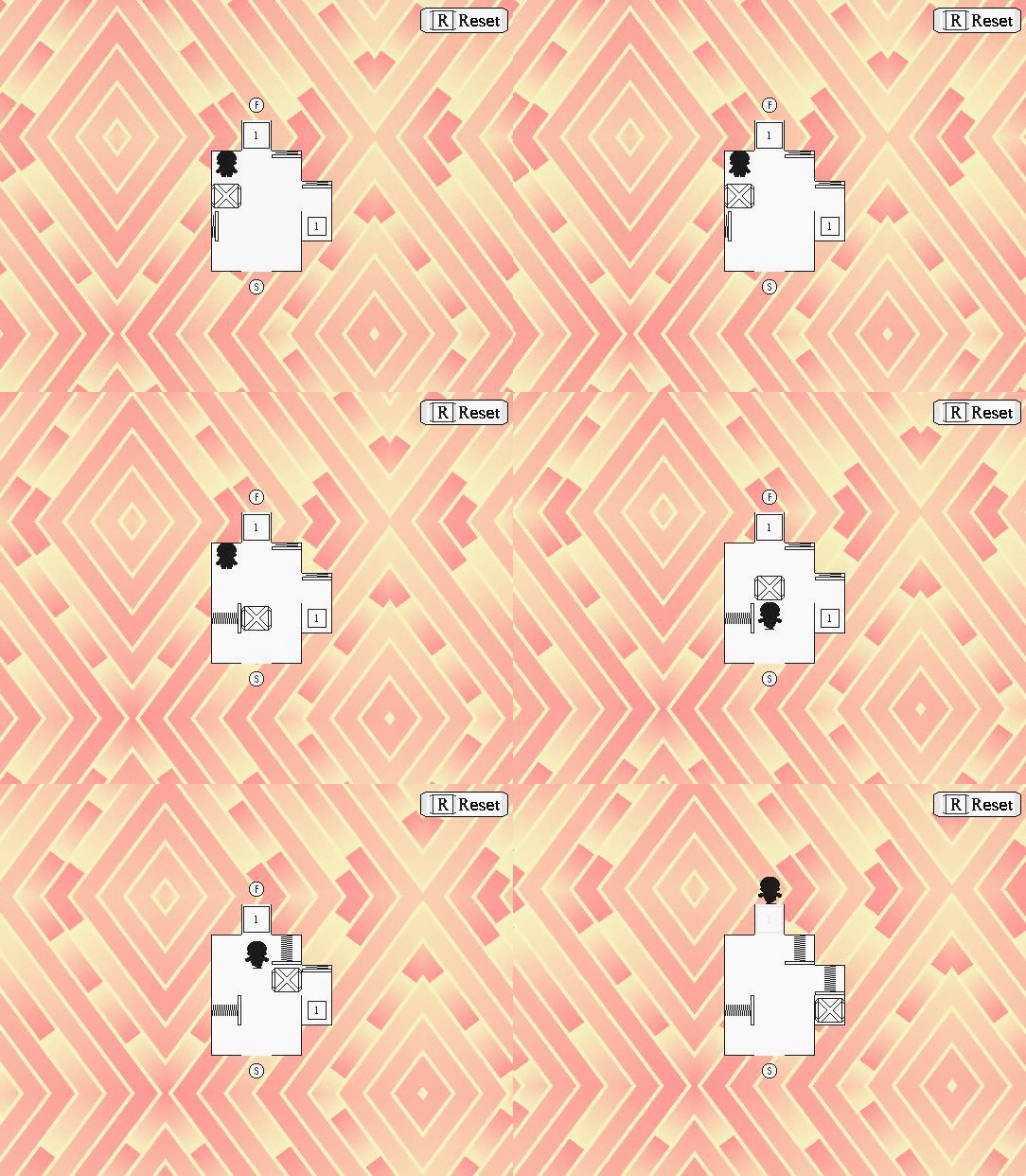
This looks like a much more thought out and well designed version of Bob Block Blob. Similar but very different. Your design is fun and I'm in love with the background.
I'm not a reader, but I want to learn to write for video games
Some basic tips, in order;
1. Decide on the big picture concept, flush out the big picture as much as you can.
2. Think about the individual events required to build that picture. For example, what draws the hero in, what motivates them along the way, what challenges do they face, who's help do they need to overcome challenges.
3. Consider the hero as a real person. What kind of person are they? Get in depth. The more depth your characters have, the more interesting your story and world become. For example, is there trauma holding them back from doing what needs to be done, how is the trauma revealed, how does it affect (what conflict) the hero and supporting characters, and how does the character overcome thr trauma? Examples of trauma could include PTSD, the loss of a child or family, or having to face an enemy who's defeated or humiliated them in the past.
4. Once you know your protagonist's personal motivations, attitude and short comings, you should be getting a picture of how they will go about tackling the big picture. So now look at the same points for supporting characters, make them people of their own. This includes villains and mission providers! There's nothing worse than a shallow villain. They want power is not enough. What was lacking in their life that lead them to world domination? People don't just wake up with the motivation to rule the world, they are driven by something psychological. Did the world hurt him? Did his father? Get uncomfortable with your villains. Same with supporting villains - why are they motivated to serve the Destroyer of Worlds?
5. Now that you've got the framework for your cast, give each a personality. Traits which make them unique. Some inspiration can come from a thesaurus/dictionary (thesaurus.com and dictionary.com) For example, you might think of a character as sad, but dad is a shallow and uninspiring term. Put sad into the thesaurus and you might be inspired by more colorful words, like gloomy or disheartened. Dictionary can be used to better define these terms which help to flesh out a feeling. Ultimately you want toninspire feelings in your player. To feel for your characters.
6. So you have your big picture and you know your characters through and through. You even have a picture of events. Start writing a rough draft and make it really rough. Just write, don't worry too much about details.
7. Review your first draft and determine if the flow of the story is good. Does there need to be more scenes? Does it get sonm side tracked the player forgets the mission? Is the conflict and motivation convincing, or does it require more preamble earlier in the story? Fix the flow for your second draft.
8. Third draft is where you solidify things. So your flow is solid but let's work on the details. Do the characters use language and take action as their personality and traits auggest they do? Do any characters act out of their character. For example, does the highly intelligent and thoughtful villain do something utterly stupid to be defeated? Why would he do that? Keep him in character.
9. Input. Here's where it gets really interesting. Every month hollywood pumps out movies rehashing stories from a couple dozen storylines. The stories are rarely unique, but people keep watching. Why? *$*!PRESENTATION!*$* Hollywood doesn't just have script read across a screen. Now you probably won't voice act your whole game and that's fine. What you need to enhance a story in these types of games is to set the scene with the right atmosphere. Music is big for this, so are weather and lighting effects, character movement as they talk, pauses in speech, chaos in the background (fire, shaking earth.)
If you're not great with dialog then look to games like Zelda. Link is a silent protagonist and none of the characters have much depth, but they still manage to tell a story and create a believable world.
There are other games which focus almost entirely in letting atmosohere tell the story. I think Unraveled was one.
WARNING: Things to Avoid
- whiney characters and fan boys. Don't include characters which will obviously annoy the player.
- cliches... there are so many and they are called cliche because they are already overly used. I have examples above, such as world domination. Try to create unique stories, they don't need to be the most badass characters ever, they could be a person fighting addiction, cancer, or abuse rather than fighting the Destroyer of Worlds. All of those examples are more human, real, and provoke feelings in your player when told well.
- Take time to tell it consistently. If you rush, players notice because immersion is broken.
- shallow characters. If there is a girl who swoons day and night for your hero, and this is the entirety of her character, and you can't figure out how to fix that, get someone else to write your stories.
1. Decide on the big picture concept, flush out the big picture as much as you can.
2. Think about the individual events required to build that picture. For example, what draws the hero in, what motivates them along the way, what challenges do they face, who's help do they need to overcome challenges.
3. Consider the hero as a real person. What kind of person are they? Get in depth. The more depth your characters have, the more interesting your story and world become. For example, is there trauma holding them back from doing what needs to be done, how is the trauma revealed, how does it affect (what conflict) the hero and supporting characters, and how does the character overcome thr trauma? Examples of trauma could include PTSD, the loss of a child or family, or having to face an enemy who's defeated or humiliated them in the past.
4. Once you know your protagonist's personal motivations, attitude and short comings, you should be getting a picture of how they will go about tackling the big picture. So now look at the same points for supporting characters, make them people of their own. This includes villains and mission providers! There's nothing worse than a shallow villain. They want power is not enough. What was lacking in their life that lead them to world domination? People don't just wake up with the motivation to rule the world, they are driven by something psychological. Did the world hurt him? Did his father? Get uncomfortable with your villains. Same with supporting villains - why are they motivated to serve the Destroyer of Worlds?
5. Now that you've got the framework for your cast, give each a personality. Traits which make them unique. Some inspiration can come from a thesaurus/dictionary (thesaurus.com and dictionary.com) For example, you might think of a character as sad, but dad is a shallow and uninspiring term. Put sad into the thesaurus and you might be inspired by more colorful words, like gloomy or disheartened. Dictionary can be used to better define these terms which help to flesh out a feeling. Ultimately you want toninspire feelings in your player. To feel for your characters.
6. So you have your big picture and you know your characters through and through. You even have a picture of events. Start writing a rough draft and make it really rough. Just write, don't worry too much about details.
7. Review your first draft and determine if the flow of the story is good. Does there need to be more scenes? Does it get sonm side tracked the player forgets the mission? Is the conflict and motivation convincing, or does it require more preamble earlier in the story? Fix the flow for your second draft.
8. Third draft is where you solidify things. So your flow is solid but let's work on the details. Do the characters use language and take action as their personality and traits auggest they do? Do any characters act out of their character. For example, does the highly intelligent and thoughtful villain do something utterly stupid to be defeated? Why would he do that? Keep him in character.
9. Input. Here's where it gets really interesting. Every month hollywood pumps out movies rehashing stories from a couple dozen storylines. The stories are rarely unique, but people keep watching. Why? *$*!PRESENTATION!*$* Hollywood doesn't just have script read across a screen. Now you probably won't voice act your whole game and that's fine. What you need to enhance a story in these types of games is to set the scene with the right atmosphere. Music is big for this, so are weather and lighting effects, character movement as they talk, pauses in speech, chaos in the background (fire, shaking earth.)
If you're not great with dialog then look to games like Zelda. Link is a silent protagonist and none of the characters have much depth, but they still manage to tell a story and create a believable world.
There are other games which focus almost entirely in letting atmosohere tell the story. I think Unraveled was one.
WARNING: Things to Avoid
- whiney characters and fan boys. Don't include characters which will obviously annoy the player.
- cliches... there are so many and they are called cliche because they are already overly used. I have examples above, such as world domination. Try to create unique stories, they don't need to be the most badass characters ever, they could be a person fighting addiction, cancer, or abuse rather than fighting the Destroyer of Worlds. All of those examples are more human, real, and provoke feelings in your player when told well.
- Take time to tell it consistently. If you rush, players notice because immersion is broken.
- shallow characters. If there is a girl who swoons day and night for your hero, and this is the entirety of her character, and you can't figure out how to fix that, get someone else to write your stories.
 Games - Tester
 Games - Other
