



 Full Games List
 Featured Games
 New Games
 Reviews
 Media
Media Images
 Blogs
Blogs Game Updates
 Images Feedback Summary
 Game Design Highlights
 Tutorials
 Articles
 Scripts
 Utilities / Plugins
 Resources
 Engines
 Engine Bulletins
 What is Makerscore?
 Past Events
 Achievements
 Misaos
 Forums
 Chat
Chat New to RMN?
 Full Store List
 RMN Music Pack (free)



 Profile
 Locker
 Play Lists
KAZESUI'S PROFILE

 Close
Close



Search
Filter
 All
All Game Pages
 User Statuses
 Custom Menu
you need to check the value of the variable you used for input, otherwise whatever's behind the input will activate upon hitting any of the "valid" keys
assuming that you're using rm2k3 (given your game profile) you could possibly check this out
http://rpgmaker.net/users/Kazesui/locker/CBS_template.zip
it's a "learning" template I made a while ago for someone who wanted to learn some of the basics for a cbs.
it's basically some simple menus and stuff stored in 5 events in the upper left of the first map.
it's "half-way" well commented, so it might be of a little help.
assuming that you're using rm2k3 (given your game profile) you could possibly check this out
http://rpgmaker.net/users/Kazesui/locker/CBS_template.zip
it's a "learning" template I made a while ago for someone who wanted to learn some of the basics for a cbs.
it's basically some simple menus and stuff stored in 5 events in the upper left of the first map.
it's "half-way" well commented, so it might be of a little help.
REALLY?
(Help)Making a game restart
have a variable set to the value of the map ID of the hero (found under "sprite" in variable menu)
have an variable x set to the x coordinates of your starting point and another variable y to the y coordinate of your starting point, and then use "recall memorized position" using those 3 variables.
if you move any events, like push a rock or anything like that or otherwise need events to reappear on their "starting points" you pretty much have to use "change event location" choose the event and set them whereever they're supposed to be.
have an variable x set to the x coordinates of your starting point and another variable y to the y coordinate of your starting point, and then use "recall memorized position" using those 3 variables.
if you move any events, like push a rock or anything like that or otherwise need events to reappear on their "starting points" you pretty much have to use "change event location" choose the event and set them whereever they're supposed to be.
8 directional movement [rm2k3]
8 directional movement [rm2k3]
except that having one or two loops doesn't seem to make a difference, and if I'm reading the code correctly, the loops aren't even used, because he's using the labels to loop instead.
the benefit of the added processing speed is pretty much lost because of the 0.0 wait in there as well, apart from whenever the hero is moving diagonally.
but once moving diagonally, he will move an entire tile before accepting new movements anyway, making any added responsiveness redundant
the benefit of the added processing speed is pretty much lost because of the 0.0 wait in there as well, apart from whenever the hero is moving diagonally.
but once moving diagonally, he will move an entire tile before accepting new movements anyway, making any added responsiveness redundant
Rm2k3- Can you make your hero target specific cords?
teleporting would from the sound of it be the easiest, but they wouldn't exactly be "walking" to their designated spots then. If you want them to actually walk to the spot, you can take the current hero x and y coordinates and subtract them with the coordinates of the designated spot. if the hero is above the spot, you will recieve a negative number for the y coordinate, and you'll have a branch making it go down with move events until the difference reach zero, and pretty much other way around if hero is below the spot.
same deal with the x coordinate.
this would make the hero "walk" to the spot, given there is no obstacle in the path
same deal with the x coordinate.
this would make the hero "walk" to the spot, given there is no obstacle in the path
Chocobo Hot and Cold - See FF9
complicated? nah
just have it search for a randomly placed event with no graphic.
have a x and a y variable set at random numbers within the range, take the terrain or ID value of the position to ensure it's on a spot you can reach if not, get some new coordinates.
once you have a set of valid coordinates, use change event location command to those coordinates, have some variable go at random to determine the prize for finding it and off you go.
have a parallel event check for key input which is for whenever you check the ground. once triggered, set the coordinates of the hero to another set of x and y variables, subtract the hero x with the event x, and hero y with the event y.
have some branches check for negative numbers and multiply them with -1 if they are. Now add the numbers together and you get the total distance from the item in terms of tiles.
have a last branch check the total distance to determine the dialog.. or "kweh".
once the item has been found redo the process from the start to set out a new item and start over again until the time runs out
just have it search for a randomly placed event with no graphic.
have a x and a y variable set at random numbers within the range, take the terrain or ID value of the position to ensure it's on a spot you can reach if not, get some new coordinates.
once you have a set of valid coordinates, use change event location command to those coordinates, have some variable go at random to determine the prize for finding it and off you go.
have a parallel event check for key input which is for whenever you check the ground. once triggered, set the coordinates of the hero to another set of x and y variables, subtract the hero x with the event x, and hero y with the event y.
have some branches check for negative numbers and multiply them with -1 if they are. Now add the numbers together and you get the total distance from the item in terms of tiles.
have a last branch check the total distance to determine the dialog.. or "kweh".
once the item has been found redo the process from the start to set out a new item and start over again until the time runs out
Key Input fishing mini-game, please help point me in the right direction.
This is something along what I meant
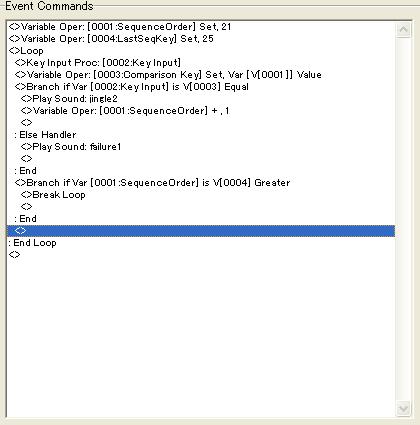
Should be doing the same as the bunch of branches except that it's obviously less code.
This one takes a 5 key sequence, where the different key's for the correct sequence is stored in the variables 21 to 25.
It doesn't really add more functionality, but can be good practice for future cases, where pointers are pretty essential (of course depending on the complexity of the mini games you'd be making).
also, it's easier to maintain or do small fixes to tinier pieces of code rather than lot's of branches
Should be doing the same as the bunch of branches except that it's obviously less code.
This one takes a 5 key sequence, where the different key's for the correct sequence is stored in the variables 21 to 25.
It doesn't really add more functionality, but can be good practice for future cases, where pointers are pretty essential (of course depending on the complexity of the mini games you'd be making).
also, it's easier to maintain or do small fixes to tinier pieces of code rather than lot's of branches
Key Input fishing mini-game, please help point me in the right direction.
do you have the "wait until key input" box checked?
do you have some event further down the road that halts the repetition of the event?
and aside from that, then this would prove as a perfect example of something which could be used to practice the pointers of rm2k3.
by listing up the different keys of the sequence into a list of variables and having a variable refer to their ID's
let's say you the sequence keys span over variable 21 to 28, then you'd have the sequence order variable start at value 21, you have a key comparison variable which takes the value of the index of the sequence order variable (right below the option which let's you use the value of a variable) .
you check if the input key equals the key comparison variable and increase the sequence order by 1 as you already do.
the advantage of doing this now won't be much except from reducing the amount of code considerably, but the practice using pointers and knowing how to using them can come very handy to future mini games you might wanna make.
do you have some event further down the road that halts the repetition of the event?
and aside from that, then this would prove as a perfect example of something which could be used to practice the pointers of rm2k3.
by listing up the different keys of the sequence into a list of variables and having a variable refer to their ID's
let's say you the sequence keys span over variable 21 to 28, then you'd have the sequence order variable start at value 21, you have a key comparison variable which takes the value of the index of the sequence order variable (right below the option which let's you use the value of a variable) .
you check if the input key equals the key comparison variable and increase the sequence order by 1 as you already do.
the advantage of doing this now won't be much except from reducing the amount of code considerably, but the practice using pointers and knowing how to using them can come very handy to future mini games you might wanna make.
Dual event triggers?
My suggestion would be to have a parallell event run on the side with a key input process at the top which waits for key to activate. once this key is hit, you take the coordinates of the hero and adjust it to become the tile infront of the hero. if hero is facing up, that would mean to subtract 1 from the hero y coordinate.
now make use of the "check event ID" with those coordinates, and store the result in some variable, which you then run against some list containing the event ID's of the different enemies. if there's a match you'll trigger a fight, if not, nothing will happen and the parallel process event will wait for another key input
now make use of the "check event ID" with those coordinates, and store the result in some variable, which you then run against some list containing the event ID's of the different enemies. if there's a match you'll trigger a fight, if not, nothing will happen and the parallel process event will wait for another key input
 Games - Tester
 Games - Other
