



 Full Games List
 Featured Games
 New Games
 Reviews
 Media
Media Images
 Blogs
Blogs Game Updates
 Images Feedback Summary
 Game Design Highlights
 Tutorials
 Articles
 Scripts
 Utilities / Plugins
 Resources
 Engines
 Engine Bulletins
 What is Makerscore?
 Past Events
 Achievements
 Misaos
 Forums
 Post History
 Chat
Chat New to RMN?
 Full Store List
 RMN Music Pack (free)



 Profile
 Locker
 Play Lists
SVIEL'S PROFILE
Sviel

2006
 Close
Close
It turns out that I really dislike words. Not surprisingly, I recently switched from a CS Engineering major to Creative Writing; practically left my degree at the altar.
I like fine-tuning mechanics and writing long novels on the beach.
I like fine-tuning mechanics and writing long novels on the beach.
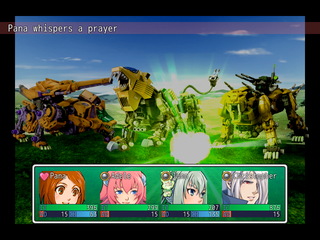
Zoids | Whisper
A healer tries to piece paradise back together after tragedy strikes...or at least keep the shards from slipping through her fingers.
A healer tries to piece paradise back together after tragedy strikes...or at least keep the shards from slipping through her fingers.
Search
Filter
 All
All Game Pages
 User Statuses
 Sunken Spire Review
 Design principles vol. 1: RPGs and strategy
^^I tried to check out the vids, but I can't watch them in a high enough quality to really understand what's going on. The sheer number of skills is off-putting to me, but, that may be because I'm just getting a peek in the middle of the game.
When you say 'add something truly new that could be done otherwise in terms...' are you saying something that does not contribute to the bar juggling or are you referring to something else?
In the third paragraph, am I right in guessing that you meant 'do away entirely with some aspects' instead of 'do entirely with?'
Assuming I have assumed correctly...
What would be an example of something that doesn't boil down to the bars? And, as the bars are ultimately the goal of combat, how would that fit? Adding such a thing would make for a more varied meta-analysis, but I don't see how it is necessary to create a great game.
I'm all for doing away with stuff (Like dungeons...I hate dungeons), but there must be a very compelling reason to dump turns or hp. Such things make RPGs accessible, much like RPG Maker makes making/playing amateur games more accessible.
When you say 'add something truly new that could be done otherwise in terms...' are you saying something that does not contribute to the bar juggling or are you referring to something else?
In the third paragraph, am I right in guessing that you meant 'do away entirely with some aspects' instead of 'do entirely with?'
Assuming I have assumed correctly...
What would be an example of something that doesn't boil down to the bars? And, as the bars are ultimately the goal of combat, how would that fit? Adding such a thing would make for a more varied meta-analysis, but I don't see how it is necessary to create a great game.
I'm all for doing away with stuff (Like dungeons...I hate dungeons), but there must be a very compelling reason to dump turns or hp. Such things make RPGs accessible, much like RPG Maker makes making/playing amateur games more accessible.
Design principles vol. 1: RPGs and strategy
I think, perhaps, you're taking some things for granted that I am not quite wed to. I don't think that having multiple paths to victory means that any of them needs to be easy. Something like Strongest Skill Spam is a definite red flag in any combat system. Any design worthy of the tag 'decent' should not be subject to that.
Even so, I think you're right in that it's more of a projection than the real deal, but that seems fine to me. So long as there is enough strategy to keep the player on their toes throughout the game, there's no need to go all the way. The goal is to make the game fun and engaging, not create a new set of mechanics to last through the ages.
In addition, it's important that the system isn't too arcane. Like Go (or chess), the rules should be simple to pick up. It is a very small subset of players that want to have to study combat for ten minutes before engaging in it with any hope of success. Simply adding complexity is, in essence, like polishing the turd.
Since combat boils down to juggling those bars, it makes sense to trim redundancy in skills. Moving the bars should happen, yes, but there should be some other motivation to use at least 3 skills at any given time, all of which can make an impact in some way, even if it's just additional bar movement. There should never be a skill that does X damage and nothing else alongside a skill that does Y damage and nothing else. Instead, give one skill an incentive in certain situations and the other incentives elsewhere, but make sure that the situations either overlap or conflict, such as where one skill makes the other less useful (but perhaps you want it to be useful later).
To be concise (is it too late for that?!), I think that a turn-based set-up can be strategic. The problems you've mentioned are real and prevalent, but not unavoidable. Much like Othello, where the players are literally fighting over two 'bars' (black chips vs white chips), the method by which the juggling happens can bear sufficient strategy.
Even so, I think you're right in that it's more of a projection than the real deal, but that seems fine to me. So long as there is enough strategy to keep the player on their toes throughout the game, there's no need to go all the way. The goal is to make the game fun and engaging, not create a new set of mechanics to last through the ages.
In addition, it's important that the system isn't too arcane. Like Go (or chess), the rules should be simple to pick up. It is a very small subset of players that want to have to study combat for ten minutes before engaging in it with any hope of success. Simply adding complexity is, in essence, like polishing the turd.
Since combat boils down to juggling those bars, it makes sense to trim redundancy in skills. Moving the bars should happen, yes, but there should be some other motivation to use at least 3 skills at any given time, all of which can make an impact in some way, even if it's just additional bar movement. There should never be a skill that does X damage and nothing else alongside a skill that does Y damage and nothing else. Instead, give one skill an incentive in certain situations and the other incentives elsewhere, but make sure that the situations either overlap or conflict, such as where one skill makes the other less useful (but perhaps you want it to be useful later).
To be concise (is it too late for that?!), I think that a turn-based set-up can be strategic. The problems you've mentioned are real and prevalent, but not unavoidable. Much like Othello, where the players are literally fighting over two 'bars' (black chips vs white chips), the method by which the juggling happens can bear sufficient strategy.
 Black Bird
So, I got to the part after finding the
alchemist witch and I'm suppose to go find Chlorie in some forest...but I don't know where this forest is. It was probably mentioned, but then I went to bed and then to work and I don't quite remember. I've checked just about everywhere in town and on the world map...but the random encounters and super slow walk speed make it rather discouraging to go pixel by pixel.
So, anywhere, could you give me a hint on where to head next?
So, anywhere, could you give me a hint on where to head next?
Design principles vol. 1: RPGs and strategy
author=Hasvers
Sviel> If I have an attack that makes the same damage as the difference in damage caused by the buff, then the only result of my choice is a different repartition of that damage over time - spiky versus continuous. It is something that can be used for tactics to some extent - in fact it is the principal form that tactics take in RPG battles, preventing spikes of damage from the enemy to avoid dying (by learning when to duck, basically).
But it's, let's say, 1.5 dimensional - it's not memory in the sense that I was intending, because the identity of individual actions still doesn't matter, only their summed effect at any given instant is important. Chess also has that time-control aspect plus the non-erasure and non-aggregation of individual moves, which makes it "2.5 dimensional".
And let's face it, a huge lot of choices in RPGs are purely cosmetic. I have a pet peeve with defense and evasion, or magic and skills and items, or stats and classes and characters and equipment and freaking battle formations - they do the exact same thing with different labels. I love Suikoden 5 but it was a terrible offender with 50 different ways of overpowering your characters with the same end result.
If it's a buff that only affects damage and the attack in question only deals damage, then yes. As you mentioned earlier, other effects that basically translate into damage would also satisfy your statement. I could argue that there are some things that do not turn neatly into DPS, but what's more important is that there are multiple ways to 'achieve' that damage. Some room for creative vision, if you will.
In the interest of better understanding what you mean by memory and dimensions, maybe I should see if I can coherently relate a decent example. How about three approaches to the same battle, using characters named One, Two and Three.
author=none
Player 1 prefers set-up strategies.
-They enter into a battle with 3 enemies and spend the first round with One buffing Three's defenses and Three drawing aggro while Two uses a self-buff (damage) that is dispelled on taking damage.
-In the second round, One buffs Two's offense while Three attacks the beefiest enemy and Two uses another self-buff (-aggro).
-During the third round, Two knocks off one enemy while One and Three dig into another.
-In the fourth round, Two takes out another target while One and Three finish their mark from round three.
Here, rounds 1 and 2 could be interchanged with minimal consequence (defense buff is more effective early), so there's little concept of memory. Round 3 and 4 could be switched, though must come after round 2, so I think it's what you would call 1.5 dimensional?
Now, let's try that with enemies that aren't ragdolls.
author=none
Player 1 again.
-They enter into a battle with 3 enemies and spend the first round with One buffing Three's defenses and Three drawing aggro while Two uses a self-buff (damage) that is dispelled on taking damage. The enemies attack Three for a total of 50% of Three's hp.
-In the second round, One buffs Two's offense while Three attacks the beefiest enemy for 20% damage. The enemies bring Three down to 30% and Two down to 50%. Two loses the previous self-buff. Two then uses another self-buff (-aggro).
-During the third round, Two brings one enemy to 30% hp while One and Three cut the beefiest one down to 30% hp. Meanwhile, the enemies bring One down to 50% and Three down to 10%.
-In the fourth round, Two brings the only unharmed enemy to 30%. Three finishes the one that Two hit last round while One heals Three to 40% hp. The enemies bring One down to 20% and drop Three to 30%.
-For round 5, Two drops the beefiest enemy while One and Three team up to finish the other that was at 30%.
This time, no two rounds can be switched around. In addition, since Two's self-buff ended up being dispelled, Two's instantaneous status is not just the summation of previous actions.
It should also be noted that the planned tactic (set-up and steamroll) is abandoned in round 3 due to concern for the player's hp, sparking a change to a less elegant approach.
In round 4, One pauses damage output to heal Three. The heal isn't enough to return the battle to an earlier state altogether, but does buy another turn for Three.
There are some improvements that could be made or some different paths to take, but would this be considered 2 dimensional? Or, approaching that? Non-erasure and non-aggregation are covered, though perhaps to a lesser degree than chess. I would think that with pieces being removed from the board, though, that chess has some degree of aggregation going on, so it does not seem necessary to realize that goal in full.
Don't want to get too wordy, though, as sleep is trying to claim me and neither you nor the world deserves my late-night rambling. Thus, I've tried for simplicity, for better or worse.
Perhaps tomorrow I'll reply to the other points being made here, as they are also interesting.
 Sunken Spire Review
I must be really unlucky, then.
I got that, but since it wasn't powering him up before hand, it still felt like deus ex machina.
Design principles vol. 1: RPGs and strategy
The system you're describing is fairly simplistic, no?
I definitely agree that it applies to many (way too many) RPG battle systems, but I would not agree that it encompasses all of them. Examples like Fire Emblem seem like they might not be what you intended, so I won't make further mention of them, but there are other ways to make battles multi-dimensional as well.
For example, anytime there are several paths that differ tactically but are roughly equal in their overall effectiveness, the battle gains dimension. Even if the overall goal is to reduce the enemy's hp, if you can do it in a manner totally different than the next guy with similar efficiency, there must be something more to the battle than a simple Golden Path.
Consider if a player can choose to buff an ally or make an attack. Assuming both are legitimate options, the player has not only made progress on their goal of eliminating enemies, but, in the case of the buff, may have also made a decision with memory, as it remains for several rounds.
Now, consider that the enemy may also pose a serious threat to the player's hp. Provided that the player can't outheal the enemy's damage, the enemy attacks can be said to have memory.
The problem, then, isn't so much that the battles cannot have strategy, but that common RPG conventions work against that. Things like abundant healing, restorative items and step-up skills (fira->firaga) lend to the issue. But, there are ways to make it shine.
I definitely agree that it applies to many (way too many) RPG battle systems, but I would not agree that it encompasses all of them. Examples like Fire Emblem seem like they might not be what you intended, so I won't make further mention of them, but there are other ways to make battles multi-dimensional as well.
For example, anytime there are several paths that differ tactically but are roughly equal in their overall effectiveness, the battle gains dimension. Even if the overall goal is to reduce the enemy's hp, if you can do it in a manner totally different than the next guy with similar efficiency, there must be something more to the battle than a simple Golden Path.
Consider if a player can choose to buff an ally or make an attack. Assuming both are legitimate options, the player has not only made progress on their goal of eliminating enemies, but, in the case of the buff, may have also made a decision with memory, as it remains for several rounds.
Now, consider that the enemy may also pose a serious threat to the player's hp. Provided that the player can't outheal the enemy's damage, the enemy attacks can be said to have memory.
The problem, then, isn't so much that the battles cannot have strategy, but that common RPG conventions work against that. Things like abundant healing, restorative items and step-up skills (fira->firaga) lend to the issue. But, there are ways to make it shine.
Black Bird
I was just guessing with the 'trans3' being the thing I needed to run at all, but yeah, that seems to have worked.
Black Bird
I don't seem to know how to run this game. I installed it and 'phase2,' w/e that was, then tried to run trans3 which had me choose the .gam file then opened a window that just told me that something wasn't found.
 Games - Tester
 Games - Other
