



 Full Games List
 Featured Games
 New Games
 Reviews
 Media
Media Images
 Game Updates
 Images Feedback Summary
 Game Design Highlights
 Tutorials
 Articles
 Scripts
 Utilities / Plugins
 Resources
 Engines
 Engine Bulletins
 What is Makerscore?
 Past Events
 Achievements
 Misaos
 Forums
 Post History
 Chat
Chat New to RMN?
 Full Store List
 RMN Music Pack (free)



 Profile
 Locker
 Play Lists
HASVERS'S PROFILE
Hasvers
1298
 Close
Close
Exeunt Omnes
A game of strategic sophistry. Convince or crush the teenage girl who wants to end your reign of evil.
A game of strategic sophistry. Convince or crush the teenage girl who wants to end your reign of evil.
Search
Filter
 All
All Game Pages
 User Statuses
 Ars Harmonia Review
This does sound interesting, but that's not what I meant by a good reason. The thing is, as long as those are things that cannot be seen without paying, I cannot really comment on them. I'm sure you will have other reviews from people who've bought the game and who will give you well-deserved higher ratings. But for now, it seems reasonable to rate what there is to see in the version that one can actually download by clicking on the Download button on top of this page.
 Design principles vol. 1: RPGs and strategy
Hey I feel like I've read this blog already. Did you post it in a comment on Tilde-One a long time ago, perhaps? It was interesting indeed, in any case. I just wish the author had had a more thorough approach, since the individual remarks were very thoughtful but also very scattershot.
Ars Harmonia Review
author=SaileriusAh, fair enough, that's not what I had understood from the gamepage. (Besides, I know it's a recurring point of contention between game devs and the rest of the software world, but in my mind a beta is feature-complete.)
That would be because it is a technical demo. :)
That being said, while I'd gladly revise my rating upon playing the actual game, I feel tied to giving a clear opinion about what there is to see in the version you released for free. For a lot of people, this is the version that will be used as a basis for deciding whether to buy the game or not, and I'll admit that I wouldn't buy it as is - there is enough there to be interested, but not enough to be convinced, as far as I'm concerned.
I won't be pig-headed about it if you give me a good enough reason to drop the star rating, but for now I don't see one.
However, it is certainly sensible to specify to which version my review applies, which I'm going to do right now.
Edit: done.
 Exeunt Omnes
Thanks a lot! Don't worry about not making a review, your feedback is much appreciated in any case ;)
Design principles vol. 1: RPGs and strategy
Oh and also, I agree with this
But I'd like to keep this topic for the next design conversation, as I think it's especially interesting for conversations, where it can be good to lose the argument if you win the heart of the audience, for instance.
author=KylailaOne of the best ways to make battles and dungeons deeper would be to do away with that single objective, replacing it by a choice between multiple objectives, or better yet, a sort of continuum.
Giving different objectives to the "get through the dungeon" might expand upon that as well.
But I'd like to keep this topic for the next design conversation, as I think it's especially interesting for conversations, where it can be good to lose the argument if you win the heart of the audience, for instance.
Design principles vol. 1: RPGs and strategy
Haha such an interesting discussion, I should have made this post earlier!
Of course it is an exaggeration to say that there is no strategy at all in a "1d" (or "1.5d") game, while chess is purely strategic - but an useful exaggeration. Every game is entirely computable in principle, so that's not really the matter.
I think to make my point clearer, I should use a picture. Let's say that the graph below represents the amount of damage dealt by the allies (blue) and by the enemies (red), turn by turn (or action by action) in the battle.
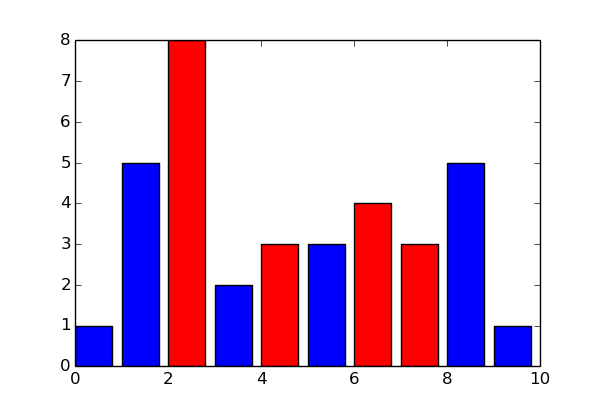
Any combination of skills and items and equipment that produces this sequence will be indiscernible. More powerful attacks increase the current bar, healing skills decrease it, attack buffs trade instantaneous bar height for higher bars in the future, agility buffs move bars forward or backward.
Even worse, the individual height and the precise sequence of the bars is not so important, the only thing that matters is whether the sum reaches a certain threshold representing death. Which means that even more combinations are equivalent.
So sure, there can be some interesting playing around with the bars - although very few games take it that far, the SMT system of gaining/losing turns allows you to move the bars around significantly, and perhaps Craze's games do this as well (I will try them, thanks for the tip!)
But such a game will always have much more action paths that are equivalent than a truly bidimensional game. It's like projecting 3d on 2d: a cylinder can have the same shadow as a sphere (or as a cube, depending on how you rotate it). Likewise, RPG characters have many dimensions represented by choices in skills and equipment and such, but once you project them on the single line shown above, most of it becomes purely "flavor" with no concrete impact on whether you will win the battle or not.
Having many equivalent paths means that people will find different ways of winning, but it also means that few people will ever have to think deeply about what they are doing - there is a high probability that spamming your strongest spell will only be marginally worse than the most clever tactics. Except in boss encounters specifically crafted to prevent that, but then it's more like solving a chess puzzle than playing chess: it's the clever arranging that makes the puzzle, not the basic rules.
Now, the existence of multiple characters is a way to mimick a little bit of the second dimension: if you kill one of the enemies, you reduce the enemy's action potential irreversibly - and action potential, the diversity of (real, non-equivalent) choices that you have at every step, is largely what strategy is about. However that remains extremely basic - I have never seen anything that goes further than "you should kill the healer then the heavy hitter then the tank" or variations.
The other thing that makes chess more strategic is that strategy is about intuition, and human brains have much better intuitions for space than for numbers (especially probabilities).
A better example than chess may be go, because after only a few weeks of playing you can already do something that feels like strategy, without any memorization - because you can see spatially how one stone affects your action potential by blocking off some avenues or allowing future bridges. I'm sure there are more general ways of getting that feeling, ways that are not specific to the abstract strategy games, and that's what I'm looking for.
As for randomness, there was a nice discussion here. You will notice I was already making poor chess analogies at the time, I really had to get that out of my system ;)
Edit: Hey this unscrupulous self-quote might illustrate what I mean by 1.5d better than what I've said before, although ultimately I stand by my point about projecting the whole on a single axis.
Of course it is an exaggeration to say that there is no strategy at all in a "1d" (or "1.5d") game, while chess is purely strategic - but an useful exaggeration. Every game is entirely computable in principle, so that's not really the matter.
I think to make my point clearer, I should use a picture. Let's say that the graph below represents the amount of damage dealt by the allies (blue) and by the enemies (red), turn by turn (or action by action) in the battle.
Any combination of skills and items and equipment that produces this sequence will be indiscernible. More powerful attacks increase the current bar, healing skills decrease it, attack buffs trade instantaneous bar height for higher bars in the future, agility buffs move bars forward or backward.
Even worse, the individual height and the precise sequence of the bars is not so important, the only thing that matters is whether the sum reaches a certain threshold representing death. Which means that even more combinations are equivalent.
So sure, there can be some interesting playing around with the bars - although very few games take it that far, the SMT system of gaining/losing turns allows you to move the bars around significantly, and perhaps Craze's games do this as well (I will try them, thanks for the tip!)
But such a game will always have much more action paths that are equivalent than a truly bidimensional game. It's like projecting 3d on 2d: a cylinder can have the same shadow as a sphere (or as a cube, depending on how you rotate it). Likewise, RPG characters have many dimensions represented by choices in skills and equipment and such, but once you project them on the single line shown above, most of it becomes purely "flavor" with no concrete impact on whether you will win the battle or not.
Having many equivalent paths means that people will find different ways of winning, but it also means that few people will ever have to think deeply about what they are doing - there is a high probability that spamming your strongest spell will only be marginally worse than the most clever tactics. Except in boss encounters specifically crafted to prevent that, but then it's more like solving a chess puzzle than playing chess: it's the clever arranging that makes the puzzle, not the basic rules.
Now, the existence of multiple characters is a way to mimick a little bit of the second dimension: if you kill one of the enemies, you reduce the enemy's action potential irreversibly - and action potential, the diversity of (real, non-equivalent) choices that you have at every step, is largely what strategy is about. However that remains extremely basic - I have never seen anything that goes further than "you should kill the healer then the heavy hitter then the tank" or variations.
The other thing that makes chess more strategic is that strategy is about intuition, and human brains have much better intuitions for space than for numbers (especially probabilities).
A better example than chess may be go, because after only a few weeks of playing you can already do something that feels like strategy, without any memorization - because you can see spatially how one stone affects your action potential by blocking off some avenues or allowing future bridges. I'm sure there are more general ways of getting that feeling, ways that are not specific to the abstract strategy games, and that's what I'm looking for.
As for randomness, there was a nice discussion here. You will notice I was already making poor chess analogies at the time, I really had to get that out of my system ;)
Edit: Hey this unscrupulous self-quote might illustrate what I mean by 1.5d better than what I've said before, although ultimately I stand by my point about projecting the whole on a single axis.
author=myself, unashamedly
t's like playing with pawns on a thousand independent rows and allowing them to interact only from time to time (I pay some MP to regain some HP) via snakes and ladders named skills and items. But unless you have as many ladders as squares, you never recover the full maneuverability of a real 2d space (and even then, it means having bazillion of skills which is just clunky and easily broken)
Design principles vol. 1: RPGs and strategy
 Origin story
No that was just a very bad pun with ominous, sorry about that! ;)
(And I'm glad there's someone to get my latin references instantly)
(And I'm glad there's someone to get my latin references instantly)
Exeunt Omnes
Haha well I guess everyone hates Kant because we always need to kill the father. Kant is such a perfect epitome of everything that came between Aquinas and Wittgenstein in philosophy that it makes him a great scapegoat.
argh> All my thanks! Claiming a statement that is mostly red for you simply translates to saying the opposite - it should become a bit more evolved than that, especially for the case when you're undecided, but the logical part of the system is a bit underexploited yet (it especially lacks clear indications of belief changes, right now it's as unsatisfying as RPG battles where you hit the enemy and you don't have that "-50HP" popup to tell you you were good!)
I wanted to try having an interface without numbers at all - even the numbers for emotional effects were meant to go - but I agree it can be frustrating, so I guess I'll make it an option.
And yes the final ending is for turning "You will let me go" at least 2/3 white, which requires a bit of the three branches. But it is perhaps a bit underwhelming, I rushed that ending to get it made before the contest end, so don't worry if you haven't got it. Or I can put up a short walkthrough of how to get it quickly, if you wish.
argh> All my thanks! Claiming a statement that is mostly red for you simply translates to saying the opposite - it should become a bit more evolved than that, especially for the case when you're undecided, but the logical part of the system is a bit underexploited yet (it especially lacks clear indications of belief changes, right now it's as unsatisfying as RPG battles where you hit the enemy and you don't have that "-50HP" popup to tell you you were good!)
I wanted to try having an interface without numbers at all - even the numbers for emotional effects were meant to go - but I agree it can be frustrating, so I guess I'll make it an option.
And yes the final ending is for turning "You will let me go" at least 2/3 white, which requires a bit of the three branches. But it is perhaps a bit underwhelming, I rushed that ending to get it made before the contest end, so don't worry if you haven't got it. Or I can put up a short walkthrough of how to get it quickly, if you wish.
Origin story
Thanks!
I did quit Pathologic after a bit - too much walking around for too little comprehension. But some of the atmosphere really stuck with me.
As for the first game, yes I guess it is! It's still a game I'd like to make, or to see someone else make some day. If I need another title I will call it "Vulnerant Omnes" and make this the "dark and omnes" series.
I did quit Pathologic after a bit - too much walking around for too little comprehension. But some of the atmosphere really stuck with me.
As for the first game, yes I guess it is! It's still a game I'd like to make, or to see someone else make some day. If I need another title I will call it "Vulnerant Omnes" and make this the "dark and omnes" series.
 Games - Tester
 Games - Other
