



 Full Games List
 Featured Games
 New Games
 Reviews
 Media
Media Images
 Blogs
Blogs Game Updates
 Images Feedback Summary
 Game Design Highlights
 Tutorials
 Articles
 Scripts
 Utilities / Plugins
 Resources
 Engines
 Engine Bulletins
 What is Makerscore?
 Past Events
 Achievements
 Misaos
 Forums
 Post History
 Chat
Chat New to RMN?
 Full Store List
 RMN Music Pack (free)



 Profile
 Locker
 Play Lists
HASVERS'S PROFILE
Hasvers
1298
 Close
Close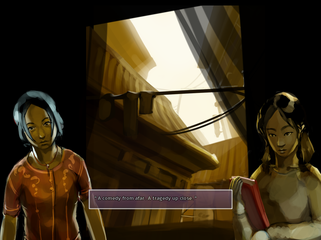
Exeunt Omnes
A game of strategic sophistry. Convince or crush the teenage girl who wants to end your reign of evil.
A game of strategic sophistry. Convince or crush the teenage girl who wants to end your reign of evil.
Search
Filter
 All
All Game Pages
 User Statuses
 Goblin Noir: Cement Shoes are Highly Unfashionable Review
That is pretty much what I would have said in a review, so thanks for voicing my thoughts!
DrunkenElfMage > Clearly, the ending suffered a little bit from the time limit, and apparently a lot of other things too judging from what you are saying - but that's to be expected in any contest (or with any deadline, really). I just hope that what wasn't used will get recycled into the webcomic and/or a future game! (when you become famous, you can do like Penny Arcade and pay people to make the game for you)
DrunkenElfMage > Clearly, the ending suffered a little bit from the time limit, and apparently a lot of other things too judging from what you are saying - but that's to be expected in any contest (or with any deadline, really). I just hope that what wasn't used will get recycled into the webcomic and/or a future game! (when you become famous, you can do like Penny Arcade and pay people to make the game for you)
 Design principles vol. 1: RPGs and strategy
Sviel> I realize now that it was a slightly obscure reference for anyone outside academia. Nature is perhaps the most influential scientific journal, it was a tad hyperbolic of me to hope to be published there ;)
Playtesting can never be removed entirely, but having some systematic bug testing would help dramatically, methinks. Well, I'll keep thinking about it for a couple of days, to design the calculus of damage rules in an accessible way.
Karins> Ha that's a great idea, although I think I will use it in my next article, about dialogue design; these comments neatly demonstrate something I'm planning to emphasize: contrary to chess, the endpoint of a conversation is not something any of us had planned in the beginning. It's a game of synthesis and learning as much as of persuasion - half chess and half collective jigsaw ;)
Playtesting can never be removed entirely, but having some systematic bug testing would help dramatically, methinks. Well, I'll keep thinking about it for a couple of days, to design the calculus of damage rules in an accessible way.
Karins> Ha that's a great idea, although I think I will use it in my next article, about dialogue design; these comments neatly demonstrate something I'm planning to emphasize: contrary to chess, the endpoint of a conversation is not something any of us had planned in the beginning. It's a game of synthesis and learning as much as of persuasion - half chess and half collective jigsaw ;)
Discourse-themed games (vol 1)
Well I am extremely happy that you did such a great job on it! It takes some time for a game to become visible on RMN (reviews really help) but don't worry, cool games like yours eventually find their audience. Still I'm glad if I can help by redirecting anyone from my own audience, modest as it is itself!
Design principles vol. 1: RPGs and strategy
I tend to think you would save a lot on the time normally spent balancing your battles by playtesting again and again. It's a sort of investment: a little bit of algebra before adding that skill to your skill tree (or that skill tree to your RPG), instead of a lot of analysis later on.
But it would certainly require a more thorough understanding of the fundamentals than probably anyone has right now. I really like your idea of a contest actually, as a way to explore the full diversity of what people can come with. Let me come up with basic rules for that contest, and I will contact the higher authorities to see if that can be arranged at an official level ;)
Note that if it works significantly, I'm offering anyone who contributed to this topic to be my coauthor for our article in Nature. Or at least our panel at E3.
But it would certainly require a more thorough understanding of the fundamentals than probably anyone has right now. I really like your idea of a contest actually, as a way to explore the full diversity of what people can come with. Let me come up with basic rules for that contest, and I will contact the higher authorities to see if that can be arranged at an official level ;)
Note that if it works significantly, I'm offering anyone who contributed to this topic to be my coauthor for our article in Nature. Or at least our panel at E3.
Design principles vol. 1: RPGs and strategy
There can certainly be legitimate strategy, but I think that to extract it we'll need to go back to first principles. The ultra-simple system I described above has all the strategic possibilities of any RPG battle system; it is in a sense the Turing machine of RPG battles (and I'd never have come up with it if not for your comments so thanks a lot ;) )
Everything except damage is just a way of making "damage delay patterns" available or not: out of mana, you can't use skills, dead or sleeping character, you can't use their skills, fully charged Limit gauge, you can access a skill, and so on. Aggro is a way of precipitating death on a specific character, i.e. removing a certain set of patterns in priority; but this is really the sort of tendencies that should emerge from the strategy instead of being imposed by some mechanical effect.
So here's my proposition: before thinking in terms of characters and enemies and status conditions and gauges and skills, plan everything as:
- a list of unique damage delaying/focusing patterns
- a set of basic rules enabling/disabling patterns as a function of which other patterns have been used so far (these rules should be predictable and generic, e.g. not "Pattern A activates Pattern B" but "any pattern with property x will temporarily activate all patterns with property z and forever disable patterns with y" with a short list of properties and intuitive relations explaining these rules)
How this system plays in abstract will convey the entire strategic possibilities of your game once you clothe everything in fluff (e.g. grouping patterns that can exist only together so as to make "characters" or "pieces of equipment").
If any one is interested and I have some spare time, I will try to come up with a demonstration.
Everything except damage is just a way of making "damage delay patterns" available or not: out of mana, you can't use skills, dead or sleeping character, you can't use their skills, fully charged Limit gauge, you can access a skill, and so on. Aggro is a way of precipitating death on a specific character, i.e. removing a certain set of patterns in priority; but this is really the sort of tendencies that should emerge from the strategy instead of being imposed by some mechanical effect.
So here's my proposition: before thinking in terms of characters and enemies and status conditions and gauges and skills, plan everything as:
- a list of unique damage delaying/focusing patterns
- a set of basic rules enabling/disabling patterns as a function of which other patterns have been used so far (these rules should be predictable and generic, e.g. not "Pattern A activates Pattern B" but "any pattern with property x will temporarily activate all patterns with property z and forever disable patterns with y" with a short list of properties and intuitive relations explaining these rules)
How this system plays in abstract will convey the entire strategic possibilities of your game once you clothe everything in fluff (e.g. grouping patterns that can exist only together so as to make "characters" or "pieces of equipment").
If any one is interested and I have some spare time, I will try to come up with a demonstration.
Design principles vol. 1: RPGs and strategy
Kylaila> Interesting, it's still a bit cluttered but there is indeed a very explicit element of manipulation that looks appealing. I've been recommended that game a couple of times now, I should try it someday.
Sviel> You assumed correctly, I edited that now thanks ;) I'll try to rephrase my thoughts more clearly. Imagine a battle system where all characters attack automatically every turn with the same power, and you have just one skill allowing you to delay or advance an attack. Then you would be able to recreate every other RPG battle ever just by changing the patterns of when and how you can use that skill - because that's all the skills of all RPGs ever do: move amounts of potential damage between now and some other time (you could kill a boss by spamming Attack if you had infinite HP, you just need to concentrate that potential damage into a shorter time, and dilute the enemies' into a longer time, to kill before you are killed).
Using this reasoning, whenever you create a new skill, you can evaluate whether it brings any new strategic possibility (instead of just being "Fire 2") by seeing whether it corresponds to a different pattern of "damage delaying" that cannot be recreated by any combination of previously existing skills.
Deltree> Hi! That's fine, we're all old people rambling here ;) Also glad you liked the game, no worries if you don't finish it, there'll be a better one to play someday.
It's like having a menu to select between 6 different openings, and you need to know which one is good against Kasparov and which one against Vera Menchik. And it will always be good against Vera Menchik because she is of type Ghost/Insect and she has low HP, not just now because she has played this precise sequence of moves. And which moves you can or cannot do at any given time will depend only barely on what you and the opponent have done so far anyway, as long as you have enough MP.
Of course I am exaggerating a bit, but I guess you can see what I mean - this is the reason why it seems to me that RPG battles are closer to chess puzzles than to chess itself: their interest comes from being unique handcrafted tactical situations to solve, not from the possibilities of the game rules themselves.
But let's roll with it and say that every RPG battle is a tactical situation. Then to have something more like strategy, there should be rules determining which enemies you will encounter next depending on those you've beaten so far, so as to have a chain of tactical situations with different effective techniques every time that you can somehow plan for and influence ahead of time.
I'd play that game, actually.
Sviel> You assumed correctly, I edited that now thanks ;) I'll try to rephrase my thoughts more clearly. Imagine a battle system where all characters attack automatically every turn with the same power, and you have just one skill allowing you to delay or advance an attack. Then you would be able to recreate every other RPG battle ever just by changing the patterns of when and how you can use that skill - because that's all the skills of all RPGs ever do: move amounts of potential damage between now and some other time (you could kill a boss by spamming Attack if you had infinite HP, you just need to concentrate that potential damage into a shorter time, and dilute the enemies' into a longer time, to kill before you are killed).
Using this reasoning, whenever you create a new skill, you can evaluate whether it brings any new strategic possibility (instead of just being "Fire 2") by seeing whether it corresponds to a different pattern of "damage delaying" that cannot be recreated by any combination of previously existing skills.
Deltree> Hi! That's fine, we're all old people rambling here ;) Also glad you liked the game, no worries if you don't finish it, there'll be a better one to play someday.
author=DeltreeIn a sense, chess on a line has the same goal since you cannot get to the king without killing all the pawns, but I digress ;) Part of the problem is that the strategies you describe in chess are complex actions elaborated from the basic game rules (moving around+capturing), whereas the strategies that you describe for RPGs are implemented as the basic rules.
RPG battles also have a basic goal: defeat all the enemies before they can do the same to me. It also has a variety of basic strategies (melee versus magic, elemental factors, special skills). Much like chess, the strategies' effectiveness varies with the opponent
It's like having a menu to select between 6 different openings, and you need to know which one is good against Kasparov and which one against Vera Menchik. And it will always be good against Vera Menchik because she is of type Ghost/Insect and she has low HP, not just now because she has played this precise sequence of moves. And which moves you can or cannot do at any given time will depend only barely on what you and the opponent have done so far anyway, as long as you have enough MP.
Of course I am exaggerating a bit, but I guess you can see what I mean - this is the reason why it seems to me that RPG battles are closer to chess puzzles than to chess itself: their interest comes from being unique handcrafted tactical situations to solve, not from the possibilities of the game rules themselves.
But let's roll with it and say that every RPG battle is a tactical situation. Then to have something more like strategy, there should be rules determining which enemies you will encounter next depending on those you've beaten so far, so as to have a chain of tactical situations with different effective techniques every time that you can somehow plan for and influence ahead of time.
I'd play that game, actually.
 Exeunt Omnes
I'll update the walkthrough tonight (I need to make a couple screenshots inside the game for clarity)
Thanks a lot for your comments, those are clearly points I should improve upon!
For now it's just for flavor in the sense that you cannot be convinced by the opponent (it is a monologue after all ;)). In the larger game, both sides of any statement will be arguable and your own beliefs will be able to change.
Thanks a lot for your comments, those are clearly points I should improve upon!
But does that have any mechanical impact, or is it just for flavor?
For now it's just for flavor in the sense that you cannot be convinced by the opponent (it is a monologue after all ;)). In the larger game, both sides of any statement will be arguable and your own beliefs will be able to change.
I think it should be possible to freely move the topic zone as an independent action, maybe costing time, but it should be possible.I agree that I should have done that, the reset to the center was a bit of a copout. There will be another solution in the future, actually: creating links yourself (that can be disputed) to move around the battlefield like Spiderman. There are a little bit more details in the commentaries of Kylaila's review.
They all increase "persuasiveness", as in belief change strength, yes? But empathy and face have other advantages (topical zone, time) whereas territory does not.Yes actually they will have much more differentiated effects in the following. Among other things, you will be able to invest territory into certain nodes, to represent emotional attachment: if the node is believed to be true, then you gain a bonus proportional to your investment. This is the basis for Pathos: you will be able to push your opponent to invest affects in a node, so that they will want the node to be true even if logic says it is false.
Design principles vol. 1: RPGs and strategy
I'm not saying that multiple paths to victory are bad, as long as they are really different. It's having many paths that boil down to the same age-old effects (healer/hitter/tank) that is frustrating in most RPGs.
But really, while I'm using this discussion as a critique of the typical RPG battles, you could reverse the direction and use it as a method for designing them. Try to find the most elegant way to represent this "bar juggling", without obscuring it by false choices. Adding secondary effects to skills is not sufficient, you should check that those effects add something truly new that couldn't be done otherwise in terms of what I've said above.
And at a deeper level you could even push the reasoning to do away entirely with some aspects of the system, perhaps multiple characters or turns or items, that exist only by tradition. What if for instance the system worked better if there were no HP and MP, only status conditions that can combine or interfere with each other? This is what made abstract strategy games so good, they were trimmed down to the essential by generations of people who had seen the big picture.
And by the way, as I said above, this applies to dungeon survival mechanics and gamespanning gold/item/health management, since they are also the same sort of one-dimensional battle.
But really, while I'm using this discussion as a critique of the typical RPG battles, you could reverse the direction and use it as a method for designing them. Try to find the most elegant way to represent this "bar juggling", without obscuring it by false choices. Adding secondary effects to skills is not sufficient, you should check that those effects add something truly new that couldn't be done otherwise in terms of what I've said above.
And at a deeper level you could even push the reasoning to do away entirely with some aspects of the system, perhaps multiple characters or turns or items, that exist only by tradition. What if for instance the system worked better if there were no HP and MP, only status conditions that can combine or interfere with each other? This is what made abstract strategy games so good, they were trimmed down to the essential by generations of people who had seen the big picture.
And by the way, as I said above, this applies to dungeon survival mechanics and gamespanning gold/item/health management, since they are also the same sort of one-dimensional battle.
author=SvielI think it is too late for all of us ;)
To be concise (is it too late for that?!)
Design principles vol. 1: RPGs and strategy
Haha sorry I tend to get a little bit carried away by my theoretical tendencies. I've enjoyed RPG battles for a long time, then got more and more frustrated with everything that they wouldn't let me do, so I guess your mileage may vary.
By the way, all my thanks to whoever featured this on the front page!
By the way, all my thanks to whoever featured this on the front page!
 Ars Harmonia Review
 Games - Tester
 Games - Other
