



 Full Games List
 Featured Games
 New Games
 Reviews
 Media
Media Game Updates
 Images Feedback Summary
 Game Design Highlights
 Tutorials
 Articles
 Scripts
 Utilities / Plugins
 Resources
 Engines
 Engine Bulletins
 What is Makerscore?
 Past Events
 Achievements
 Misaos
 Forums
 Post History
 Chat
Chat New to RMN?
 Full Store List
 RMN Music Pack (free)



 Profile
 Locker
 Play Lists
HASVERS'S PROFILE
Hasvers
1298
 Close
Close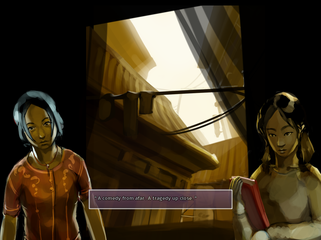
Exeunt Omnes
A game of strategic sophistry. Convince or crush the teenage girl who wants to end your reign of evil.
A game of strategic sophistry. Convince or crush the teenage girl who wants to end your reign of evil.
Search
Filter
 All
All Game Pages
 User Statuses
 Design principles vol. 1: RPGs and strategy
Haha yes what I called solution is just a random idea that deserves more thought for execution. There are certainly tons of other ways of solving the problem depending on your preferences. Having no battles at all, or only in a very abstract ways, or more integrated into the dungeon-crawling itself (for instance in rogue-likes, with the possibility of using the terrain and such) are other solutions.
Actually this makes me think that another part of strategy is being able to predict the consequences of your actions; you cannot strategize much if you don't know what is coming next, so in a battle you will just try not to spend too many items, but you will never be really sure of what you can or cannot afford to spend (unless you've done the dungeon before).
Maybe this could make battles more interesting, if you could understand in advance what position they occupy with respect to the dungeon as a whole, and this could influence your choices - i.e. instead just having random encounters where you must be economical and the final boss where you can spend everything, you would know that you can afford to lose more HP here, more ethers there... Sort of extending the trade-off choices from the "pre-dungeon planning phase" into the dungeon itself.
(And slowness in battles should simply be punishable by law, it's really the worst contribution of Squaresoft to the gaming world)
Actually this makes me think that another part of strategy is being able to predict the consequences of your actions; you cannot strategize much if you don't know what is coming next, so in a battle you will just try not to spend too many items, but you will never be really sure of what you can or cannot afford to spend (unless you've done the dungeon before).
Maybe this could make battles more interesting, if you could understand in advance what position they occupy with respect to the dungeon as a whole, and this could influence your choices - i.e. instead just having random encounters where you must be economical and the final boss where you can spend everything, you would know that you can afford to lose more HP here, more ethers there... Sort of extending the trade-off choices from the "pre-dungeon planning phase" into the dungeon itself.
(And slowness in battles should simply be punishable by law, it's really the worst contribution of Squaresoft to the gaming world)
Design principles vol. 1: RPGs and strategy
NB: If you want a magnificent example of non-RPG gamewide "dungeon survival", play The Void. The survival mechanics is distilled to a single variable, with a clarity and efficacy I haven't found anywhere else. The game is extremely clever and extremely hard.
Design principles vol. 1: RPGs and strategy
Woo, some opposition! (I like dialectic, who would've thought)
Thank you for your ramblings, and allow me to mass my own rant powers for great justice.
First I should note that yes, what I'm saying applies only to the standard RPG battle, not the T/S-RPG or the A-RPG (or for that matter the FPS-RPG a la Mass Skyrim: New Vegas)
Second, I should note that a game having no strategy at all doesn't necessarily make it bad. I'm glad that people can enjoy Canabalt for different reasons than they enjoy go. But strategy is what I, personally, am looking for in something that looks like a battle, so I'm fine with battle-less strategy-less, or battleful and strategyful games.
Merlandese and Kylaila>
Problem 1: Battles serve to whittle down your resources. Fine. But then why do you need to spend a good two thirds of your playtime dealing with them? It's micromanaging to an absurd extent.
There may be a learning aspect to reward the quick-witted with smaller losses. But if the player finds the appropriate actions once, he just has to apply them again and again without any further creative thought - the only point of repeating them is a mental attrition war where the player will eventually make a suboptimal move due to sheer exhaustion (or boredom). That is a possible form of tension, just not a mechanics that I find strategic - or even fun in my own case.
Problem 2: having those two systems in interaction could seem like a good idea, but in many, many cases, it largely obscures the dungeon-based survival part. Because it's hard to have something that is balanced at both levels; well adjusted survival mechanics can become extremely punitive with the added randomness of battles - and let's face it, RPGs are the most terribly balanced of all games, anywhere (as you remark it, Kylaila, it's due in part to the fact that gameplay can be a chore that you do to "earn" story, which means there's something very, very wrong with the genre conventions).
The probability that there's some inelegant, repetitive solution that will outperform every well thought-out tactics grows exponentially with the number of ingredients you try to put in a game (3d RPGs are the worst, because then you can even block your enemies behind a door or throw them off a mountain instead of winning the fight). And in many cases, all you have to do to solve a problem is spend more time on it. The dungeonesque version is grinding, a bug that became pretty much accepted as a feature, like perfect level memorization in shmups (and perfect boss action sequence memorization in SMT) or quicksave/quickload in other provinces of gaming.
Solution: We can keep the learning/reward aspect. The first time you battle a certain group of enemies, you consume X potions and Y ethers. Fine, from now on, every encounter with those enemies is skipped and replaced by the same consumption, unless you want to challenge them again to obtain a better result. Once you're fine with that cost, you just incorporate it in your larger, dungeon- or game-scale planning and stop losing time on it.
The thing is, once again, resource attrition is not really strategy. It is a one dimensional battle on a larger scale - gold converted into potions converted into surviving battles that give gold. I'm not denying there can be some cool tactics, at the battle level or at the game level - I will be excited if I finally understand the sequence of actions to beat that boss, and relieved when I see the light with two characters standing after a terrible dungeon.
But in a sense, winning at tactics is about optimal action, about not making mistakes; winning at strategy is about creative vision, and that part is what I'm more deeply interested in recreating in a game.
Sviel>
If I have an attack that makes the same damage as the difference in damage caused by the buff, then the only result of my choice is a different repartition of that damage over time - spiky versus continuous. It is something that can be used for tactics to some extent - in fact it is the most common form that tactics take in RPG battles, preventing spikes of damage from the enemy to avoid dying (by learning when to duck, basically).
But it's, let's say, 1.5 dimensional - it's not memory in the sense that I was intending, because the identity and sequence of individual actions still doesn't matter, only their summed effect at any given instant is important. Chess also has that time-control aspect plus the non-erasure and non-aggregation of individual moves, which makes it "2.5 dimensional".
And let's face it, a huge lot of choices in RPGs are purely cosmetic. I have a pet peeve with defense and evasion, or magic and skills and items, or stats and classes and characters and equipment and freaking battle formations - they do the exact same thing with different labels. I love Suikoden 5 but it was a terrible offender with 50 different ways of overpowering your characters with the same end result.
Thank you for your ramblings, and allow me to mass my own rant powers for great justice.
First I should note that yes, what I'm saying applies only to the standard RPG battle, not the T/S-RPG or the A-RPG (or for that matter the FPS-RPG a la Mass Skyrim: New Vegas)
Second, I should note that a game having no strategy at all doesn't necessarily make it bad. I'm glad that people can enjoy Canabalt for different reasons than they enjoy go. But strategy is what I, personally, am looking for in something that looks like a battle, so I'm fine with battle-less strategy-less, or battleful and strategyful games.
Merlandese and Kylaila>
Problem 1: Battles serve to whittle down your resources. Fine. But then why do you need to spend a good two thirds of your playtime dealing with them? It's micromanaging to an absurd extent.
There may be a learning aspect to reward the quick-witted with smaller losses. But if the player finds the appropriate actions once, he just has to apply them again and again without any further creative thought - the only point of repeating them is a mental attrition war where the player will eventually make a suboptimal move due to sheer exhaustion (or boredom). That is a possible form of tension, just not a mechanics that I find strategic - or even fun in my own case.
Problem 2: having those two systems in interaction could seem like a good idea, but in many, many cases, it largely obscures the dungeon-based survival part. Because it's hard to have something that is balanced at both levels; well adjusted survival mechanics can become extremely punitive with the added randomness of battles - and let's face it, RPGs are the most terribly balanced of all games, anywhere (as you remark it, Kylaila, it's due in part to the fact that gameplay can be a chore that you do to "earn" story, which means there's something very, very wrong with the genre conventions).
The probability that there's some inelegant, repetitive solution that will outperform every well thought-out tactics grows exponentially with the number of ingredients you try to put in a game (3d RPGs are the worst, because then you can even block your enemies behind a door or throw them off a mountain instead of winning the fight). And in many cases, all you have to do to solve a problem is spend more time on it. The dungeonesque version is grinding, a bug that became pretty much accepted as a feature, like perfect level memorization in shmups (and perfect boss action sequence memorization in SMT) or quicksave/quickload in other provinces of gaming.
Solution: We can keep the learning/reward aspect. The first time you battle a certain group of enemies, you consume X potions and Y ethers. Fine, from now on, every encounter with those enemies is skipped and replaced by the same consumption, unless you want to challenge them again to obtain a better result. Once you're fine with that cost, you just incorporate it in your larger, dungeon- or game-scale planning and stop losing time on it.
The thing is, once again, resource attrition is not really strategy. It is a one dimensional battle on a larger scale - gold converted into potions converted into surviving battles that give gold. I'm not denying there can be some cool tactics, at the battle level or at the game level - I will be excited if I finally understand the sequence of actions to beat that boss, and relieved when I see the light with two characters standing after a terrible dungeon.
But in a sense, winning at tactics is about optimal action, about not making mistakes; winning at strategy is about creative vision, and that part is what I'm more deeply interested in recreating in a game.
Sviel>
If I have an attack that makes the same damage as the difference in damage caused by the buff, then the only result of my choice is a different repartition of that damage over time - spiky versus continuous. It is something that can be used for tactics to some extent - in fact it is the most common form that tactics take in RPG battles, preventing spikes of damage from the enemy to avoid dying (by learning when to duck, basically).
But it's, let's say, 1.5 dimensional - it's not memory in the sense that I was intending, because the identity and sequence of individual actions still doesn't matter, only their summed effect at any given instant is important. Chess also has that time-control aspect plus the non-erasure and non-aggregation of individual moves, which makes it "2.5 dimensional".
And let's face it, a huge lot of choices in RPGs are purely cosmetic. I have a pet peeve with defense and evasion, or magic and skills and items, or stats and classes and characters and equipment and freaking battle formations - they do the exact same thing with different labels. I love Suikoden 5 but it was a terrible offender with 50 different ways of overpowering your characters with the same end result.
 tilda3.PNG
 Last Word (IGMC Version)
author=Merlandese
crafted in the what sense, Last Word dwells consistently on the how
That is actually a very fair point, that my suggestion misses entirely.
I guess one cause of ambiguity (at least in my case) is that the "what" seems at first to be part of the design, since the Key Topic thing looks like a game system. It isn't really, it's more a certain way of representing the textual side of exploration.
So instead of doing what I suggested and tying them better together, you could move in the opposite direction entirely and make the "what" even less gamey and more exploratory, perhaps in a very concrete sense (spatializing it somehow?). I do think that it can be done better than the current talk to everyone again and again solution, although if that's not your priority I certainly won't argue about it! A layer of fresh paint over well-worn mechanics is often enough to allow the player to focus on what is more interesting to you.*
* Edit: by the way, it is slightly strange that having to talk to the same NPCs over and over again can feel more boring that having to talk to new NPCs that would say the exact same things. I guess perhaps the only part that is really unfun about talking to the same people repeatedly is when one ends up spending a lot of time rereading things they have already said, so that could be the problem to solve to make the "what" part entirely satisfying.
In any case it was very clear from the start that we're not at all competing to make the same game (which is great since I might wish to play other games than my own from time to time, especially when they are that much fun)
I would totally enjoy seeing Last Word 2: Even Laster delve deeper into the subtleties of inflection, while leaving other people to deal about more complex semantics if they so wish.
Last Word (IGMC Version)
author=Kylaila
Unlocking new secrets seems more like trial and error, but that might just seem like it right now.
You do get some hints later on, but it's true that having a consistent way of guessing who might know about something, and perhaps making it preferable to avoid talking to some people about some things, would make that aspect more gamey.
Merlandese, I don't know how heavy the revisions that you're considering could be, but I feel that somehow tying the two phases together a bit more would help with most criticisms so far. I'm not sure of the best way of doing this, though.
 Dust to Dust Review
author=Kylaila
You are very right, Hasvers. I could've expanded much more upon that.
Thank you for mentioning it.
Haha no problem, actually your review prompted me to look into this game, and that was pretty much the only thing I had to add so it didn't make sense to make another review right now. It's a good thing you did yours though, because games with no review at all get basically no exposure.
Goatboy> Still, I hope those comments don't come off as disheartening, you have the entrails of a really great game here if you do it right. It would be a shame not to see it through!
Dust to Dust Review
I was going to write another review, and then I thought to myself: if another version of this game is coming, I'd better give you my opinions now "off the record" and make a review with a better score for the final game. Mostly, what I would like to add to Kylaila's assessment is that the game felt great in the beginning - mysterious setting, amazing visuals, some interesting character interaction - up to the point where you get the money for the doctor. Then suddenly everything feels extremely rushed and shallow. I think you would have done a better job dropping that succession of world spanning revelations and remaining at a personal level, as you apparently planned initially!
The money collection part was the high point of the game and had me ponder my choices a lot. Atia's story is much more common and far less compelling than this sort of vignettes, and whenever you have a mystery you should either leave it be or back it up by very strong revelations, which wasn't so much the case here.
So please, make this game closer to your original vision, don't deflower the mystery unless you have something awesome to put in its stead, avoid cliche plotkeys that don't really contribute to the unique atmosphere of your game, and most of all take your time - and you will have an instant winner in my book.
The money collection part was the high point of the game and had me ponder my choices a lot. Atia's story is much more common and far less compelling than this sort of vignettes, and whenever you have a mystery you should either leave it be or back it up by very strong revelations, which wasn't so much the case here.
So please, make this game closer to your original vision, don't deflower the mystery unless you have something awesome to put in its stead, avoid cliche plotkeys that don't really contribute to the unique atmosphere of your game, and most of all take your time - and you will have an instant winner in my book.
 Origin story
Haha thank you so much, it is a bit frustrating actually because it makes genre writing (like, say, Goblin Noir) very painstaking - I'm always getting the idiomatic expressions slightly wrong on the first try.
I will probably have to get native proofreaders for the next game, although sometimes there can be something pleasantly eerie to the unnatural sentences only a bad translation can engender (it really contributed to the atmosphere in the Russian game Pathologic)
I will probably have to get native proofreaders for the next game, although sometimes there can be something pleasantly eerie to the unnatural sentences only a bad translation can engender (it really contributed to the atmosphere in the Russian game Pathologic)
 Exeunt Omnes Review
Thank you so much for this review. I wish there points with which to disagree, so that I could scoff and throw my hat at you, but your criticisms are pretty much spot on, so I will have to tip it instead.
Improving the flow of conversation is the main thing I will be working on and I welcome all ideas on that matter.
In the original - and future - game concept, you can plan much more ahead of time: your character can learn the main topics on the map in advance (and make guesses about their opponent's opinions on those, so that one can try to estimate the sequence of deductions needed to win), and only smaller nodes, shortcuts and bonuses are to be discovered on the way depending on the character's skill in improvisation.
As for the getting stuck, this is probably something that I should have made clearer, but if there are links leaving the topical zone you can click on the link itself to move toward the argument, and in the worst case wait as the zone centers more and more on the last things that was said. There are still fails when a link crosses the topical zone by 2 pixels so you can't reach it but it prevents the reset to the center. Reset which won't exist in future games, by the way - it felt a bit like a cop out. I'm hoping that more opponent interventions and the possibility of inventing fallacious links will solve that trapping problem, but I'd love to hear other ideas.
In any case, thank you so much for taking the time to review the game in such detail, and for you very generous appreciations on it all! With such encouragement, you can be sure that perfect it I will.
Improving the flow of conversation is the main thing I will be working on and I welcome all ideas on that matter.
In the original - and future - game concept, you can plan much more ahead of time: your character can learn the main topics on the map in advance (and make guesses about their opponent's opinions on those, so that one can try to estimate the sequence of deductions needed to win), and only smaller nodes, shortcuts and bonuses are to be discovered on the way depending on the character's skill in improvisation.
As for the getting stuck, this is probably something that I should have made clearer, but if there are links leaving the topical zone you can click on the link itself to move toward the argument, and in the worst case wait as the zone centers more and more on the last things that was said. There are still fails when a link crosses the topical zone by 2 pixels so you can't reach it but it prevents the reset to the center. Reset which won't exist in future games, by the way - it felt a bit like a cop out. I'm hoping that more opponent interventions and the possibility of inventing fallacious links will solve that trapping problem, but I'd love to hear other ideas.
In any case, thank you so much for taking the time to review the game in such detail, and for you very generous appreciations on it all! With such encouragement, you can be sure that perfect it I will.
 Games - Tester
 Games - Other
